
11 Broadway Office Rental – Hudson Views


Office Space
$ 8,750 /month
3,000 SF
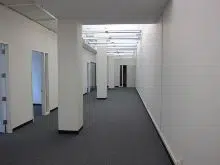
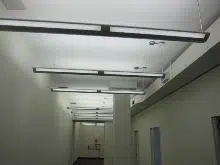
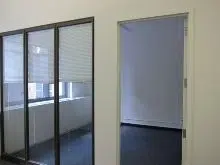
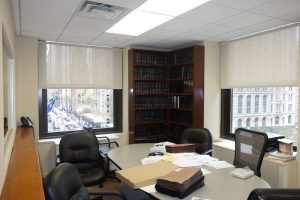
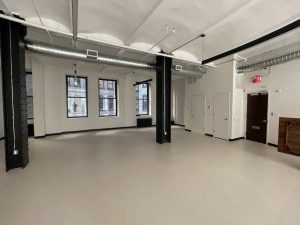
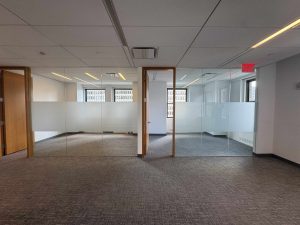
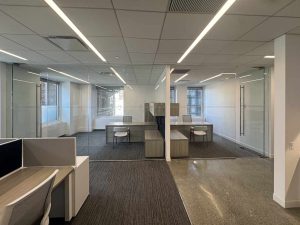
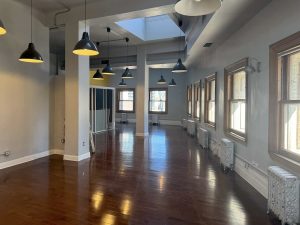
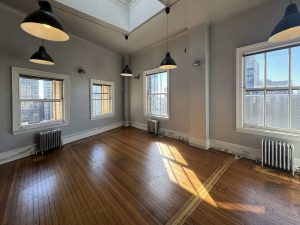
Desirable Lower Manhattan former law firm space for rent. 6 windowed offices and conference room. Bullpen large enough for 12 cubicles. 11′ ceilings. Central HVAC. Below average loss factor. Hudson River views.
Flexible lease term. Good space for law firm, accounting firm or any office use.
Lobby attended 24/7.
Call Alan Rosinsky at (212) 444-2241 to arrange an inspection of this property.
Location
Nearby Public Transportation
Property Details
Listing 58544
| Size: | 3,000 SF | Rent/SF: | $ 42.00 |
| Monthly Rent: | $ 8,750 | Lease Type: | Direct |
| Available: | 03/01/2025 | Lease Term: | 3-10 Years |
| Suite/Floor: | 906 | Address: | 11 Broadway |
Features
| 24/7 Access | Attended Lobby |
| Carpet | Central HVAC |
| Class B Building | Prebuilt |
| Work Available |
Listings are presented for illustrative purposes only; they may no longer be available and are provided merely as an exemplary representation of the types of spaces in a given neighborhood for a given price.
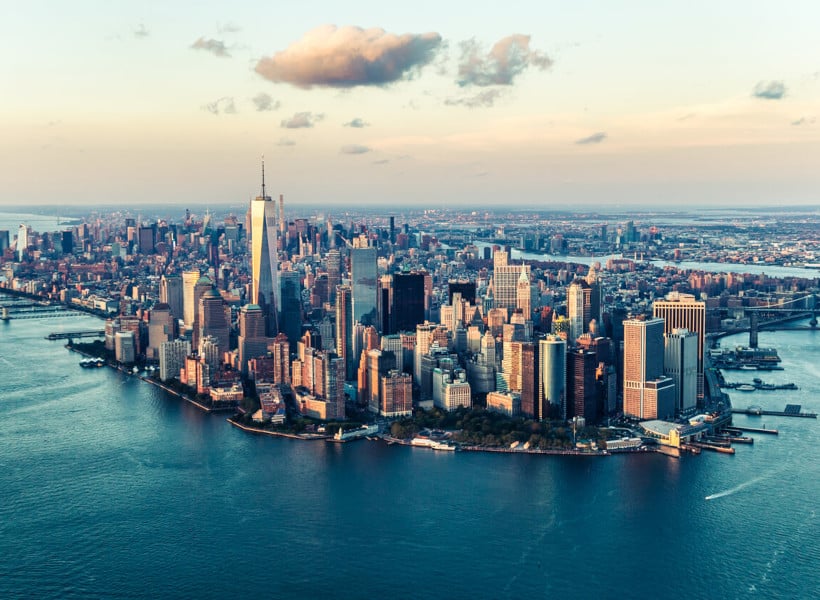


Downtown covers about 90 million SF of office space across five very different submarkets: the Financial District, the World Trade Center and World Financial Center complex, Civic Center, City Hall / Insurance, and Chinatown. They don't price the same, they don't lease at the same pace, and they don't attract the same tenants. Where you land Downtown matters as much as whether you land Downtown. If you're looking at Downtown right now, you're looking at a market that's been quietly tightening for a year and a half. Asking rents have climbed for six straight quarters, the longest run since Q2 2017, and Q1 2026 brought the steepest single-quarter gain in that whole stretch: a 3.1% jump to $61.70/SF (Colliers, Q1 2026). What that means for you: the days of naming your price Downtown are ending. Available supply has fallen 27.1% from the February 2024 peak. If you've been waiting for landlords to get more desperate, they're getting less desperate. Net absorption hit +0.66M SF in Q1 alone, and 16.80M SF of inventory is still available across the district, which is plenty of room to find what you need, but the leverage isn't what it was last year. Q1 2026 was a real turning point. Cushman & Wakefield clocked 2.9M SF of leasing, the second-highest quarter they've ever logged Downtown (Cushman & Wakefield, April 2026). Colliers, who counts more conservatively, came in at 1.04M SF (Colliers, Q1 2026). The two firms use different methodologies and come to different numbers, but they're telling the same story: Downtown is being chosen again. The headline event was American Express committing to nearly 2 million SF at 2 World Trade Center. The announcement landed February 25, 2026, and it's the kind of deal that resets how landlords think about asking rents on the rest of the campus. Silverstein Properties is developing the 55-story Foster + Partners tower on Port Authority land. Construction begins this spring. Amex stays at 200 Vesey Street until the building opens in 2031. Cushman & Wakefield represented Amex, JLL and Savills advised the Port Authority, and CBRE represented Silverstein. Why this matters to you: when an anchor of that size commits Downtown, every WTC-area landlord knows they're not the next concession-heavy deal. Pricing power has shifted. Four Forces to Monitor For broader context, see our recent post on the largest Manhattan office leases of 2025. The Downtown price range is wide, and the spread is your friend if you know how to use it. A small business in Chinatown can land Class C space for a fraction of what a hedge fund pays for trophy floors at the top of the WTC towers. Class A direct rents averaged $61.77/SF in Q1 2026, up $0.54 from Q4 2025 (Cushman & Wakefield, April 2026), but that average hides everything that actually matters: which submarket, which building, which floor. And Class B is where the conversation gets interesting. The Class A premium over Class B Downtown is 25.5% as of Q1 2026, up from 14% in mid-2024 (Cushman & Wakefield, April 2026). The widest gap in two years. Since 2020, 73% of all Downtown leasing has gone to Class A buildings. If your team needs a Class A address for client meetings or recruiting, that gap costs you. If you can make Class B work, that gap is leverage. Same building, same neighborhood, same subway, often the same lobby renovation, and you walk in with a lot more room to negotiate. Class A clusters in two places Downtown: around the WTC campus and along Water Street, with another pocket in the Financial District core. The average Class A direct asking rent was $61.77/SF in Q1 2026 (Cushman & Wakefield, April 2026), but if you're looking at trophy floors at the top of the World Trade Center towers, expect to pay meaningfully more (Metro Manhattan internal research, May 2026). Those views, those amenities, those addresses don't come at the district average. Here's what the Amex deal at 2 World Trade Center tells you: every other WTC-area landlord just got a fresh data point on what their building is worth. If you're looking at trophy Class A Downtown, your timeline matters. Anchors like 28 Liberty Street, One Liberty Plaza, and 85 Broad Street have always commanded premium pricing, but the trajectory now is upward, not flat. Most of the leasable space Downtown is Class B. Think buildings in the 100,000 to 800,000 SF range with renovated lobbies, modern mechanical systems, and a short walk to whatever subway line gets your people to work. If you're a midsize firm that doesn't need a trophy address to win business, this is probably where you should be looking. Here's where the math gets interesting. The gap between Class A and Class B Downtown is wider than it's been in two years. Cushman & Wakefield reports a 25.5% Class A premium over Class B as of Q1 2026, up from 14% in mid-2024 (Cushman & Wakefield, April 2026). C&W hasn't published a standalone Class B dollar figure in this report, but the direction is clear: Class A is getting more expensive faster than Class B. Why is that gap so wide? Because demand has tilted hard toward Class A. C&W reports 73% of all Downtown leasing since 2020 has happened in Class A space (Cushman & Wakefield, April 2026). Class B and lower-tier assets have seen demand soften, marketing periods stretch out, and tour activity drop (Cushman & Wakefield, April 2026). Translation: Class B landlords are more motivated than they've been in a long time. If you can make Class B work, you can probably make a really good deal. Buildings worth knowing on the Class B side: 100 Wall Street, 80 Broad Street, 110 Wall Street, 39 Broadway, and a deep pool of Water Street stock. Most carry active capital-improvement programs and offer prebuilt, move-in-ready suites for smaller tenants. If you're not sure what "Class B" actually means in 2026 or how it compares to Class A and Class C, our explainer on Class A, B, and C buildings breaks it down. If your priority is keeping your fixed costs as low as possible and you don't need to impress anyone with your lobby, Class C is where the deals live. Most of it is older walk-ups, small elevator buildings, or 5 to 12-story properties that haven't been renovated in a while. The approved brokerages don't publish a Class C average for Downtown, so anyone giving you a single number is making it up. The deepest Class C inventory Downtown is in Chinatown and the older blocks of the Financial District. Pricing typically sits well below Class B, but how far below depends entirely on the building, the floor, and the block (Metro Manhattan internal research, May 2026). This is a tier where touring matters way more than averages. What you actually get for Class C money: attended or buzzer-entry lobbies, tenant-controlled HVAC, and basic shared amenities. It's the right call for small businesses, early-stage startups, medical and dental practices, nonprofits, and anyone who'd rather put the budget into people and product than into a marquee address. This is the part most tenants under-negotiate. The asking rent is the headline. The free rent and TI allowance is where the real value lives, especially Downtown and especially outside the trophy tier. The ranges below are typical-market figures from Metro Manhattan internal research (May 2026), based on our recent deals. What you actually get on your lease depends on your credit, your term, the building, and how the negotiation runs. On a Class B Downtown deal, your net effective rent usually lands well below the face rent your broker first quotes you. The math takes a minute to learn, but it's the difference between a fine deal and a great one. Our deeper look at rising landlord concessions walks through how the math actually works. Downtown stopped being a finance-only neighborhood a long time ago. Media, tech, fashion, advertising, government, and law all have meaningful footprints here, and each of them gravitates to different blocks for different reasons. The table below is the cheat sheet: find your business type, see where you'd fit, see what kind of building you'd be touring. If you toured Downtown ten years ago, you'd find a totally different market. The WTC campus, Brookfield Place, and a long run of capital improvements at older Financial District and Water Street buildings have changed what tenants get when they sign here. Amenities aren't a perk anymore. They're how landlords compete for your business, and how you'll compete to attract people back to the office. Three tiers of amenity packages are common Downtown: Trophy and World Trade Center tier: Tenant-only amenity floors with conferencing, lounges, fitness, and dining. Concierge services, observation decks (One World Observatory), and direct PATH and subway access. LEED certification across most WTC buildings (Gold or Platinum). When 2 World Trade Center opens, it adds more than an acre of landscaped terraces and gardens to the campus. Class A and renovated Class B core: Renovated lobbies, on-site fitness, conferencing facilities, modern mechanical systems, ground-floor retail and dining, and walking-distance transit. Many Financial District Class A buildings added tenant-only amenity floors during the 2018 to 2024 capital-improvement cycle. Class B and Class C: Pre-war character, attended or buzzer-entry lobbies, tenant-controlled HVAC, and increasingly common spec suites with furniture and IT cabling preinstalled. Featured Buildings See all Downtown buildings or filter active listings by size and price. For background on landlord ownership in NYC, see our overview of the biggest commercial real estate landlords in NYC. Here's a Downtown selling point you can use with your team: this is one of the most transit-rich office submarkets in the country. Whether your people are coming from Brooklyn, Queens, New Jersey, or even Staten Island, they can probably get to the Fulton Street complex or the World Trade Center Transportation Hub (Oculus) without a transfer. If commute time is hurting retention right now, Downtown deserves a serious look. Run specific addresses through our Commute Calculator to see what your people would actually experience.
Learn more about Downtown ManhattanNearby Office Rentals
Featured Listings

Choose a convenient date for your tour and we will contact you shortly!