







6 Commercial Lease Negotiation Mistakes to Avoid
As a business owner or entrepreneur, you may find negotiating the ideal commercial lease for your new office space intimidating.


Flatiron is where the AI money is going. Not the only place, but the loudest one. For two years now the fastest-growing software and AI companies in New York have been planting their flags between Union Square and Madison Square Park, and in Q1 2026 it stopped being a trend and became the whole story. Savills came out and called Midtown South the city’s AI hub, and the engine driving that label sits right here in Flatiron and along Park Avenue South (Savills, Q1 2026 Manhattan Office Market Report, April 2026).
Here is the part the headlines skip. Flatiron is really two markets wearing one name. Up on Park Avenue South and around Madison Square Park, AI and fintech tenants are signing from $90 to $120/SF and buildings are hitting 100% leased. Three blocks west, on the Sixth Avenue side and the prewar side streets, there is still real loft space at real prices for a growing company that does not need to make a statement. Where you land in these dozen blocks matters far more than the fact that you landed in Flatiron, the highest-profile submarket in Midtown South.
Here is the mistake almost everyone makes with Flatiron: they shop it like one market. It is not. It is a trophy AI corridor and a value loft district sharing a few blocks, and the deal at One Madison Avenue has nothing to do with the deal in a prewar side-street loft off Sixth. Figure out which one you are shopping before you tour anything, or you will burn a month on buildings that were never going to work.
The backdrop is loud. Midtown South posted 3.0 million SF of leasing in Q1 2026, its strongest first quarter since the third quarter of 2019, and availability dropped 90 basis points to 16.9%, the lowest since the fourth quarter of 2020 (Newmark, Manhattan Office Market Report 1Q26, April 15, 2026). The Flatiron and Union Square piece of that ran tighter than the district at 13.9% availability (Newmark, 1Q26).
Want the proof? Look at who’s signing.
When companies growing this fast commit to ten-year leases at the top of the market, you stop arguing with the chart. For the wider pattern, see our breakdown of the largest Manhattan office leases behind the numbers.
Short version: it depends entirely on which side of the neighborhood you are standing on. The Midtown South district average was $88.32/SF in Q1 2026 (Newmark, 1Q26), but that blended number is close to useless for Flatiron on its own, because the spread inside these blocks is enormous. One Madison Avenue asks around $120/SF. Clay just paid $90/SF at 11 Madison. Hex, an AI company out of San Francisco, took a full floor at 250 Park Avenue South at $80/SF (Commercial Observer, January 2026). And on the prewar side streets off Sixth, you can still find office space in the $60s.
So before you tour, answer one question, because it changes everything: do you need to be in the AI corridor, or do you just need to be in Flatiron? A venture-backed AI company recruiting talent against OpenAI money, sure, you pay up for Park Avenue South and Madison Square. A profitable services firm or a growing startup that wants the neighborhood and the commute without the trophy bill, you go west and you go side-street. Same Flatiron. Same trains. Very different rent. Not sure how much space you actually need? Run your headcount through our Office Space Calculator before you tour anything.
If you have not shopped Midtown South before, one thing to know up front: the Class A, B, C system does not work here the way it does in Midtown or Downtown. Most of Flatiron’s buildings are converted lofts, former warehouses, and turn-of-the-century cast-iron, not purpose-built office towers. So a 1900s loft on Park Avenue South can technically carry a Class B label and still command rent that beats a Class A tower uptown, because the ceiling height, the light, the floor plate, and the address are what tenants actually pay for. Class describes the building. Rent tier describes what tenants pay. Do not get hung up on the letter. Our explainer on what makes a building Class A, B, or C breaks it down.
| Corridor | Class A Profile | Class B / C Coverage | Availability | Typical SF for New Leases | Tier |
|---|---|---|---|---|---|
| Park Avenue South corridor | Renovated loft and prewar tower (AI cluster) | Limited Class B | ~10 to 14% | 5,000 to 100,000+ SF | Premium |
| Madison Square & NoMad edge | Trophy and Class A (11 / One Madison) | Minimal Class B | ~5 to 12% | 10,000 to 100,000+ SF | Trophy / Premium |
| Fifth Avenue & Broadway (core) | Class A loft | Class B available | ~12 to 15% | 2,500 to 40,000 SF | Class A loft |
| Sixth Avenue / Ladies' Mile | Class A / B loft | Class B and C available | ~13 to 16% | 2,000 to 50,000+ SF | Class A / B loft |
| Flatiron side streets | Limited Class A | Class B and C dominate | ~14 to 17% | 1,500 to 15,000 SF | Value |
| Flatiron / Union Sq. (Newmark) | Not separately published | Not separately published | 13.9% | Varies | Mixed |
Midtown South district average of $88.32/SF and Flatiron/Union Square availability of 13.9% from Newmark, Manhattan Office Market Report 1Q26 (April 15, 2026). Savills tracks Flatiron ($64.66/SF) and Park Avenue South ($77.50/SF) as separate submarkets, reflecting the corridor's split (Savills, Q4 2025 Manhattan Office Market Report). Corridor-level profiles, coverage descriptors, and availability ranges are Metro Manhattan internal research (May 2026); approved firms publish Midtown South, and in some cases Flatiron or Park Avenue South, figures, but do not publish per-corridor breakouts at the granularity shown here. Building-specific asking rents (11 Madison $90/SF, One Madison about $120/SF, 250 Park Avenue South $80/SF) are marketed quotes, not submarket averages.
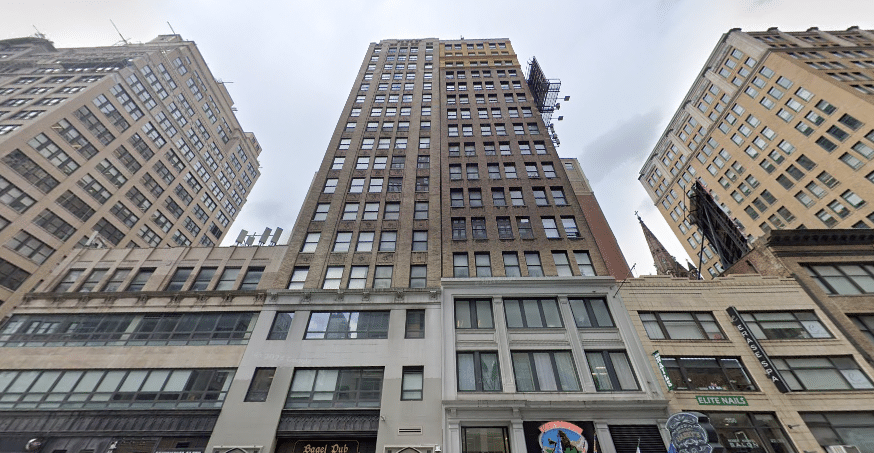
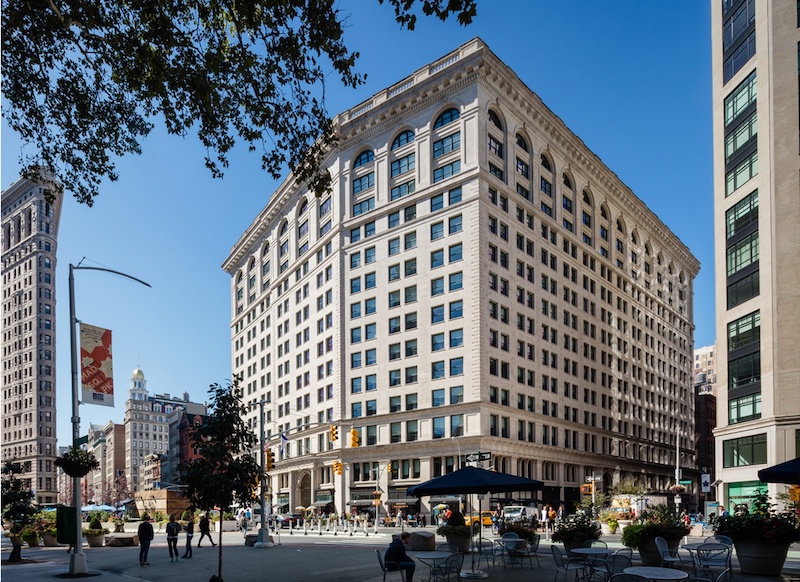
Park Avenue South is the story. For a decade this was a solid but unremarkable loft corridor. Then the AI companies arrived, and it repriced. The marquee deals all landed within a few blocks of Madison Square Park across 2025 and early 2026: Clay’s 163,000 SF at 11 Madison Avenue at $90/SF (Commercial Observer, March 9, 2026), Harvey AI’s expansion to roughly 185,000 SF at One Madison Avenue, where asking rents run around $120/SF, Pinterest and Tempus AI taking space at 11 Madison, and a steady stream of smaller AI tenants like Hex at 250 Park Avenue South and EliseAI nearby at 401 Fifth Avenue (Commercial Observer; The Real Deal, 2025 to 2026). The two anchors, 11 Madison and One Madison, are both owned by SL Green and both fully leased as of Q1 2026.
These are full-block trophy and trophy-adjacent buildings with the amenity packages and the addresses AI flagships want. If you need that kind of space, this is a timing problem, not a budget problem, because they are leasing faster than they are emptying. For what actually separates trophy from regular Class A, see our piece on how trophy buildings set themselves apart in NYC. One caveat on geography: 11 Madison and One Madison sit on the Madison Square edge, which the site’s taxonomy also covers under Park Avenue / Madison Square. Different page, same cluster.
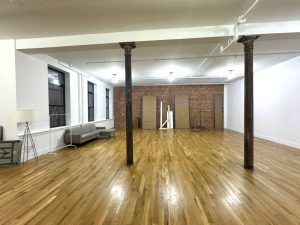
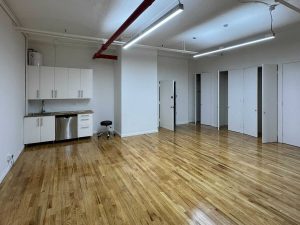
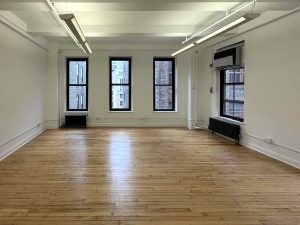
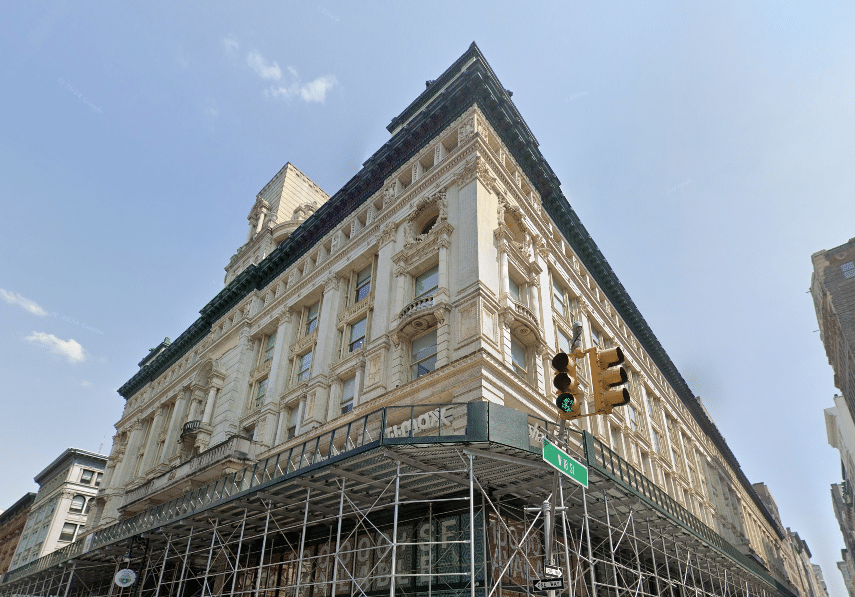
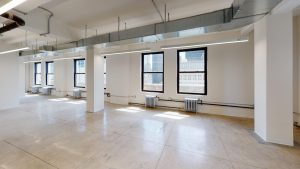
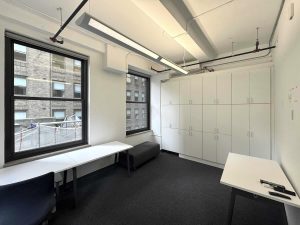
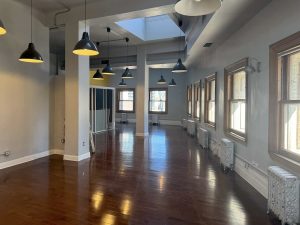
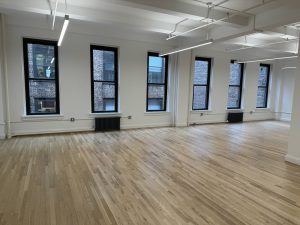
Step off the AI corridor and Flatiron is loft country. Renovated prewar and cast-iron buildings with high ceilings, big windows, and floor plates that suit a 5,000 to 40,000 SF tenant. This is where most Flatiron leases that are not AI megadeals get signed, and it is a deep pool. A lot of these landlords spent real money on lobbies and prebuilt spec suites over the last five years, so a 2026 Class A loft here often shows better than a glassy tower built in 2008. The character is the point, and tenants pay for it. The best of this stock spans Fifth Avenue, Broadway, and the blocks around the old Flatiron Building.
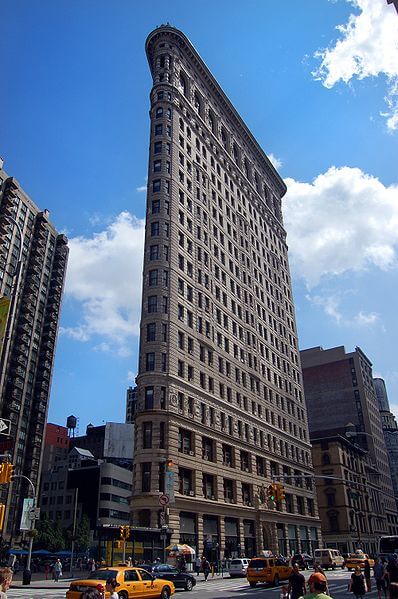
One thing to know: the Flatiron Building itself, at 175 Fifth Avenue, is no longer an option. After 120 years as offices it is being converted to 38 luxury condominiums, wrapping in fall 2026 (6sqft, 2026). The ground floor will keep retail, including a new restaurant from the team behind Bar Pisellino, but the office floors are gone. If you want the most famous triangular silhouette in America, you will have to buy a condo.
Here is where the value lives, and most tenants do not realize it is there. On the Sixth Avenue side, in the converted Ladies’ Mile department stores, and on the prewar side streets between Fifth and Sixth, Flatiron still has loft space that prices well below the Park Avenue South corridor. Savills’ Flatiron submarket averaged $64.66/SF in late 2025 against $77.50/SF for Park Avenue South, and that gap is the whole opportunity (Savills, Q4 2025). Same neighborhood, same trains, materially lower rent. This tier works for startups, small and midsize firms, medical and dental practices, nonprofits, and anyone who wants the Flatiron energy without the AI-corridor invoice.
Side-street buildings off Sixth in the West 18th to 22nd Street range carry strong 1,500 to 15,000 SF inventory, and a fair amount of it comes as spec suites you can move into fast. A chunk also trades as sublease, which can be the quickest, cheapest way in if the term fits. Two practical notes before you sign down here. First, the approved brokerages do not publish a standalone Class C average for Flatiron, so if anyone quotes you a single Class C number, they are guessing; the value-tier read here is Metro Manhattan internal research (May 2026). Second, almost every NYC landlord will want a security deposit, and for smaller or newer companies, a Good Guy Guarantee, so understand both before you negotiate. If you are coming out of a coworking space, our guide to scaling from coworking to your own office is the playbook.
Here is where most tenants leave the most money on the table. They negotiate the asking rent, win a few dollars, and sign, and they never push hard on free rent or the build-out allowance, which is where the real value lives in a Flatiron loft deal. Who pays for the build-out is negotiable, and outside the white-hot AI corridor you have more room than you think. The ranges below are typical-market figures from our recent deals (Metro Manhattan internal research, May 2026), assuming a 5 or 10-year term. Shorter terms get smaller packages; 10 to 15-year terms pull richer ones.
| Building class | Free rent (typical) | TI allowance (typical) | Notes |
|---|---|---|---|
| Park Avenue South and trophy | 8 to 12 months free | $100 to $160/SF | The tightest concessions in Flatiron, because there is an AI tenant lined up behind you. |
| Standard Class A loft | 12 to 17 months free | $80 to $120/SF | The best balance of a real Flatiron address and real concessions. |
| Class B loft | 14 to 18 months free | $60 to $90/SF | Spec suites widely available. Take a 10-year term and this tier still has serious leverage. |
| Class C and value | 12 to 18 months free | $40 to $70/SF | Many landlords will hand you a turnkey, fully built-out suite. Sign one month, move in the next. |
Source: Metro Manhattan internal research (May 2026), based on recent Flatiron and Midtown South lease transactions. Ranges assume a 5- or 10-year term; shorter terms get smaller packages and 10 to 15-year terms can pull richer ones. Deal-specific concessions vary materially by building, landlord, tenant credit, lease term, and negotiating posture.
One more thing: net effective rent typically lands well below the face rent your broker first quotes. The math takes ten minutes to learn and it is the difference between a fine deal and a great one. Our breakdown of 3-year, 5-year, or 10-year lease terms covers how term length moves the package, and our concessions explainer walks through the effective-rent math.
Flatiron tenants cluster tight by industry, and not by accident. AI and fintech want Park Avenue South and Madison Square. Media, creative, and showroom tenants want the lofts off Fifth and Sixth. Smaller firms want the prewar side streets. There is a logic to it: your clients, your talent, and the company down the block you want to poach from are already there. Match your industry to the right corridor and most of the search narrows itself. The table is the cheat sheet.
| Industry | Best-Fit Corridors | Inventory / Class | Rent Tier | Example Buildings |
|---|---|---|---|---|
| AI / Machine Learning | Madison Square edge, Park Avenue South | Trophy and renovated loft | Premium | 11 Madison Ave (Clay, Tempus), One Madison (Harvey AI), 250 Park Ave South (Hex), 401 Fifth Ave (EliseAI) |
| Fintech / Trading | Park Avenue South, Sixth Ave / Ladies' Mile | Renovated loft and cast-iron | Premium | 28-40 West 23rd (Ramp), 225 Park Ave South, 1250 Broadway (Nomad Tower) |
| Technology / SaaS | Park Avenue South, Fifth Ave & Broadway, Sixth Ave | Renovated loft | Mid to Premium | 122 Fifth Ave (Microsoft), 902 Broadway, 225 Park Ave South, 200 Fifth Ave |
| Media / Publishing / Creative | Fifth Ave & Broadway, Sixth Ave / Ladies' Mile | Cast-iron and renovated loft | Mid-market | 200 Fifth Ave, 915 Broadway, 1115 Broadway |
| Venture Capital / Investment | Madison Square edge, Fifth Ave & Broadway | Boutique and trophy loft | Premium | One Madison, 11 Madison, 1250 Broadway |
| Professional Services (Legal, Accounting, Real Estate) | Park Avenue South, Madison Square edge | Renovated loft and prewar tower | Mid to Premium | 381 Park Ave South (Corcoran), 387 Park Ave South, 225 Park Ave South |
| Healthcare / Medical Practices | Fifth Ave & Broadway, Flatiron side streets | Prewar loft and converted office | Mid-market | 71 West 23rd, 902 Broadway, 30 East 20th, 215 Park Ave South |
| Fashion / Apparel / Showroom | Sixth Ave / Ladies' Mile, Fifth Avenue | Cast-iron loft (showroom-ready) | Variable | 28-40 West 23rd, Ladies' Mile cast-iron, Fifth Avenue showroom floors |
| Startups / Small Business (under 20 people) | Flatiron side streets, Sixth Ave / Ladies' Mile | Prewar loft side-street inventory | Value to Mid | 19 West 21st, 37 West 20th, 54 West 21st, 1133 Broadway, 113-133 West 18th |
| Retail / Storefront | Fifth Avenue, Broadway, Sixth Ave | Ground-floor retail | Variable | Flatiron core retail, Ladies' Mile flagships |
Corridor and class fits are Metro Manhattan internal research (May 2026).
Running a lean team? Flatiron is not the cheapest corner of Manhattan, the deepest value is elsewhere, but the side streets off Sixth are competitive once you factor in the talent you can recruit by being in the AI neighborhood. Our guide to the top neighborhoods for small businesses lays out the trade-offs. And if you are chasing the AI cluster but priced out of Park Avenue South, the same energy is spilling into SoHo, Chelsea (where Clay leased before its move to 11 Madison), and even down to the Financial District, where Scale AI recently relocated to fit a workforce that doubled to 500 (The Real Deal, 2026).
If your last Flatiron tour was pre-2020, the picture in your head is wrong. The AI money pulled the amenity game up to Midtown trophy standards, and the best buildings here now compete on lounges and terraces, not just exposed brick. Three tiers to expect:
Trophy and Class A core (11 Madison, One Madison, Nomad Tower): Tenant-only amenity floors, conferencing, lounges, fitness, rooftop event space, and Madison Square Park views. Marquee on-site dining, with three-Michelin-star Eleven Madison Park at 11 Madison and La Tete d’Or by Daniel Boulud at One Madison. Smart-building systems. The top of Midtown South, full stop.
Renovated loft (28-40 West 23rd, 225 Park Avenue South, 122 Fifth Avenue, 200 Fifth Avenue): Restored lobbies, new mechanical systems, on-site fitness and conferencing in the bigger buildings, ground-floor retail, and the high ceilings and natural light that draw tenants to lofts in the first place.
Class B and value loft (71 West 23rd, 113-133 West 18th, side-street prewar stock): Prewar character, big windows, attended lobbies, tenant-controlled HVAC, and a growing number of fully built-out spec suites with furniture and cabling already in place so you can move in fast.
Ground-floor and flagship retail space along Fifth Avenue, Broadway, and the Ladies’ Mile stretch of Sixth is some of the highest-traffic retail in the neighborhood. If you are after a storefront rather than a floor upstairs, that is a different and very good search here.
Who owns your building matters as much as which building you pick, because every major Flatiron landlord negotiates differently. SL Green, the city’s largest office landlord, owns both Madison Square anchors and just posted its best first quarter in 28 years, so it is dealing from strength and pushing hard (SL Green, March 2026). Williams Equities holds the Ramp building and runs a tight, well-capitalized shop. Smaller owners like Olmstead, Feil, and Bromley are aggressive on the Park Avenue South side and will move quickly for the right tenant. A good broker knows what you are walking into. For background, see our overview of the biggest commercial real estate landlords in NYC. Several of these owners also hold much larger portfolios in Downtown Manhattan, where the same dollar buys more space.
| Landlord | Notable Flatiron Properties | Approx. Portfolio | Typical Lease Profile |
|---|---|---|---|
| SL Green Realty | 11 Madison Avenue (with PGIM), One Madison Avenue | ~25M SF (NYC's largest office landlord) | 10,000+ SF, 10+ yr |
| Williams Equities | 28-40 West 23rd Street (Ramp anchor) | ~1M SF Midtown South | 5,000+ SF |
| The Feil Organization | 250 Park Avenue South | Diversified national owner | 5,000+ SF |
| Olmstead Properties / Vertex (JV) | 381 Park Avenue South, Flatiron holdings | Active Flatiron acquirer | 2,500+ SF |
| TF Cornerstone | 387 Park Avenue South | Mixed-use developer | 5,000+ SF |
| The Bromley Companies | 122 Fifth Avenue | Single-asset focus in Flatiron | 10,000+ SF |
| PGIM Real Estate (Prudential) | 11 Madison Avenue (40% stake, with SL Green) | Institutional investor | Owner / JV |
| Rockrose Development | 11 East 26th Street, Madison Square holdings | ~2M SF Midtown South | 5,000+ SF |
Portfolio figures are approximate and weighted toward Flatiron and the broader Midtown South market. Several owners listed (SL Green, PGIM) hold substantially larger portfolios across Midtown, Midtown South, and Downtown. Ownership of 225 and 233 Park Avenue South moved to special servicing in 2024 and is omitted pending resolution. Metro Manhattan internal research (May 2026).
Flatiron sits in the dead center of Manhattan, which makes it a faster commute from almost everywhere than your team probably realizes. Union Square anchors the south end with eight subway lines, the 23rd Street stations cover the core, PATH runs to New Jersey, and Penn Station and Grand Central are both a short hop away. If anyone on your team is resisting the commute, send them our Commute Calculator with their home address. The numbers usually do the convincing.
| From | To Flatiron (23rd St / Union Square) | Mode |
|---|---|---|
| Hoboken, NJ | 10 to 15 min | PATH to 14th or 23rd St |
| Jersey City (Exchange Place) | 12 to 18 min | PATH to 14th or 23rd St |
| Newark, NJ | 25 to 30 min | NJ Transit to Penn + 1 stop |
| Williamsburg, Brooklyn | 10 to 15 min | L to Union Square |
| Bushwick, Brooklyn | 20 to 28 min | L to Union Square |
| Downtown Brooklyn | 15 to 22 min | 4, 5 or R to Union Square / 23rd St |
| Park Slope, Brooklyn | 20 to 28 min | R to 23rd St |
| Long Island City, Queens | 15 to 22 min | 7 to Times Sq + transfer |
| Astoria, Queens | 25 to 35 min | N or W to Union Square / 28th St |
| Hicksville, NY (Long Island) | 45 to 55 min | LIRR to Penn + 1 to 2 stops |
| Stamford, CT | 55 to 65 min | Metro-North to Grand Central + 4, 5, 6 |
It depends heavily on where in Flatiron and what kind of space. The Midtown South district average was $88.32/SF in Q1 2026 (Newmark, 1Q26), but the range inside Flatiron is wide. AI and finance tenants on Park Avenue South and around Madison Square Park are signing from roughly $80 to $120/SF, with Clay paying $90/SF at 11 Madison Avenue and One Madison asking around $120/SF (Commercial Observer, 2026). On the Sixth Avenue side and the prewar side streets, loft space prices materially lower, with Savills’ Flatiron submarket averaging $64.66/SF in late 2025 (Savills, Q4 2025).
It is not, uniformly. One specific part of it repriced. Over the last two years, AI and fintech companies made Park Avenue South and Madison Square Park the center of New York’s AI office market, and Savills now calls Midtown South the city’s AI hub (Savills, Q1 2026). Marquee deals like Clay’s $90/SF lease at 11 Madison and Harvey AI’s expansion at One Madison pulled the top of the corridor up to trophy levels (Commercial Observer; SL Green, 2026). Three blocks west, prices have moved far less.
The value runs along the Sixth Avenue side, through the converted Ladies’ Mile buildings, and on the prewar side streets between Fifth and Sixth (Metro Manhattan internal research, May 2026). Savills tracked its Flatiron submarket at $64.66/SF in late 2025 against $77.50/SF for Park Avenue South, and that gap is where smaller and growing tenants find room (Savills, Q4 2025). Side-street buildings in the West 18th to 22nd Street range carry strong 1,500 to 15,000 SF inventory.
The Park Avenue South corridor and the full-block towers fronting Madison Square Park, led by 11 Madison Avenue and One Madison Avenue (Metro Manhattan internal research, May 2026). Both buildings hit 100% leased in Q1 2026, with asking rents from $90/SF at 11 Madison to around $120/SF at One Madison (Commercial Observer; SL Green, March 2026).
Newmark grouped Flatiron with Union Square at 13.9% availability in Q1 2026, tighter than the 16.9% Midtown South district figure and close to the 13.7% Manhattan-wide rate (Newmark, 1Q26; Colliers, Q1 2026). Availability splits sharply by corridor: near-full on the AI side around Madison Square, looser in older loft stock on the side streets and the Sixth Avenue edge.
Fintech Ramp expanded to 285,300 SF at 28-40 West 23rd Street, the largest Midtown South lease of Q1 2026 and the third-largest in Manhattan (The Real Deal, April 2026). AI sales company Clay signed 163,000 SF at 11 Madison Avenue at $90/SF, bringing the building to 100% leased (Commercial Observer, March 9, 2026). Harvey AI expanded to roughly 185,000 SF at One Madison Avenue the same quarter (SL Green, March 2026).
In Flatiron the class system is less useful than in Midtown or Downtown, because most buildings are converted lofts and turn-of-the-century cast-iron rather than purpose-built towers. A renovated 1900s loft can carry a Class B label and still out-rent a Class A tower uptown, because tenants pay for ceiling height, light, floor plate, and address. Our explainer on what makes a building Class A, B, or C breaks down the distinctions.
No. After more than a century as commercial offices, the Flatiron Building at 175 Fifth Avenue is being converted into 38 luxury condominiums by the Brodsky Organization, GFP Real Estate, and Sorgente Group, with the conversion wrapping in fall 2026 (6sqft, 2026). The ground floor will retain retail, but the upper floors are residential. Tenants who want the Flatiron address now look to the surrounding loft and tower stock instead.
Talent, peers, and product. The neighborhood already had a dense tech and startup base, the loft floor plates suit fast-growing engineering teams, and clustering near other AI firms helps with recruiting and visibility. AI firms leased more than 600,000 SF across Manhattan in Q1 2026 alone, surpassing the full 2024 total, and Midtown South is the epicenter (Colliers, via The Real Deal, April 2026). As Park Avenue South tightens, the cluster is spilling into SoHo, Chelsea, and the Financial District.
Flatiron sits at the center of Manhattan’s transit grid. Union Square (4, 5, 6, L, N, Q, R, W) anchors the south end, the 23rd Street stations (1, F, M, N, R, W, 6) cover the core, and PATH reaches New Jersey from 14th, 23rd, and 33rd Streets. Penn Station and Grand Central are both a short ride away, putting the LIRR, Metro-North, NJ Transit, and Amtrak within reach.
A lot of Flatiron inventory, especially the best loft floors and spec suites, never reaches public search platforms, and a broker provides access plus knowledge of which landlords are dealing and where asking rents have room to move. Brokerage commissions are paid by the landlord, so the cost to the tenant is effectively zero. Before you tour, it is worth reviewing the essentials to ask before leasing NYC office space.
Accessibility Tools