Office Space for Law Firms in New York City
Find the right property, avoid hidden costs, and negotiate favorable terms.

Find the right property, avoid hidden costs, and negotiate favorable terms.

New York is the center of gravity for American law, and the office market shows it. The same city that just set an office rent record at One Vanderbilt also has well-built value space renting Downtown for roughly half what a Park Avenue tower commands. What your firm pays is not really a citywide number. It comes down to three decisions: which corridor you choose, which building class you choose, and how hard you negotiate the build-out and the lease.
This page is your guide to all three, plus the buildings where firms actually sit and exactly how a legal lease works once you start. Two things to keep in mind up front. Broker representation costs a tenant nothing in New York, because the landlord pays the commission, so getting an expert in your corner is free. And almost none of the best legal space sits on public search platforms, which is why this page pairs a map of the market with the building and leasing knowledge a data feed cannot give you. For the broader citywide picture across every industry, see our overview of office space for rent in New York City.
A tenant representation broker works only for you, with no building of their own to fill. Out of the thousands of spaces on the market at any moment, that means the ones you tour are the ones worth seeing.
Law firms are leasing with confidence again. After several years of shedding space, the largest firms spent late 2025 and early 2026 recommitting to the office, and often to more of it. Major law firms accounted for roughly 1.9 million square feet of Manhattan leasing in the first quarter of 2026, and about 70% of that was firms renewing or expanding where they already sit (Savills, Q1 2026). The firms that define this market are staying, and many are growing.
Most of New York’s law firms sit in a few Midtown corridors, with a strong litigation cluster Downtown near the courts and a growing boutique scene in Midtown South. Pick the corridor first, because it sets your rent, your prestige, and your team’s commute before you ever look at a floor plan.
| Submarket | Why Firms Go There | Typical Asking Rent | Example Firms & Buildings |
|---|---|---|---|
| Park Avenue | The most prestigious legal address in the country, steps from Grand Central and the major banks, and the tightest corridor in the city. | $105.33/SF; 7.4% availability (CBRE, Q1 2026) | Big Law’s signature corridor, anchored by towers such as 245 and 280 Park Avenue, with One Vanderbilt at its southern end. |
| Grand Central & Lexington | Well-run Class A at a discount to Park Avenue, with prebuilt floors and unbeatable transit for a commuting team. | $65 to $90/SF | Robinson+Cole took 48,000 SF at 100 Park Avenue (2026); the Graybar Building and One Grand Central Place offer prebuilt floors. |
| Sixth Ave & Rockefeller Center | Big floor plates and corporate gravitas along the Avenue of the Americas, a long-time home for the largest firms. | $80 to $120/SF | Paul, Weiss (1285 Sixth Ave), Withers (30 Rockefeller Plaza), and Groombridge, Wu (1185 Sixth Ave), among other large firms. |
| Plaza District | White-glove buildings and marquee addresses near the city’s wealth managers, private equity, and financial services clients. | $90 to $150+/SF | White-shoe and finance-facing firms around the GM Building and Fifth Avenue. |
| Midtown East & Third Avenue | Newer and renovated Class A just east of Park Avenue, often at better economics, with room for large firms to grow. | $60 to $95/SF | Kirkland & Ellis (601 Lexington Ave and 900 Third Ave). |
| Hudson Yards & Penn District | The newest trophy towers in the city, with the amenities firms use to recruit talent and bring partners back to the office. | $90 to $200+/SF | Skadden (One Manhattan West) and Cravath (Two Manhattan West, 481,000 SF). |
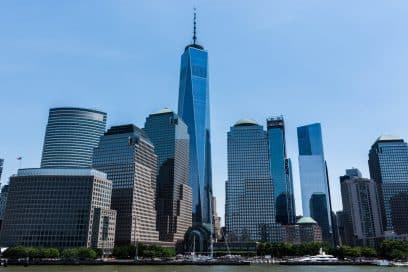
| Downtown & Financial District | The home of litigation, within walking distance of the federal and state courthouses and City Hall, at the best value of any Manhattan core. The PATH train also connects Downtown directly to New Jersey, an easy commute for firms with New Jersey-based attorneys and staff. | $60 to $75/SF (Class A outside the WTC) | Sullivan & Cromwell (125 Broad St) and Cleary Gottlieb (One Liberty Plaza), close to the courts. |
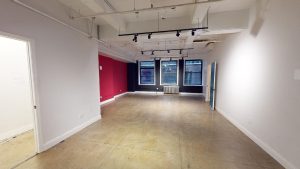
| Midtown South | Converted loft space with high ceilings and character for firms that want a less corporate feel. | $50 to $90/SF | Boutique IP, entertainment, and creative-facing firms in SoHo and Chelsea loft buildings. |
Submarket rent ranges are Metro Manhattan internal research (June 2026) except Park Avenue (CBRE, Q1 2026) and Downtown (Savills, Q4 2025; Colliers, Q1 2026). Firm and building examples reflect publicly reported headquarters and recent leases and are illustrative, not exhaustive.
Your practice mix usually decides your neighborhood more than your budget does.
| Practice Type | What It Prioritizes | Best-Fit Areas |
|---|---|---|
| Litigation & trial firms | Fast access to the federal and state courthouses, City Hall, and agencies, with rent low enough to put budget into people. | City Hall and Civic Center, and the wider Downtown core. |
| Corporate, M&A & finance firms | Proximity to bank and private-equity clients, a prestige address, and large high-floor blocks. | Park Avenue, Sixth Ave / Rockefeller Center, Plaza District, Hudson Yards. |
| IP, entertainment & boutique firms | Character space, flexibility, and a client base in technology and the creative industries. | Midtown South, SoHo, Chelsea. |
| Mid-size & regional firms | Value Class A, prebuilt or lightly modified space, and top transit for a commuting team. | Grand Central, Midtown East, the Garment District, and Downtown. |
For a smaller practice deciding where to plant a flag, our roundup of the top New York neighborhoods for small businesses is a practical starting point.
Before you compare two spaces, get the class system straight, because it drives price, perception, and what the space will feel like to work in. For law firms, the choice usually sits between trophy and Class A, with value Class A and Class B in play for boutiques and cost-conscious firms.
| Class | What It Means | Rough Rent Position | Typical Buildings |
|---|---|---|---|
| Trophy | The newest supertalls and flagship towers, hotel-grade service, the addresses that win client meetings. | Top of the market, well above Class A | One Vanderbilt, Manhattan West, the Park Avenue trophies |
| Class A | Modern or well-renovated towers, staffed lobbies, real amenities, strong building systems. | Premium, below trophy | Park Avenue, Sixth Ave / Rockefeller Center, Plaza District |
| Class B | Solid, functional, often prewar buildings, many with prebuilt or move-in-ready floors. | Mid-market | Grand Central side streets, Garment District, Midtown South lofts |
| Class C | Older, no-frills, often converted manufacturing or loft stock, the deepest value in the city. | The value tier | Garment District, Financial District side streets |
A warning on those letters: the A, B, and C system is only a rough grade of a building’s age, systems, and prestige, and it bends in loft markets. A renovated prewar building near Grand Central can serve a 30-attorney firm beautifully, and a character loft in SoHo can out-rent a plain Class A tower, because tenants are paying for ceiling height, light, and the block, not the letter. Treat class as a starting filter, not a verdict. Our explainer on what makes a building Class A, B, or C breaks down the distinctions, and the city’s best Class A towers cluster in Midtown, which our roundup of the top Class A buildings in Midtown covers in detail.
What you pay depends on the building class more than anything else, so the ranges below are organized that way. Most of the profession leases Class A and trophy space in premium corridors, where rents run above the Manhattan average of $77.55/SF (Colliers, Q1 2026), while litigation boutiques and solos find real value Downtown and in Midtown South. The ranges are meant to put you in the right ballpark before you tour, not to price a specific space.
| Building Class | Typical Asking Rent ($/SF/year) | Typical Available Space | Best Suited For |
|---|---|---|---|
| Trophy | $100 to $320+ | Full floors and large blocks, 20,000 SF and up | Flagship Big Law and finance-facing firms |
| Class A | $60 to $75 | Full and partial floors, 5,000 to 50,000 SF | Established firms wanting a marquee address |
| Value Class A | $65 to $90 | Prebuilt and partial floors, 3,000 to 25,000 SF | Mid-size and regional firms |
| Downtown Class A | $60 to $75 | Full and partial floors near the courts | Litigation firms wanting value |
| Class B & loft | $35 to $70 | Small suites and value floors, 1,000 to 10,000 SF | Boutiques, solos, and growing firms |
Asking rents as of April 1, 2026. Updated quarterly; next update July 1, 2026.
For current asking rents by market, see: Midtown Manhattan, Midtown South, Downtown Manhattan, and Uptown Manhattan.
Most expensive: Park Avenue leads at $105.33/SF (CBRE, Q1 2026), with the Plaza District and the new Hudson Yards trophy towers close behind. Best value in a prime location: the Financial District, where Class A space outside the World Trade Center runs in the $60s/SF and puts litigators steps from the courts.
Ranges are directional and span the borough; actual rents vary by neighborhood, floor, and lease term. Compiled from CBRE, Colliers, Savills, and Cushman & Wakefield Q1 2026 reports plus Metro Manhattan internal research (June 2026). Anchors: Manhattan average $77.55/SF (Colliers); Park Avenue $105.33/SF (CBRE); Midtown Class A $85.28/SF (Cushman & Wakefield, April 2026); a $320/SF record at One Vanderbilt (JLL via Commercial Observer, April 2026); Downtown average $61.70/SF (Colliers) with Class A outside the WTC near $67/SF (Savills, Q4 2025).
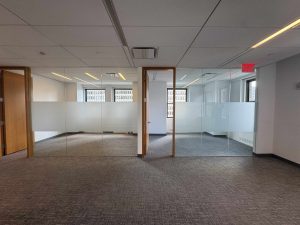
A law office has to do things a typical office does not. It hosts clients for sensitive meetings, protects privileged conversations, and gives partners and associates the private, windowed offices the profession still expects. Plan around those needs before you fall for a view.
| Element | Why It Matters for a Firm | Planning Note |
|---|---|---|
| Private windowed offices | Partners and most associates still expect a door and a window, and it affects recruiting and retention. | Corner and double-corner space maximizes windowed offices. A rectangular floor plate fits more offices into less rentable area, which holds down rent. |
| Conference & deposition rooms | Depositions, closings, mediations, and client strategy sessions all happen on site, often at the same time. | Cluster them near reception so clients and opposing counsel never walk through your work areas. Size at least one room for large groups. |
| Reception & building security | The lobby and reception are the firm’s first impression and the first line of confidentiality. | Look for a 24/7 attended lobby, turnstiles, and visitor sign-in, with security cameras in the elevators and corridors. Keep reception visually separate from the attorney floors. |
| Confidentiality & soundproofing | Privilege and client trust depend on conversations staying in the room. | Demising walls that run slab to slab, solid-core doors, sound masking, and rated glass keep discussions private. Plan ethical walls between practice groups when needed. |
| Paralegal & support staff space | Paralegals, legal secretaries, and administrative staff need workstations close to the attorneys they support. | Plan open workstations or shared interior offices near the practice groups they serve, which also frees the windowed perimeter for attorney offices. |
| Library & file storage | Most firms have gone largely digital, but many still keep a working library and active files. | Footprints are shrinking fast, and many firms are converting old library and file rooms into flexible conference or focus space. |
| IT, server & work rooms | Document production, secure networks, and reliable connectivity are non-negotiable. | Confirm fiber availability and a secure, cooled server or IT room, and build a copy and work room near the offices it serves. Plan for high-volume document production (printing, scanning, and copying) and secure remote access so attorneys can work safely from home, court, or a client site. |
| Staff amenities | Amenities help bring attorneys and staff back to the office and support long working days. | Plan for a kitchen and pantry and a dining or break area, and look for buildings that offer a gym, a café, and bike storage. |
| Client access & ADA | Clients, witnesses, and staff arrive from across the region. | Choose a building near major transit and confirm full ADA accessibility, with a step-free path from the street to your suite. |
Before you tour anything, decide what kind of space you are actually shopping for. A traditional direct lease, a move-in-ready prebuilt, a converted loft, a coworking desk, and a sublease are five different products with five different commitments and price points. Most firms do not realize they have this many options.
| Type | Best For | Typical Commitment | Trade-Offs | Explore |
|---|---|---|---|---|
| Direct lease | Established firms that want a custom build-out and control. | 5 to 15 years | Best concessions and leverage, longest commitment, the norm for large firms. | |
| Prebuilt / spec suite | Firms that need to move fast without managing construction. | 3 to 7 years | Move-in ready, less customization. | |
| Loft space | Boutique IP, entertainment, and creative-facing firms. | 5 to 10 years | High ceilings and character, concentrated in Midtown South. | Loft |
| Coworking / flex | Solos, new firms, and satellite teams under about 20 people. | Month to 2 years | Fast and flexible, higher per-desk cost, less control. | Coworking |
| Sublease | Cost-sensitive firms and shorter time horizons. | 1 to 5 years | Often well below market and prebuilt, terms set by the existing tenant. | Sublets |
Commitment ranges are typical-market and vary by deal (Metro Manhattan internal research, June 2026).
Two notes on flexibility. If you are scaling out of a shared space into your own, our guide to transitioning from coworking to an office is the playbook. And if a sublease looks appealing, understand sublease and assignment clauses before you sign someone else’s lease, because you inherit the terms they negotiated.
Leasing a legal office is not like renting an apartment, and it is not even like a standard office deal. Build-out lead times are longer, terms are longer, and almost none of the good space sits on public search platforms. A tenant rep broker who works only for you, and is paid by the landlord, levels the field. Below is the path from “we need space” to “we moved in.”
The face rent your broker first quotes is almost never what you actually pay. Net effective rent, after free months and build-out money, can land well below the asking number. The savviest firms negotiate the whole package, not just the headline rate, and because law firms build out so much space, the construction terms carry extra weight.
Concessions remain tenant-favorable across much of Manhattan, and they are richest in older Class B and value buildings where landlords compete harder for tenants. Typical packages right now:
| Class | Free Rent | TI Allowance | Notes |
|---|---|---|---|
| Trophy / premium A | 8 to 12 months | $100 to $160/SF | Tightest terms, because another tenant is often lined up behind you. |
| Standard Class A | 12 to 16 months | $80 to $120/SF | The sweet spot for most established firms, a real address with real economics. |
| Value Class A / Class B | 14 to 18 months | $60 to $90/SF | Real leverage on a 10-year term, and prebuilt floors are common. |
| Downtown / loft value | 12 to 18 months | $40 to $70/SF | Turnkey, fully built suites are widely available. |
Two ideas do most of the work. First, the value lives in the free rent and the TI allowance, not the asking rate, as our look at rising landlord concessions explains. Second, those allowances are negotiable; our primer on tenant improvement allowances walks through the common structures and how to bargain. For a hard-walled legal build-out, the TI number can decide whether a deal pencils.
Typical-market figures based on recent Metro Manhattan deals (internal research, June 2026). Final terms depend on credit, lease length, building, and negotiation.
Large firms often sign 10 to 15 years to justify a major build-out and lock in a prestige address, while boutiques and newer practices lean to 3 to 5 years for flexibility. Longer terms pull richer concessions and lock in your rent; shorter terms keep you nimble. Our breakdown of 3-year, 5-year, or 10-year lease terms lays out which fits which kind of firm.
The face rent is rarely what you actually pay. Budget for the rest before you sign:
The clearest signal of where the legal market is heading is where firms are actually signing. Law firms took three of the ten largest Manhattan office leases in April 2026 alone, and the first quarter’s biggest legal deals were dominated by firms renewing and expanding (Savills, Q1 2026).
| Firm | Building | Submarket | Size | Deal |
|---|---|---|---|---|
| Gibson, Dunn & Crutcher | 200 Park Avenue (MetLife Building) | Park Avenue / Grand Central | 362,000 SF | Renewal (Q1 2026) |
| Willkie Farr & Gallagher | 787 Seventh Avenue | West Midtown | +53,000 SF (368,000 total) | Expansion (May 2026) |
| Kirkland & Ellis | 900 Third Avenue | Midtown East | +52,000 SF (309,000+ total) | Expansion (May 2026) |
| Sidley Austin | 787 Seventh Avenue | West Midtown | +52,000 SF | Expansion (late 2025) |
| Robinson+Cole | 100 Park Avenue | Grand Central | 48,000 SF | New lease (April 2026) |
| Groombridge, Wu, Baughman & Stone | 1185 Sixth Avenue | Sixth Ave / Rock Center | 43,000 SF | New lease (April 2026) |
| Withers | 30 Rockefeller Plaza | Sixth Ave / Rock Center | 33,000 SF | New lease (April 2026) |
Compiled from Savills Q1 2026 and reporting by The Real Deal and Commercial Observer (April and May 2026).
The throughline is consolidation into quality. Firms are renewing where they sit, expanding into adjacent floors, and relocating into newer towers, all of which keep the best space moving and the premium corridors tight.
A handful of owners control much of Manhattan’s best office space, and each negotiates differently, which matters as much as which building you pick. SL Green, the city’s largest office landlord, owns the Park Avenue and Grand Central towers where Big Law clusters. Vornado holds the Penn District and a large Midtown portfolio. Tishman Speyer runs Rockefeller Center, a long-time legal address. Who you sit across from shapes the deal. Background reading: our overview of the biggest commercial real estate landlords in NYC.
| Landlord | Notable Properties | Approx. Portfolio | Lease Profile |
|---|---|---|---|
| SL Green Realty | One Vanderbilt, the Graybar Building, 245 Park Ave | ~25M+ SF | 10,000+ SF, 10+ yr |
| Vornado Realty Trust | Penn 1 & 2, 1290 Ave of the Americas, 770 Broadway | ~20M SF | 5,000+ SF |
| Tishman Speyer | Rockefeller Center, 300 Park Ave, the Spiral | ~13M+ SF | 5,000+ SF |
| Brookfield Properties | Manhattan West, One Liberty Plaza, Brookfield Place | ~18M SF | 15,000+ SF |
| The Related Companies | Hudson Yards (10, 30, 50, 55), Time Warner Center | ~14M SF | 10,000+ SF |
| Empire State Realty Trust | Empire State Building, One Grand Central Place | ~10M SF | 1,000+ SF |
Portfolio figures are approximate and weighted toward Manhattan office holdings; several owners hold larger national portfolios (Metro Manhattan internal research, June 2026). Notable properties reflect publicly reported holdings and are illustrative, not exhaustive.
Manhattan’s average office asking rent was $77.55/SF in Q1 2026 (Colliers), but most law firms pay more because they cluster in premium corridors. Park Avenue, the profession’s most sought-after address, asks $105.33/SF (CBRE, Q1 2026), while litigation boutiques find Class A value Downtown in the $60s/SF. Your number depends on the corridor, the building class, and how much build-out your layout needs.
Big Law concentrates on Park Avenue, Sixth Avenue and Rockefeller Center, the Plaza District, Midtown East, and increasingly the new towers at Hudson Yards and the Penn District. Litigation firms favor the Financial District and the City Hall area for fast access to the courts, and boutique, IP, and entertainment firms are growing in Midtown South lofts.
It depends on your practice. Litigators usually choose Downtown for walking-distance access to the federal and state courthouses, the best rents of any core, and a direct PATH connection for New Jersey-based staff. Corporate, M&A, and finance firms usually choose Midtown to sit near their bank and private-equity clients and the prestige addresses those clients expect.
Generally yes. Most New York landlords will deliver a full, custom build-out for a firm signing a lease of five years or more, and many will modify existing space for a term of at least three years. The construction is funded through a tenant improvement allowance, which is one of the most important things to negotiate.
A common planning range is about 150 to 250 usable square feet per attorney office, though firms have been densifying with smaller, single-size offices and more shared space. Remember you pay for rentable square footage, which runs roughly 30% above usable, so confirm both numbers. The most reliable way to size a firm is to run your headcount and layout through an office space calculator before you tour.
Prioritize confidentiality and soundproofing, enough conference and deposition rooms clustered near a secure reception, and easy client access with full ADA compliance. Floor plate shape matters more than most firms expect: a rectangular layout, a corner location, and especially a double-corner configuration all maximize the number of windowed offices you can give partners and associates. Leasing a full floor also lowers your loss factor and delivers greater usable efficiency than splitting a floor, since you avoid shared corridors and common areas.
Less than they used to. Most firms have digitized and keep only a small working library and active files, and many are converting former library and file rooms into flexible conference or focus space. If your practice still relies on paper, plan secure, well-organized storage early, because it is expensive square footage in New York.
Concessions remain tenant-favorable across most of Manhattan, especially in older Class B and value buildings. Premium Class A leases typically include 8 to 12 months of free rent and $100 to $160/SF in tenant improvement allowances, while value Class A and Class B leases often include 14 to 18 months free and $60 to $90/SF (Metro Manhattan internal research, June 2026). Final terms depend on your credit, lease length, and the building.
Large firms commonly sign 10 to 15 years to justify a major build-out and secure a marquee address, while boutiques and newer practices often prefer 3 to 5 years for flexibility. Longer terms generally pull richer free rent and TI allowances. A sublease or a prebuilt floor can offer a shorter commitment when speed matters more than customization.
Most of the best legal space never appears on public listing sites, so a tenant rep broker is how you see the full market and learn which landlords are dealing. Brokerage commissions are paid by the landlord, so representation costs your firm effectively nothing. A broker also helps structure the build-out and lease terms that drive the real cost of the deal.













Accessibility Tools