Public Relations Office Space for Rent in New York City
Find the right property, avoid hidden costs, and negotiate favorable terms.

Find the right property, avoid hidden costs, and negotiate favorable terms.

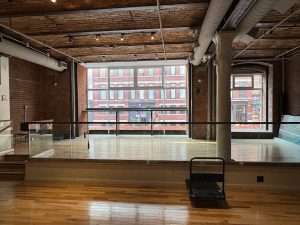
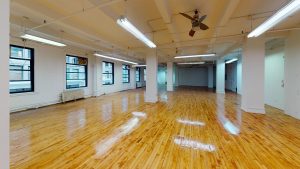
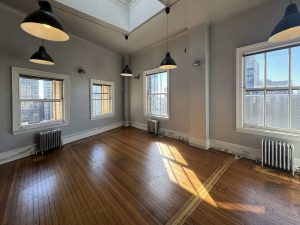
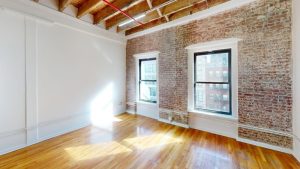
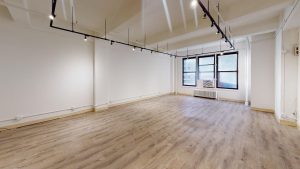
For about fifteen years the trade in this business was a good one. A PR shop could take a loft floor in Flatiron with twelve-foot ceilings and windows on three sides for less than a mid-size law firm paid for beige carpet on Third Avenue. Character was cheap because nobody else wanted it.
That trade is gone. The AI companies found the lofts.
Manhattan asking rents hit $78.03/SF in the second quarter, up 5.7% on the year, the sharpest midyear jump since 2016, and availability fell to 13.0%, the lowest since October 2020 (Colliers, Q2 2026). Free rent has thinned to 12.4 months, the weakest since 2019. Anthropic took an entire sixteen-story building on Hudson Street, and in July Brookfield opened talks for a piece of the Hudson Square portfolio at a $3.5 billion valuation, largely on the back of tech leasing.
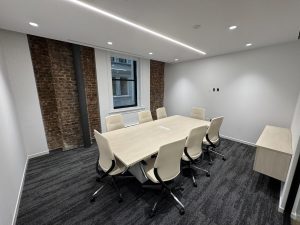
The other half of the story runs your way. Your industry just went through a demolition. Omnicom closed its $13.5 billion purchase of Interpublic last November, cut more than four thousand jobs, merged Golin into Ketchum and folded Porter Novelli into FleishmanHillard. Networks that size do not shrink quietly. They shrink by handing back finished floors with the conference rooms and the cabling already in them.
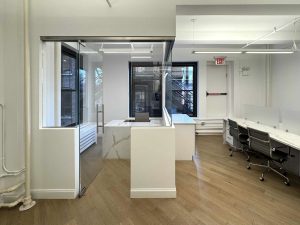
Which is the whole play for 2026, and it is the opposite of what most agencies do. Do not shop the listings. Shop the wreckage. A network’s castoff floor in a good building beats a raw floor in a beautiful one, because you are not spending nine months and two hundred thousand dollars turning it into an office.
We put this page together to skip the brochure copy and get to the parts that cost money: what agency space actually goes for by neighborhood, which submarket fits which kind of practice, what a build-out with a studio in it really runs, how the lease works, and where your competitors sit.
Two quick things before you start reading. A broker in your corner is free, because the landlord pays us the same way they would on any office deal. And the good built creative floors mostly never reach a listing site, since they get passed between brokers before anybody bothers to post them. Somebody who walks these buildings will beat a search bar every time.
Want the whole city, every use type? Start with our rundown of office space for rent in New York City.
Public relations gets counted inside TAMI, the technology, advertising, media and information bucket brokers use for creative tenants, and TAMI is having a loud year. It took 27% of all Manhattan leasing in the second quarter, behind professional services at 30% and ahead of finance at 24% (Colliers). Nine of the ten largest deals in the quarter went to a law firm or a TAMI tenant (Savills). Your industry is not a footnote in this market. Five things worth understanding before you tour.
Sources: Colliers Q2 2026 (July 1, 2026) for rent, availability, industry share and concessions; Cushman & Wakefield Q2 2026 MarketBeat (July 13, 2026) for submarket rents, sublease supply and class share; Savills Q2 2026 for the largest-lease breakdown; Avison Young Q2 2026 for the small-tenant trend; JLL (June 2026) for AI leasing; Campaign US, PRWeek and Financial Times (November 2025 to February 2026) for the Omnicom and IPG integration. Refresh quarterly. This is the one dated market narrative on the page.
Pick the neighborhood before the building. It sets your rent, it sets how a certain kind of client reads you, and it decides whether an account director can get coffee with a reporter without losing forty minutes to the subway. It also cuts a tour list from thirty buildings to four. If you are a newer shop still deciding where to plant a flag, our roundup of the best NYC neighborhoods for small businesses is a practical starting point.
| Submarket | The Read | Asking Rent | Best For |
| Flatiron & NoMad | Every independent wants it and increasingly cannot afford it. Loft floors, clients within walking distance, and a queue of AI firms bidding on the same 6,000 feet. See something good, sign it that week. | $80 to $120/SF | Consumer, tech and B2B shops, 2,000 to 15,000 SF |
| Chelsea | The district average is misleading you. It carries the trophy product near the High Line. Get onto the side streets in the high 20s and you are in the $60s for a floor that shoots beautifully. | $94.16/SF district average (Yardi, Q2 2026); side streets well below | Beauty, fashion, arts, hospitality, content-heavy teams |
| SoHo & NoHo | You are buying the address, and for a luxury client that is a real asset. Small floor plates, so you cap out near thirty people before you start splitting floors. | $88.41/SF district average (Yardi, Q2 2026) | Fashion, luxury, beauty, influencer practices |
| Hudson Square & Tribeca | Edelman’s home and the best creative stock in Manhattan, which is exactly why tech outbid you for it. Worth touring if you need 20,000 feet and have the budget. | $95 to $150+/SF | Large agencies and holdco offices |
| Fifth & Madison Avenues | Buildings that look like money. If your clients are general counsels and CFOs, this is where they expect to find you, and the tour does real work. | $75 to $130/SF | Corporate, financial and public affairs practices |
| Midtown East & Third Avenue | Weber Shandwick’s corner. Third Avenue availability runs above 20% (Colliers, Q2 2026), which is another way of saying those landlords will deal. Underrated for a commuting team. | $60 to $95/SF | Corporate comms, IR and healthcare practices |
| Penn & Garment District | The value play nobody puts in a pitch deck and plenty of good shops quietly use. Loft floors in the $40s and $50s, showroom neighbors, the best transit in Manhattan. | $38 to $65/SF | Fashion and consumer shops, and anyone watching the number |
| Financial District | Class A runs $63.60 here against $88.50 in Midtown (C&W, Q2 2026). BerlinRosen worked that out a decade ago and has anchored 15 Maiden Lane ever since. The PATH puts New Jersey staff at your door. | $50 to $70/SF | Public affairs, nonprofit, real estate and financial comms |
Submarket ranges are Metro Manhattan internal research (July 2026) except Chelsea and SoHo (Yardi and Hubble, Q2 2026) and the Class A anchors (Cushman & Wakefield, Q2 2026). Agency and building examples reflect publicly reported headquarters and are illustrative, not exhaustive.
One more thing on Chelsea, since it is the advice we give most often and almost nobody takes. A district average blends a $150 floor overlooking the High Line with a $62 floor on West 29th Street, and you are only ever renting one of them. Tour the second one before you decide the neighborhood is out of reach. For the wider picture, see Midtown South and Downtown Manhattan.
What you specialize in decides your neighborhood faster than your budget does. Sitting near the client base is worth more than the rent you save by sitting far from it.
| Practice | What It Needs Nearby | Best-Fit Areas |
| Consumer, beauty & lifestyle | Brand offices, showrooms, sample logistics, and a space that photographs well. | SoHo, Chelsea, Flatiron, the Garment District. Adjacent retail and store clients cluster the same way. |
| Corporate & financial comms | Client C-suites, a conservative address, and rooms private enough for an earnings call. | Fifth and Madison, Midtown East, the Plaza District, near financial services tenants. |
| Technology & B2B | Founder proximity and a floor that does not feel corporate. | Flatiron, Hudson Square, SoHo, and the startup and tech belt generally. |
| Health & healthcare comms | Hospital systems, pharma offices, regulated content workflow. | Midtown East, Murray Hill, Park Avenue South, near medical and healthcare tenants. |
| Public affairs & nonprofit | Government offices, advocacy groups, and rent low enough to fund headcount. | Financial District, City Hall and Civic Center, Downtown broadly. |
| Crisis, litigation & reputation | Counsel, the courts, and soundproofing that actually works. | Midtown East, Grand Central, Downtown near the courthouses and the law firms you work alongside. |
| Entertainment, media & sports | Studios, networks, talent agencies, and a room you can film in. | Hudson Square, Chelsea, Times Square and the West Side. |
Get the class system straight before you compare two spaces, because it drives price, perception and what the floor feels like to work in. For PR the honest answer is that most agencies belong in a well-run Class B loft rather than a Class A tower, and the ones who insist on the tower usually do it for a client who never visits.
| Class | What It Means | Rent Position | Where PR Finds It |
| Trophy | The newest supertalls and flagship towers, hotel-grade service, the lobby that ends an argument. | Top of the market | Hudson Yards, One Vanderbilt, Manhattan West. Holdco flagships, not boutiques. |
| Class A | Modern or fully renovated towers, staffed lobbies, real amenities, reliable systems. | Premium, below trophy | Fifth and Madison, Sixth Avenue, Midtown East, Hudson Square |
| Class B loft | Solid prewar and converted industrial stock, high ceilings, big windows, character you cannot build. | Mid-market, and where most agencies land | Flatiron, Chelsea, SoHo, Union Square, the Garment District |
| Class C | Older, no-frills, often converted manufacturing. Slower elevators, plainer lobby, deepest value in the city. | The value tier | Garment District, Herald Square, Financial District side streets |
A warning about those letters. The A, B and C system is a rough grade of a building’s age, systems and prestige, and it falls apart in loft markets. A Class B cast-iron building on Greene Street will out-rent a plain Class A tower on Third Avenue, because the tenant is paying for ceiling height, light and the block, not the grade. For an agency the letter matters far less than three things: whether the lobby holds up when a client walks in, whether the ceilings are high enough to shoot in, and whether the elevators arrive before your ten o’clock gets annoyed.
Our explainer on what makes a building Class A, B, or C breaks down the distinctions. If a marquee address genuinely matters for your roster, our look at how trophy buildings set themselves apart explains what the premium buys, and our roundup of the top Class A buildings in Midtown covers the towers worth the money.
Most agencies land between $55 and $110 per square foot, a band wide enough that the neighborhood and the building condition matter more than any citywide number. Manhattan averaged $78.03/SF in Q2 2026 (Colliers). Midtown South, where most PR sits, averaged $81.14/SF with Class A at $104.50/SF (C&W). The ranges below put you in the right ballpark before you tour, not on a specific floor.
| Tier | Asking Rent ($/SF/yr) | What You Get | Best Suited For |
| Premium loft (Hudson Square, SoHo, Meatpacking) | $95 to $150+ | Full floors, restored industrial detail, serious lobbies, a terrace in a few buildings | Large agencies and holdco offices, 15,000 SF and up |
| Midtown Class A | $75 to $130 | Tower floors, staffed lobby, strong systems, prebuilt options | Corporate, financial and public affairs practices |
| Core creative loft (Flatiron, NoMad, Union Square) | $80 to $120 | Partial and full loft floors, 3,000 to 15,000 SF, high ceilings | Independent agencies of 15 to 60 people |
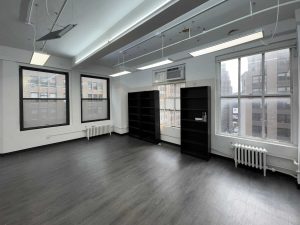
| Value loft (Chelsea side streets, Herald Square) | $55 to $85 | Well-located Class B, often built and furnished by the last tenant | Growing shops of 10 to 40 people |
| Downtown & Financial District | $50 to $70 | Class A at $63.60/SF (C&W, Q2 2026), deeper value on the side streets | Public affairs, nonprofit and cost-disciplined agencies |
| Garment & Penn value | $38 to $65 | Loft floors, showroom neighbors, unbeatable transit | Fashion and consumer shops, and anyone watching the number |
| Coworking private office | $821 per desk / month | Furnished, everything included, no build-out (Hubble, Q2 2026) | Teams under about ten people, or a first New York office |
Asking rents as of July 1, 2026. Updated quarterly; next update October 1, 2026. Ranges are directional and span multiple buildings. Rents are asking rents before concessions.
Most expensive corner of the PR map: Hudson Square and the premium loft belt, where tech demand pushed pricing past most of Midtown. Best value in a neighborhood that still works for the job: the Financial District, and the Garment District, where a good loft floor still trades in the $40s and $50s. For current asking rents by market, see Midtown Manhattan and Uptown Manhattan.
A PR office has to do things a normal office does not. It hosts clients and reporters, it produces content on camera, it runs a crisis at eleven at night, and it does all of that in front of people whose entire job is noticing details. Plan around this list before you fall for a view.
| Element | Why It Matters | Planning Note |
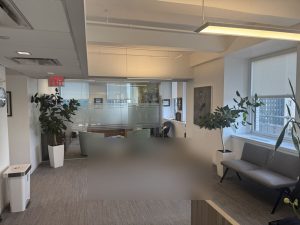
| Front of house | Reception is the pitch. A client forms an opinion in fifteen seconds, and so does a reporter you have courted for a year. | Put reception, a waiting area and your best conference room in one client-facing zone near the elevator, with the working floor out of the sightline. Budget attention for the lobby too, since you do not control it and your client judges it anyway. |
| Conference & war rooms | Pitches, media training, crisis calls and client workshops often run the same day. | One large room seating twelve or more with real AV, plus two small rooms. A war room that can go closed-door for a week during a crisis is worth more than a fourth open meeting table. |
| Podcast & video studio | The biggest change in agency space since 2020. Earned media now includes owned video and executive podcasts, and clients expect you to produce it. | One acoustically treated room of roughly 150 to 250 SF with sound isolation, controllable light and a backdrop wall. Interior rooms beat window rooms, since street noise and shifting daylight both wreck a shoot. Far cheaper at fit-out than as a year-three retrofit. |
| Phone rooms & focus space | Media relations is still a phone job, and an all-open floor makes pitching miserable and confidential calls impossible. | One enclosed phone room per eight to ten people. The most commonly underbuilt item on this list and the first thing agencies add later. |
| Soundproofing | Embargoes, M&A comms, litigation support and crisis work all depend on a conversation staying in the room. | Demising walls slab to slab around leadership and the war room, solid-core doors, sound masking on the open floor. Loft buildings with hard surfaces and exposed ceilings are beautiful and acoustically brutal, so budget for treatment. |
| Bandwidth & power | A live stream, a large upload, an all-hands on video and a shoot running at once will find a cheap building’s ceiling fast. | Confirm fiber and at least two carriers before you sign, and check electrical capacity if you are adding studio lighting or an edit bay. |
| Product & sample storage | Consumer, beauty and fashion practices move physical product constantly, and it has to live somewhere other than the conference room floor. | Real closed storage plus a receiving plan. Confirm freight elevator hours and package handling, and ask what happens to a pallet arriving at 4:45 on a Friday. |
| Event capacity | A room you can clear for eighty people saves a venue rental several times a year, and outdoor space sells itself. | Look for a floor that opens up, a service path that avoids the working area, and a building that permits after-hours guests. A private terrace is the hardest thing to find in New York office space and the first thing every agency asks us for. |
| Amenities & commute | Agency teams skew young, hybrid and vocal about the office, and attendance is a real operating problem. | Bike storage, a decent gym, food downstairs and a short walk from a train do more for attendance than any perk inside your four walls. |
Space-planning guidance is Metro Manhattan internal research (July 2026) drawn from agency deals we have represented. Requirements vary by practice mix and headcount.
Decide what you are actually shopping for before you tour anything. A direct lease, a prebuilt, a raw loft, a coworking suite and a sublease are five different products with five different commitments, and most agencies do not realize they have this many options.
| Type | Best For | Commitment | Trade-Offs | Explore |
| Direct lease | Established agencies wanting a custom build-out and control of the front of house | 5 to 10 years | Best concessions and leverage, longest commitment, the only real route to a purpose-built studio | |
| Prebuilt / spec suite | Firms that need to move fast without managing construction | 3 to 7 years | Move-in ready, limited customization, rarely includes a studio | |
| Loft space | Creative-facing agencies wanting ceiling height, light and character | 5 to 10 years | The classic agency product, concentrated in Midtown South, acoustically demanding | Commercial loft |
| Coworking / flex | New shops, satellite offices, teams under about ten people | Month to 2 years | Fast and flexible, higher per-desk cost, and no front of house that belongs to you | Coworking |
| Sublease | Cost-sensitive agencies and shorter horizons | 1 to 5 years | Often 20% to 40% under comparable direct space and frequently furnished, but you inherit somebody else’s terms | Sublets |
Two notes on flexibility. Agencies outgrow coworking faster than almost anyone, usually the moment a real pitch needs a room that belongs to them, and our guide to transitioning from coworking to an office is the playbook for that move. And if a sublease looks appealing, understand sublease and assignment clauses before you sign, because you are stepping into a deal somebody else negotiated. Post-merger holdco space is exactly where the good built subleases are right now, and it is worth seeing what a shrinking network is quietly offering before you commit to a raw floor.
Commitment ranges are typical-market and vary by deal (Metro Manhattan internal research, July 2026).
Leasing an agency office is not like renting an apartment, and it is not quite like a standard office deal either. The build-out is more specialized, the front of house carries commercial weight, and almost none of the good space sits on a public platform. Below is the path from “we need space” to “we moved in.”
The face rent your broker first quotes is almost never what you pay. Net effective rent, after free months and build-out money, can land well below the asking number. Agencies that do well negotiate the whole package instead of arguing about the headline rate.
Concessions are still real but thinner than eighteen months ago. Free rent averaged 12.4 months across Manhattan in the first half of 2026, the lowest since 2019, while improvement allowances held near $140.02/SF (Colliers, Q2 2026). The packages below are typical for agency-sized deals.
| Tier | Free Rent | TI Allowance | Notes |
| Premium loft / Midtown Class A | 8 to 12 months | $90 to $150/SF | Tightest terms, because somebody else is usually lined up behind you |
| Core creative loft | 10 to 14 months | $70 to $110/SF | The sweet spot for a growing independent on a seven-to-ten-year term |
| Value loft & Class B | 12 to 16 months | $50 to $90/SF | Real leverage, and second-generation space is common |
| Downtown & Garment value | 12 to 18 months | $40 to $75/SF | Built, furnished suites are widely available |
Two ideas do most of the work. First, the value lives in the free rent and the allowance, not the asking rate, as our look at rising landlord concessions explains. Second, those allowances are negotiable, and our primer on tenant improvement allowances walks through the structures and how to bargain. For a build-out with a studio and acoustic work in it, the TI number often decides whether the deal pencils at all.
Typical-market figures based on recent Metro Manhattan deals (internal research, July 2026). Final terms depend on credit, lease length, building and negotiation.
Most agencies land on five to seven years, long enough to earn a real concession package and short enough to survive losing a major account. Larger firms sign ten years to justify a full custom build-out. Newer shops lean to three years or a sublease and pay for that flexibility in weaker terms. Our breakdown of 3-year, 5-year, or 10-year lease terms lays out which fits which kind of business.
One piece of advice specific to this industry. If your revenue is concentrated in two or three accounts, negotiate growth and contraction options rather than betting on a short term. A five-year lease with an expansion right beats a three-year lease with nothing in it.
Budget for the rest before you sign.
The fastest way to read this market is to look at where the shops you compete with planted themselves. The pattern is not subtle. Corporate and financial practices went to Midtown, consumer and creative practices went to Midtown South, and the firms that care most about the number went Downtown.
| Agency | Building | Submarket | What It Tells You |
| Edelman | 250 Hudson Street | Hudson Square | The largest independent picked the printing district over Midtown, and the creative world followed |
| Weber Shandwick | 909 Third Avenue | Midtown East | A global network taking value Class A near Grand Central instead of paying Park Avenue money |
| Ketchum (merged with Golin under OPRG) | 1285 Avenue of the Americas | Sixth Ave & Rock Center | Big corporate floor plates for a big corporate roster |
| MWWPR | 304 Park Avenue South | Park Ave South / NoMad | The loft corridor splitting the difference between Midtown polish and Flatiron energy |
| Sard Verbinnen & Co | 630 Third Avenue | Grand Central / Midtown East | Financial and crisis comms sitting close to the banks and counsel it works alongside |
| BerlinRosen | 15 Maiden Lane | Financial District | A top-ranked shop proving Downtown works, at roughly Midtown minus thirty percent |
| Factory PR | Flatiron District | Flatiron | Fashion and lifestyle work living where the clients and showrooms are |
| Coyne PR | 501 Seventh Avenue | Penn District / Garment | Consumer PR in the value belt with the best transit in the city |
| J/PR | Skylark Building | Garment District | Travel and hospitality PR choosing a loft address over a tower |
| Capital V Strategies | 6,000 SF, February 2026 | Lower Manhattan | A new strategic-comms firm launching Downtown with a members-club feel rather than a Midtown floor |
Agency locations reflect publicly reported headquarters and reported leases and are illustrative, not exhaustive. Confirm current occupancy before publishing, since the Omnicom and Interpublic integration is still moving offices. Compiled from company sources, O’Dwyer’s, Commercial Observer and GlobeNewswire, 2019 to 2026.
The throughline for this year is that consolidation at the holding-company level is pushing space in both directions. Networks are shedding square footage while independents are adding it, which means the built agency floor you want is more likely to come from a shrinking network than a landlord’s marketing brochure. The same dynamic is playing out on the advertising agency side, and the two searches overlap more than most people expect.
A handful of owners control most of the space an agency would want, and each negotiates differently. Who you sit across from matters nearly as much as which building you pick. Background reading: our overview of the biggest commercial real estate landlords in NYC.
| Landlord | Notable Properties | Manhattan Portfolio | What Agencies Should Know |
| Hudson Square Properties (Trinity Church Wall Street, Norges Bank, Hines) | 345 Hudson St, 75 Varick St, 205 Hudson St, and a 13-building portfolio | ~6.2M SF | The best concentration of creative loft in the city, priced accordingly. Brookfield opened talks for a stake at a $3.5B valuation in July 2026 |
| SL Green Realty | One Vanderbilt, 1185 Sixth Avenue, 245 Park Avenue | ~25M+ SF | The city’s largest office landlord. TAMI tenants were 23% of the square footage it leased in Q2 2026, at an average of $93.17/SF over a 5.8-year term |
| Vornado Realty Trust | Penn 1 & 2, 1290 Avenue of the Americas, 770 Broadway | ~20M SF | Deep Penn District and Midtown South holdings, and the value belt agencies keep rediscovering |
| Empire State Realty Trust | Empire State Building, 501 Seventh Avenue, 1333 Broadway | ~10M SF | The most small-tenant-friendly major landlord in Manhattan, with prebuilt suites from around 1,000 SF |
| Tishman Speyer | Rockefeller Center, 300 Park Avenue, The Spiral | ~13M+ SF | Corporate addresses for corporate practices, plus its own flex brand for smaller teams |
| The Feil Organization | 261 Fifth Avenue and a broad boutique portfolio | Mid-size | Boutique buildings in the 3,000-to-10,000 SF range where a lot of agency deals actually get done |
Portfolio figures are approximate and weighted toward Manhattan office holdings; several owners hold larger national portfolios (Metro Manhattan internal research, July 2026). SL Green figures from its Q2 2026 investor materials. Notable properties reflect publicly reported holdings and are illustrative.
Most agencies pay between $55 and $110 per square foot depending on neighborhood and building. Manhattan averaged $78.03/SF in Q2 2026 (Colliers), while Midtown South, where most PR sits, averaged $81.14/SF with Class A at $104.50/SF (Cushman & Wakefield). Chelsea asked $94.16/SF and SoHo $88.41/SF in the same quarter (Yardi and Hubble), and the Financial District runs closer to $50 to $70/SF.
It depends on your client base rather than your taste. Consumer, beauty, fashion and lifestyle practices cluster in SoHo, Chelsea and Flatiron because the brands and showrooms are there. Corporate, financial and public affairs practices go to Fifth and Madison or Midtown East to sit near client C-suites, while cost-conscious and public affairs firms increasingly choose the Financial District, where Class A runs about 30% below Midtown.
A useful planning range is 150 to 200 usable square feet per person, which lands most agencies at roughly 175 to 225 rentable square feet per head once you account for the loss factor. Agencies typically need more shared space than headcount implies, because conference rooms, phone rooms and a studio all come off the same floor. Run your real numbers through an office space calculator before you tour, and plan for the Tuesday-through-Thursday peak rather than the weekly average.
More agencies are building one than not. Earned media now routinely includes owned video, executive podcasts and social-first content, and clients increasingly expect production capability in-house. A workable studio is one acoustically treated interior room of roughly 150 to 250 square feet with sound isolation, controllable lighting and a backdrop wall, which is far cheaper to build during the initial fit-out than to retrofit in year three.
For most agencies, a well-run loft. Loft buildings give you ceiling height, natural light and character that photograph well and that creative staff actually want, usually below comparable tower rent. A Class A tower makes more sense for corporate, financial and public affairs practices whose clients expect a conventional address, and for any agency needing a large uniform floor plate.
Concessions remain meaningful but have tightened. Manhattan free rent averaged 12.4 months in the first half of 2026, the lowest since 2019, with improvement allowances near $140.02/SF (Colliers, Q2 2026). Agency-sized deals in core creative loft typically see 10 to 14 months free and $70 to $110/SF in TI, while value loft and Downtown space can reach 12 to 18 months free (Metro Manhattan internal research, July 2026).
Five to seven years suits most agencies, since it earns a real concession package without betting the firm on client retention. Larger agencies sign ten years to justify a full custom build-out and secure a specific address. If your revenue is concentrated in a few accounts, negotiate expansion and contraction rights rather than simply signing a shorter term.
For a team under about ten people, or a first New York office, yes. Manhattan private-office desks averaged $821 per month in Q2 2026 (Hubble), everything is included, and you can be working within days. The limitation is the front of house. Once you are pitching accounts that need a conference room and reception that belong to you, coworking starts costing you business.
Three reliable value plays: the Garment and Penn District, where good loft floors still trade in the $40s and $50s; the Financial District, where Class A ran $63.60/SF against $88.50/SF in Midtown in Q2 2026 (Cushman & Wakefield); and the side streets of Chelsea, which price well below the neighborhood’s $94.16/SF average. Subleases run another 20% to 40% below comparable direct space and frequently come furnished.
Representation costs a tenant nothing in New York, because the landlord pays the commission. That matters more than usual right now, since the built, camera-ready creative floors rarely reach public listing sites and the best of them trade quietly between brokers. A tenant rep also structures the work letter and the concession package, which for an agency build-out is where the real money sits.













Accessibility Tools