

Coworking Vs. Traditional Office Space – Which is Right for You?
Finding the right office space is a vital component of your company’s long-term success.



Civic Center office space is what you lease when your business lives and dies by the courts and City Hall. This is the government heart of the city, and it wears it on its sleeve: City Hall itself, the state and federal courthouses ringing Foley Square, One Police Plaza, and a parade of agency buildings marching up Broadway and Centre Street. Because so much of the neighborhood is public property, the private office market here is smaller and quieter than the Financial District a few blocks south. And honestly, that’s the whole appeal.
What you get is a landmark Lower Manhattan address, government and legal neighbors, and rents that sit at or below the Downtown average, never mind what the trophy towers to the west are charging. Prewar Class B and loft floors here run roughly $38 to $56/SF, and for a five-minute walk to the courthouse steps, that’s real money staying in your pocket.
There’s a catch, though, and it’s the same one reshaping all of Lower Manhattan: the cheapest floors are quietly becoming apartments. Since 2021, developers have pulled millions of square feet of tired old office off the market, and a lot of it was the exact prewar stock this district and its Tribeca edge are built on. So yes, the value is real, but the window on it is closing.
Which makes the play here dead simple: grab a landmark address next to the courts while it’s still a bargain, and don’t wait around until the bargain’s gone.
One thing explains Civic Center better than any rent number: the government doesn’t leave. Across Downtown Manhattan, leasing just posted its strongest first half in more than two decades, and Manhattan overall tightened to a 13.0% availability rate, the lowest since October 2020 (Colliers, Q2 2026). But on these blocks, demand barely flinches. The courts, the agencies, and the law firms that need to be near them keep this district leased straight through the downturns that gut trophy Midtown.
The second story is the one playing out across all of Lower Manhattan: the weakest, cheapest towers are getting converted into apartments, so everything that’s left gets a little tighter and a little pricier every quarter.
Anybody who quotes you a single number for Civic Center office space is guessing. A repositioned Class A floor on Broadway might ask in the high $60s while a Tribeca-edge loft down the block asks $42, and those two buildings can sit two blocks apart. So here’s the honest map. Downtown overall averages about $57 a foot and Class A about $62 (Cushman & Wakefield, April 2026), and Civic Center sits on the older, cheaper end of that range. From there it splits three ways: the handful of Class A and repositioned buildings run roughly $58 to $72, the Class B stock that makes up most of what you can actually lease runs $45 to $56, and the Class C and loft floors run $38 to $50. That bottom tier is some of the cheapest office you’ll still find anywhere Downtown.
So the real question was never what it costs. It’s whether you actually need a Class A address at all. Client-facing law and finance firms sometimes do, and that’s fair enough. But government-facing firms, litigation shops, nonprofits, and back-office teams usually don’t, and for them, a solid Class B floor a block from the courthouse is the smarter money every time.
And before you tour a single building, run your headcount through our office space calculator, so you’re chasing the right amount of space instead of the prettiest lobby.
| Area | Class A Profile | Class B / C Coverage | Availability | Typical SF for New Leases | Tier |
|---|---|---|---|---|---|
| City Hall core (City Hall Park) | Limited; mostly city-occupied | Class B dominant | ~12 to 16% | 3,000 to 40,000+ SF | Mixed |
| Foley Square / the courts (Centre St) | Government-occupied courts and federal | Limited private Class B | ~10 to 14% | 2,000 to 25,000 SF | Institutional |
| Broadway corridor (Chambers to Duane) | Prewar / repositioned Class A, $58 to $72 | Deep Class B, $45 to $56 | ~14 to 18% | 2,000 to 30,000 SF | Mixed |
| Chambers / Tribeca edge (Worth / Reade / White) | Limited Class A | Loft and Class B, $42 to $55, converting | ~15 to 19% | 1,500 to 20,000 SF | Value / Loft |
| Centre / Canal edge | Limited Class A | Class C and value stock, $38 to $50 | ~16 to 20% | 500 to 8,000 SF | Value |
| Downtown average (context) | $61.77 Class A | $56.67 overall district average | 16.8% | Varies | Mixed |
Downtown Class A ($61.77/SF), overall average ($56.67/SF), and availability (16.8%) from Cushman & Wakefield and Colliers, Q1 2026, the most recent Downtown-specific breakouts. Area-level profiles, coverage, availability ranges, and the $38 to $72 rent bands are Metro Manhattan internal research (July 2026); the approved firms publish the Downtown average, not per-area Civic Center breakouts, in the named reports. Rents are asking rents, before concessions.
There’s no trophy tower inside Civic Center, and here’s the thing, you don’t need one. The trophies are a short walk west at the World Trade Center and Brookfield Place, over in the WTC / World Financial Center submarket. What you get here instead is good prewar bones and a few smartly repositioned addresses, so figure $58 to $72 a foot, right around the Downtown Class A average once you leave the trophy bubble. For a government-adjacent or litigation tenant, that’s the sweet spot: a real Lower Manhattan Class A address, elevators and security that’ll impress a client, and none of the WTC premium. And if you’re trying to tell a genuine trophy from a building that just charges like one, our guide to what separates trophy space is worth a read first.
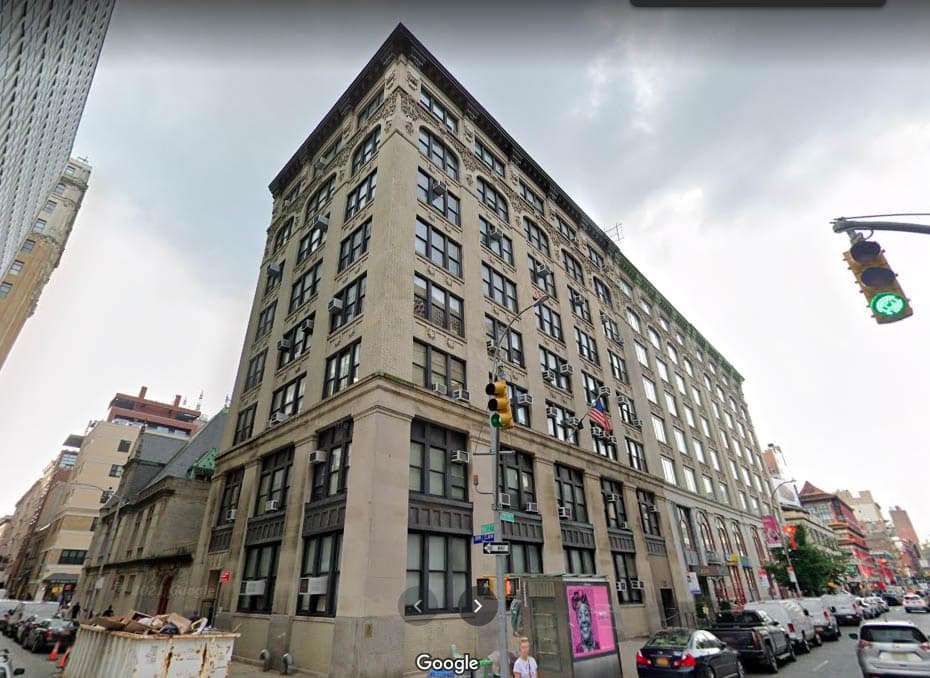
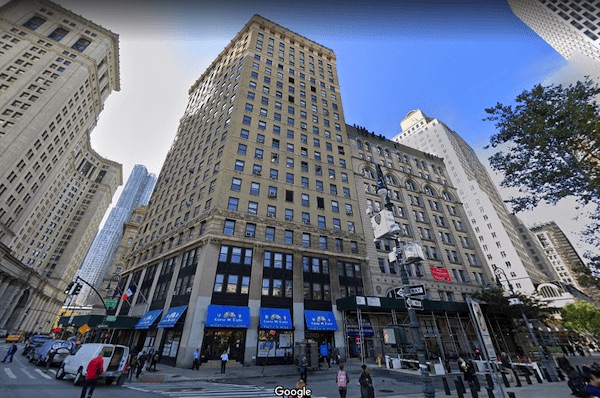
Strip away the government buildings, and most of the private leasing here happens in the old Class B towers, which is good news, because the stock is genuinely solid. The anchor is 225 Broadway, the 43-story Transportation Building sitting straight across from City Hall Park, packed with practical Class B and medical floors. Up and down the Broadway corridor, you’ll find renovated lobbies, tenant-controlled HVAC, and prebuilt suites in the 1,500-to-6,000-foot range you can move right into without a construction project.
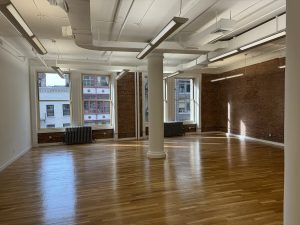
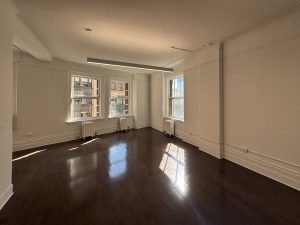
Here’s one piece of advice worth more than the letter grade on the door: two Class B buildings on the same block will quote you wildly different numbers, depending on the landlord’s vacancy and how they read your credit. So tour them yourself, and don’t put much faith in the average. With Class B demand at a multi-year high, a well-run floor here is a genuine steal. And plenty of these floors read like loft space once you’re inside, all high ceilings and big windows, which is exactly why the district pulls some of the same tenants who’d otherwise chase SoHo and Chelsea lofts uptown, only at lower rents.
The real bargains sit in the oldest elevator and loft buildings out toward the Chambers and Tribeca edge and along the Centre and Canal border, where floors run roughly $38 to $50 a foot. This is where the small law shops, the nonprofits, the startups and small tech teams, and the medical and dental practices sign their leases. And if you’d rather spend your money on people than on rent, this is exactly where you ought to be looking.
Two honest warnings, though. First, nobody publishes a clean Class C average for this district, so if a landlord hands you one precise figure like it’s settled fact, keep your guard up. And second, this is the same stock getting converted into apartments, which means the cheapest office here is vanishing faster than almost anywhere Downtown. Whatever’s open today will be a little slimmer a year from now.
This is where tenants leave the most money on the table, and it gets me every time. They grind away on the asking rent, claw back a few bucks, feel like they’ve won, and completely ignore the two levers that actually move the math: the free rent and the build-out money. Sure, the market’s tightening, so the giveaways aren’t what they were two years ago. But off the Class B and C towers, there’s still real room to work.
Here’s roughly what recent Downtown deals have looked like on a five- or ten-year term, and keep in mind that shorter terms earn you less while longer ones earn you more:
| Building class | Free rent (typical) | TI allowance (typical) | Notes |
|---|---|---|---|
| Repositioned Class A | 10 to 14 months free | $90 to $140/SF | The thinnest concessions in the district, but still generous by Midtown standards. |
| Standard Class A | 12 to 16 months free | $70 to $110/SF | A prime address that still comes with real give on the terms. |
| Class B | 14 to 20 months free | $50 to $85/SF | Prebuilt suites are everywhere, and a 10-year term is your leverage. |
| Class C and loft | 12 to 18 months free | $35 to $65/SF | Usually already built out and ready to move into. |
Concession ranges are typical-market figures from Metro Manhattan broker data (July 2026), and they vary by credit, term, and building. For reference, Manhattan’s H1 2026 average free-rent period fell to 12.4 months and average TI allowance was about $140/SF (Colliers, Q2 2026).
Two things to get straight before you sit down at the table. First, your effective rent almost always lands well below the face rent once you factor in the free months, and our breakdown of rising landlord concessions walks through that math in full. Second, a build-out check is only worth what it actually pays to build, so settle who pays for the build-out before you start talking real numbers. And if the length of the term is your sticking point, our guide to three, five, and ten-year leases lays out the tradeoffs. And if the right sublease turns up, it can beat all of it.
This was never a one-industry district, but it’s a legal-and-government town first. It’s built around the courts and City Hall, with litigation and government-facing law firms leading the way, plus nonprofits, professional-services shops, and a growing set of small tech and design teams filling out the loft floors. The talent pipeline is right here, too: New York Law School sits on the Tribeca edge, and Pace University is a block from City Hall. On these blocks, the building tends to pick the tenant about as much as the tenant picks the building, so find your row in the table below, and you’ve narrowed the search before you’ve toured a single space.
| Industry | Best-Fit Areas | Class Fit | Example Buildings |
|---|---|---|---|
| Litigation & Trial Law Firms | Foley Square, Broadway corridor | Class A / B | 225 Broadway, 40 Worth Street, 291 Broadway |
| Immigration / Criminal Defense / PI / Government-Facing Law | Broadway corridor, Centre Street | Class B / C | 225 Broadway, 305 Broadway, Centre Street stock |
| Government Contractors & Agencies (leased overflow) | City Hall core, Broadway | Class A / B | 250 Broadway area, 100 Church nearby |
| Nonprofits, Legal Aid & Advocacy | Broadway corridor, Tribeca edge | Class B / C | 291 Broadway, 40 Worth Street, Chambers-edge lofts |
| Accounting & Professional Services | Broadway corridor | Class B | 225 Broadway, 299 Broadway |
| Architecture / Engineering / AEC | Chambers-Tribeca edge | Class B / loft | 40 Worth Street, White & Reade Street lofts |
| Technology / Startups (under 20) | Tribeca edge, Centre / Canal edge | Class B / C / loft | 40 Worth Street, Tribeca-edge lofts |
| Healthcare / Medical & Dental | Broadway corridor | Class B | 225 Broadway (medical floors) |
| Coworking / Flex | Broadway corridor, WTC edge | Class A / B | 225 Broadway area, WTC-edge space |
| Retail / Showroom | Broadway, Chambers, Centre | Ground-floor | Broadway ground floor, Chambers retail |
Industry and class fits are Metro Manhattan internal research (July 2026). Vertical landing pages: Law Firm Offices, Financial Services, Startup & Tech Space, Medical Offices, Retail/Stores.
Running a small team? Look, this isn’t the cheapest corner of Manhattan, and we’re not going to insult you by pretending it is. But the loft floors and the Centre Street edge make it a lot more attainable than a courthouse-steps address has any right to be, and it earns a spot on our shortlist of the best NYC neighborhoods for small businesses.
The pitch here isn’t sky lobbies and infinity pools, so let’s not pretend it is. It’s one of the densest runs of civic and prewar architecture anywhere in the city, wrapped around a working court district, with a handful of solid private towers you can actually lease space in. And the conversions have quietly helped on the ground, because all those new apartments nearby dragged restaurants, gyms, and weekend life onto blocks that used to empty out at six sharp. It breaks into three tiers.
Repositioned and modern Class A (Broadway corridor, WTC edge): renovated lobbies, full-service elevators, modern systems, ground-floor retail, and transit at the door.
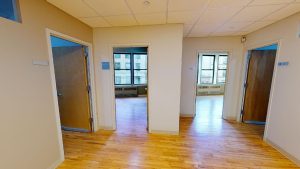
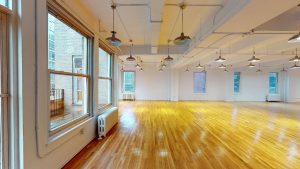
Renovated prewar Class B (225 Broadway and the Broadway corridor): restored lobbies, tenant-controlled HVAC, big windows, high ceilings, and a growing supply of built-out suites.
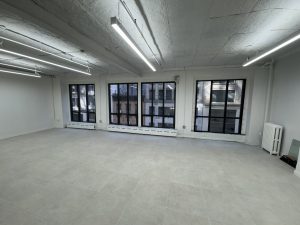
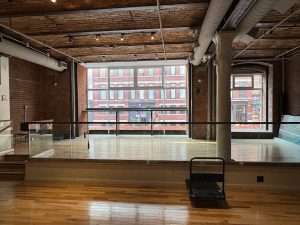
Class C and loft (Chambers and Tribeca edge, Centre and Canal border): exposed brick, character over polish, buzzer or attended entry, and the lowest rents Downtown.
See all Downtown buildings, or filter live listings by size and price
Who holds the keys matters about as much as which building you pick, and Civic Center is a strange one. The two biggest landlords here are the City of New York and the federal government, and they own and occupy the marquee buildings outright, no leasing involved. The private stock that’s left sits with value-focused owners who know older Lower Manhattan product cold and will actually deal. This is where a good broker earns their keep, because knowing which owner deals straight and which one will grind you on the last dollar is worth more than any listing site. Our rundown of the biggest landlords in NYC covers the wider field.
| Landlord | Notable Holdings Nearby | Approx. Downtown Portfolio | Typical Lease Profile |
|---|---|---|---|
| City of New York | City Hall, 1 Centre Street (Municipal Building), 52 Chambers (Tweed), 250 & 280 Broadway | Public / owner-occupied | Government |
| U.S. General Services Administration (GSA) | 26 Federal Plaza (Javits), 290 Broadway (Ted Weiss), Moynihan & Marshall courthouses | Federal / owner-occupied | Government |
| GFP Real Estate | Older Broadway and Lower Manhattan value assets, conversions (222 Broadway) | ~5M SF | 2,000+ SF |
| Time Equities | Lower Manhattan value stock (111 John Street area) | ~3M SF | 2,000+ SF |
| SL Green Realty | Select Broadway and Water Street Downtown holdings | ~3M SF Downtown | 10,000+ SF |
| Metro Loft & partners | Lower Manhattan conversion pipeline | Conversion pipeline | Residential (removes office) |
Portfolio figures are approximate and limited to Downtown holdings; several owners hold larger books across Manhattan. Ownership and management change, so confirm at lease time. Metro Manhattan internal research (July 2026).
The transit here is genuinely excellent, and that’s not a throwaway broker line, it’s a real reason to sign on these blocks. Nearly every major subway line converges around Chambers Street and the Brooklyn Bridge, and the WTC hub and Fulton Center are a short walk south, which means most of your team can get here from Brooklyn, Queens, or New Jersey without a single transfer. So before the commute turns into an office-wide argument, settle it up front with our commute calculator and everybody’s home addresses.
| From | To Civic Center | Mode |
|---|---|---|
| Jersey City (Exchange Place) | 10 to 15 min | PATH to WTC or Chambers, then a short walk |
| Hoboken, NJ | 20 to 25 min | PATH to WTC |
| Newark, NJ | 25 to 35 min | PATH to WTC |
| Downtown Brooklyn | 8 to 15 min | 4, 5, 6 or A, C to Chambers / Brooklyn Bridge |
| Williamsburg, Brooklyn | 20 to 30 min | J or M to Chambers, or ferry to Pier 11 |
| Long Island City, Queens | 22 to 32 min | E to WTC, or 7 plus transfer |
| Midtown / Grand Central | 15 to 20 min | 4, 5, 6 to Brooklyn Bridge / City Hall |
| Hicksville, NY (Long Island) | 55 to 65 min | LIRR to Grand Central Madison plus 4, 5, 6 |
| Stamford, CT | 60 to 70 min | Metro-North to Grand Central plus 4, 5, 6 |
Most of the leasable stock here comes in at or below the Downtown average of about $57 a foot. The handful of Class A and repositioned buildings ask roughly $58 to $72, Class B runs $45 to $56, and Class C and loft floors run $38 to $50. Where you land comes down to the building, the pocket, and how hard you’re willing to negotiate.
Yes, and by a meaningful margin. The WTC and Brookfield Place towers sit at the very top of the Downtown market, while Civic Center’s prewar Class B and loft stock runs below Downtown’s $57 average. You give up trophy finishes and sky lobbies, but you keep the same trains and gain a landmark address next to the courts at a value price.
It’s a legal-and-government district first. Litigation and government-facing law firms lead, alongside nonprofits and legal-aid groups, accounting and professional-services shops, government contractors, and a growing set of small tech, design, and AEC teams on the loft floors. Medical and dental practices take space in buildings like 225 Broadway.
Because the courts are here, plain and simple. The New York County Supreme Court at 60 Centre, the criminal courts at 100 Centre, and the federal courthouses at Foley Square are all within a few minutes’ walk, and New York Law School sits right on the Tribeca edge. For litigation, immigration, criminal defense, and government-facing practices, that proximity is worth real money, and the Class B rents keep it affordable. See our page on Law Firm Offices for more.
Just about anything, from 500-foot loft suites on the Tribeca and Canal edges to full floors of 30,000 to 40,000 feet and up in the Broadway towers. Small firms and startups usually find deep options under 5,000 feet, while larger legal and professional-services tenants take full floors at 225 Broadway and along the corridor.
Downtown availability was 16.8% in Q1 2026 and heading down, with positive net absorption (Colliers). Manhattan-wide availability tightened further to 13.0% in Q2 2026, its lowest since 2020 (Colliers). Civic Center’s private stock is limited and government demand is steady, so availability on the floors you can actually rent often runs at or below the Downtown average, and it’s tightening as older buildings convert to apartments.
The loft-style and Class C buildings on the Chambers and Tribeca edge and along the Centre and Canal border give you the most for your money, including 40 Worth Street and the smaller prewar walk-ups nearby. Many come with prebuilt suites on flexible terms you can move into fast, and coworking and flex options sit a short walk west toward the WTC.
Still generous, though thinner than two years ago. A standard Class A deal usually runs 12 to 16 months free with $70 to $110 a foot in improvement money, and Class B often reaches 14 to 20 months free and $50 to $85 a foot. Your credit, your term length, and the building set the final number, and Manhattan’s average free-rent period has already fallen to about 12 months (Colliers, Q2 2026).
The two largest landlords are the City of New York and the federal government, which own and occupy the marquee buildings around City Hall and Foley Square outright. The private leasable stock is held by value-focused owners such as GFP Real Estate, Time Equities, and SL Green, with Metro Loft and partners driving the nearby residential conversions.
It’s one of the most transit-rich districts in the country. The Brooklyn Bridge / City Hall and Chambers Street complex carries the 4, 5, 6, J, and Z, with the A, C, 1, 2, 3, R, and W all within a few blocks, and Fulton Center and the WTC PATH hub a short walk south and west. NYC Ferry and the free Staten Island Ferry are a short walk away, too.
Accessibility Tools