
I’ve represented tenants in Manhattan for years, and I can count on one hand the number of times an international event or crisis changed someone’s plan to lease a commercial space. Two weeks ago might be one of those times.
Not because the U.S. and Israel hit Iran and killed the Ayatollah. That’s a headline. What caught my attention was watching the Strait of Hormuz, the skinny little waterway that one-fifth of the world’s oil supply passes through, go from trade route to war zone overnight. Iran said it would burn any ship that tried to cross. Brent crude rose to $119.50 by March 9, up from $70 just ten days earlier. The EIA is now projecting prices above $95 through May, only cooling back toward $70 if the conflict wraps up quickly.
That word “if” is doing all the work right now.
Commercial leasing activity hasn’t stopped, but I’ve noticed the pace of new inquiries slowing down since the conflict started. Almost as if tenants are waiting for the dust to settle. When clients do call, the question is usually along the lines of “Should we be worried?” Every time, I give the same answer. The war itself won’t impact your lease. At least not directly. It’s three or four months of triple-digit oil and the inflation it brings home with it that you should be more concerned about.
The Stagflation Risk (and Why NYC Is Different)
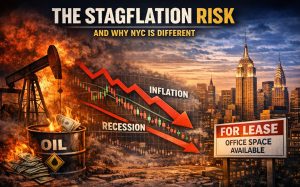

Many clients I’ve talked to since the outbreak of the war and subsequent oil spike have dropped the word “stagflation” into conversation. I don’t blame them. Oil spikes have started economic fires before, and two of the worst ones burned through NYC commercial office space markets in ways worth understanding before you make your next office decision.
1973 Was Brutal, and NYC Took It on the Chin
Following the Yom Kippur War, the OAPEC embargo sent oil prices through the roof and dragged the whole economy down with them. New York City got hit especially hard. The NYC Comptroller’s office has called 1974-75 the city’s worst job cycle in modern history and points directly at the embargo as the cause. Office employment collapsed. The city almost went under. If that’s your only frame of reference, I can understand why $120 oil concerns you.
1979 Should Confuse You
Oil doubled between April ’79 and April ’80 during the Iranian Revolution. Same type of shock. Same fears. But Manhattan did the opposite of what you’d expect. The New York Fed reported office vacancy fell to about 3.8% by autumn 1980, and midtown rents jumped over 60% that year. The national economy was getting crushed ,and Manhattan landlords were raising prices. Local demand, tenant mix, and capital flows told a completely different story than the macro headlines. That won’t necessarily repeat today, but it should make you question anyone offering a simple “oil up, leasing down” take.
Your Law Firm Doesn’t Run on Diesel
Fifty years changed the American economy. The St. Louis Fed puts services at roughly 77-78% of GDP now. NYC skews higher. The tenants who fill Manhattan office towers, law firms, financial services, insurers, consultancies, don’t have energy costs baked into their operations the way manufacturers and logistics companies do. Oil at $120 guts a shipping company’s margins. Your corporate law firm barely notices at the operating level. That gap between the national economy and Manhattan’s tenant base is the single biggest reason NYC commercial leasing doesn’t trade one-for-one with oil shocks anymore.
But Duration Will Find You
That gap has limits, though. A cited IMF analysis ties every 10% rise in oil to about 0.4 percentage points of added inflation and 0.15 points of lost growth. Manhattan office tenants won’t feel that through their own energy bills. They’ll feel it when their clients pull back, when financing terms get uglier, and when their CFO puts a hiring freeze on “until things settle down.” Oil prices won’t shut down your 15,000-square-foot expansion plans. But it could if they stay expensive long enough to change how your leadership team thinks about risk. That’s the variable to watch.
The Industries That Benefit
Here’s where I push back on the “war is bad for business” reflex. It’s too simple to build a lease strategy around. Some Manhattan tenant categories get genuinely busier when the world looks like this, and those tenants are concentrated in Midtown, which means they’ll drive whatever NYC commercial leasing demand exists over the next few quarters.
Energy Trading and Commodities Finance
Volatility is the product og these firms. Wood Mackenzie modeled a scenario where disruption pulls roughly 15 million barrels per day off global supply and pushes crude toward $150. Whether or not we get there, the swings alone generate trading volume, hedging activity, and risk management work. Desks get busier. Headcount conversations accelerate. When oil is boring, these firms run lean. When oil is doing what it did on March 9, they staff up.
Defense and Cybersecurity
Conflict pulls security spending forward. A wider geopolitical threat environment and a bigger enterprise attack surface mean companies approve cybersecurity budgets they were sitting on for months. Defense contractors and security consultants tend to move faster than normal corporate hiring cycles during periods like this. They’re hiring, they need space, and they’re not waiting around to find it — which is why I’d expect to see more of these tenants in the market over the coming weeks.
Law Firms
Sanctions work alone could keep Midtown law firms billing through the summer. Add insurance disputes, force majeure claims, and cross-border arbitration to the pile, and you’ve got legal workflows that stay healthy even while other sectors hit pause. Not every firm will grow headcount off this, but partners aren’t canceling lease expansions when utilization is climbing.
Financial Services and Safe-Haven Flows
Risk-off sounds bad until you look at where capital goes when it runs scared. Hedging demand spikes. Advisory work around portfolio repositioning picks up. Certain fund strategies perform better in exactly this kind of environment. The commercial leasing question for these firms is whether the extra work shows up as late nights at existing desks or as a reason to lock in space at a well-amenitized Midtown building. Both are happening right now, depending on the firm.
The Industries That Could Face the Most Pressure
Now the other side. Some sectors will feel real pain from sustained high oil prices, and I don’t want to sugarcoat that. But what matters more for NYC commercial leasing is the fact that most of the pressure lies outside core Midtown Class A office spaces. The bigger threat to Manhattan’s office market isn’t tenants defaulting on leases. It’s tenants sitting on their hands for two quarters because their CFO wants to “wait and see.” Decision latency kills deals. Defaults are a distant second.
Retail
Manhattan retail was already a block-by-block story before oil hit $120. Higher shipping costs on apparel, electronics, and consumer goods from Asia will squeeze margins for retailers who were barely hanging on. Luxury and non-essential storefronts feel it fastest when consumers pull back discretionary spending. A 30-cent jump at the pump doesn’t bankrupt anyone, but it changes how freely people spend on Madison Avenue.
Hospitality and Tourism
Hotels and restaurants run on thin margins in good times. Layer on higher fuel costs, pricier food imports, and a global uncertainty that makes international travelers think twice about booking, and you’ve got a sector that feels pressure from every direction. Convention bookings and leisure travel are the first line items companies and families cut when they feel nervous. NYC hospitality was still finding its post-pandemic footing, and this doesn’t help.
Import-Dependent and Outer-Borough Industrial
Strait disruptions force ships around Africa instead of through Hormuz. Freight rates spike. Lead times stretch. Insurance premiums balloon. Warehousing and distribution operators in Brooklyn, the Bronx, and Queens feel that directly in their cost structure. But notice where that pain sits. It’s port-adjacent and industrial. It’s not a Midtown office story.
Construction
Imported metals, plastics, and equipment all get more expensive when shipping lanes tighten. Energy-intensive construction operations incur higher fuel costs on every project. Timelines slip. Budgets blow out. For a city with active development pipelines, sustained disruption could stall projects that looked fine at $70 oil but look shaky at $110.
The Duration Scenarios
Everything I’ve laid out so far comes back to one variable: how long does oil stay expensive? The conflict itself is noise for NYC commercial leasing purposes. The duration of the supply disruption is the signal. The EIA is modeling price paths based on exactly this: how quickly transit through Hormuz gets restored, and their outlook makes clear that oil flows are the entire swing factor. So here are the three scenarios I’m walking every tenant client through right now.
Under Two Months: Shock, Then Back to Normal
Oil stays elevated for a few weeks, cools off, and the market goes back to arguing about return-to-office policies and building amenities. CFOs stop treating energy prices as a budget-altering input. Lease committees ask for one round of updated forecasts, get comfortable, and greenlight the deal they were already working on. The EIA’s base case, where prices stay high near-term but drift lower once flows reestablish, fits this scenario. For tenants, this is the window where you negotiate like it’s a normal market, but with a small leverage bump. Landlords know deals fall apart in committee during uncertainty, and they’d rather give you a concession than watch you disappear for six months.
Three to Six Months: The Freeze
The war stops being a headline and starts being a budget problem. Oil above $95 keeps inflation in every boardroom conversation. Internal hurdle rates tighten. And firms that were planning expansions decide to renew in place or sign short-term extensions instead. The pipeline doesn’t collapse. It just slows down hard. Fewer new searches. More renewals. A lot of “let’s revisit in Q4.” Landlord concessions start widening here, not through dramatic face-rent cuts but through more generous tenant improvement packages, extra months of free rent, and more flexible timelines. If you’re a tenant who can commit during this window, you have leverage you didn’t have in January.
Six Months Plus: Recession-Adjacent, and Opportunity for the Prepared
At this point, the economy has internalized the shock. Even Manhattan’s service-heavy tenant base feels the drag through weaker client revenue, tighter financing, and slower hiring. Landlord posture changes visibly, especially outside trophy buildings that were already capturing most of the commercial leasing activity. But here’s what I tell well-capitalized clients: this is where the best deals live. Underwriting gets cautious. Deal volume drops. A tenant with clean credit and a real timeline becomes the most valuable thing a landlord can find. You won’t get a desperate fire sale on Park Avenue, but you will get economic terms that weren’t on the table twelve months ago.
What I’m Telling My Clients Right Now
“Should we wait?” is a question I’ve heard increasingly over the last two weeks. But my answer hasn’t changed once. Waiting works when you know what you’re waiting for. Most tenants I’m talking to don’t have a trigger point. They’re just hoping the world gets less confusing. That’s not a strategy.
Here’s what I’m advising. If you’re mid-negotiation, push for closing. Landlords are sharpening concessions right now because they want committed tenants on their rent rolls before the market picture changes. That leverage has a shelf life. If you’re early in a search, lock your requirements down tight so you can move fast when the right space opens up. And if you’re sitting on a renewal, use the next 60 days to test the market before your landlord figures out how much leverage you’re giving away by staying put.
The tenants who come out of these periods with the best deals usually weren’t trying to time anything. They just knew what they needed and were ready to move when the right terms came together.