
Con Ed just got the nod for another rate hike. Electricity goes up 3.5% this year, with more increases stacked on for 2027 and 2028. Manhattan office tenants already pay roughly 22 cents per kWh on the commercial side, which is about 50% above what businesses pay nationally.
None of that is changing. But your NYC electric bill isn’t fixed in stone either. Most of what you’ll pay over the next five years gets locked in the day you sign your lease, and most tenants never push back on it.
Below are five things you can do to move the needle, roughly in the order you’ll hit them.
1. Get the Meter Account in Your Name, Not Your Landlord’s
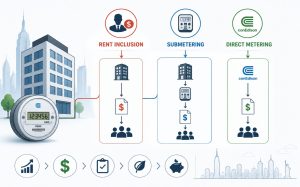
How your electricity gets billed is the biggest factor in your NYC electric bill. Offices run on three setups:
- Rent Inclusion: A flat charge in your rent, usually $3 to $3.75 per square foot. You pay that whether you run one laptop or a server room; the landlord pockets the difference.
- Submetering: The building meters your usage and bills you at the Con Ed rate. You pay for what you use.
- Direct Metering: Con Ed bills you directly, so you skip the landlord markup.
For tenants over 2,500 square feet or signing three years or longer, direct or submetered wins on math alone. A 5,000-foot tenant on rent inclusion at $3.50 pays $17,500 a year. On a submeter, that’s typically $10,000 to $13,000.
Local Law 88 already mandates submeters in most non-residential spaces over 5,000 square feet, so the meter is often already there. If not, push for one during lease negotiations.
2. Retrofit the Lights and Let Con Ed Pay for It
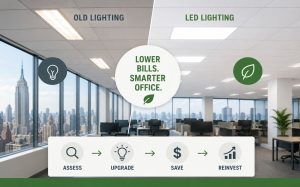
LED retrofits are still the fastest payback in any office. Swapping old fluorescent troffers for LED panels cuts lighting energy roughly in half. At Manhattan rates, the savings show up the next month.
Once you stack the rebates, the numbers can get aggressive. The Con Edison Commercial and Industrial Energy Efficiency Program takes applications between May 1 and September 30, 2026, with installations wrapped by October 31. If your project also qualifies for the federal Section 179D deduction, construction has to start before June 30, 2026, or the credit is gone.
The smart move is getting it funded through your tenant improvement allowance instead of paying out of pocket. Landlords staring down Local Law 97 penalties ($268 per metric ton of CO2 over the limit) tend to say yes, since cleaner lighting helps their compliance too.
3. Get a Real Handle on Your HVAC
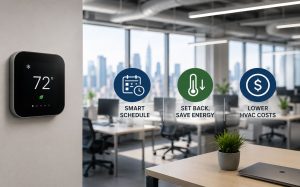
HVAC is usually 40 to 60% of an office’s electric load, so this is the biggest single dial you can turn after lighting.
The easy fix is scheduling. A smart thermostat or basic controls package runs $150 to $400 per zone and lets you set back temps at night, weekends, and in unoccupied areas. A 10-degree setback cuts HVAC energy use 15 to 20%, and most tenants see payback inside a year.
The expensive trap is after-hours HVAC. Standard leases cover Monday to Friday, 8 to 6. Anything outside that runs $80 to $150 an hour per zone, and it stacks up fast if your team works evenings or Saturdays. Negotiate the rate, ask for a free allotment of overtime hours each month, or get the system submetered so you pay for actual use.
Our hidden charges guide covers the language landlords usually accept.
4. Apply for the NYC Programs Most Tenants Never Touch

Hardware aside, NYC and Con Ed both run programs that pay tenants directly to cut their NYC electric bill, and most offices never apply. Three are worth the paperwork:
- Energy Cost Savings Program (ECSP): Up to 45% off your regulated electricity delivery charges and 35% off gas, capped at $10,000 per employee. Benefits last eight years before a four-year phase-out. You qualify through ICAP, by leasing a Special Eligible Premises, or by relocating into a designated zone. ECSP also caps landlord markups on submetered electricity at 12%.
- Lower Manhattan Energy Program (LMEP): The downtown version of ECSP, designed for offices below Murray Street.
- Smart Usage Rewards: Con Ed pays you $18 per kW per month from May through September if you cut electricity during summer peak demand events. A 100 kW commitment works out to about $18,000 a summer.
5. Shop Your Supplier and Bake Protections Into the Lease
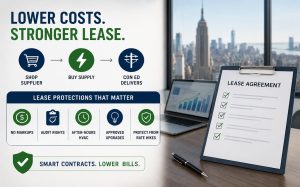
New York deregulated electricity supply in 1996, so you can buy your supply from a third-party ESCO while Con Ed still delivers it. Fixed-rate contracts can hedge against the 2026 to 2028 hikes, but read the fine print on teaser rates that reset, termination fees, and variable plans. The state runs a Power to Choose tool.
The bigger long-term win sits in the lease itself. Five clauses worth pushing for:
- Submeter rate capped at the actual Con Ed tariff, no markup
- Right to audit electricity bills once a year
- After-hours HVAC clearly defined with a cap or free hours
- LED, thermostats, and controls listed as approved TIA uses
- Protection from retroactive electric rent hikes triggered by a landlord-commissioned usage survey
Most tenants and a lot of attorneys breeze past these lease terms. Don’t.
Stop Overpaying on Your NYC Electric Bill
In any NYC lease negotiation, the tenant’s attention goes to one number: rent per square foot. Everything else gets read on Friday afternoon by an attorney charging by the hour, and electricity provisions get the least attention of all. They sit at the back, written in landlord-friendly boilerplate, and the lease gets signed before anyone notices.
Before you know, it’s five years later, and you’re paying for that mistake. A 5,000-foot Midtown Manhattan office, in fact, can overpay $50,000 to $100,000 on electricity terms alone. Nobody refunds that money, either. It leaves your account every month until you move out.
Every tactic in this article happens before the LOI. After that, your billing structure, overtime HVAC rate, submeter cap, and audit rights are set. Worse, Con Ed rates climb through 2028, so every skipped clause grows costlier each year.
If your lease is up in the next year or you’re already touring, call Metro Manhattan Office Space at (212) 444-2241. The rent number is the easy fight. Everything else in the lease is where we earn our keep.