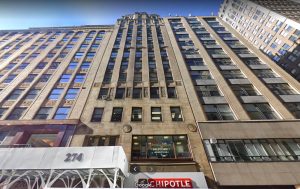
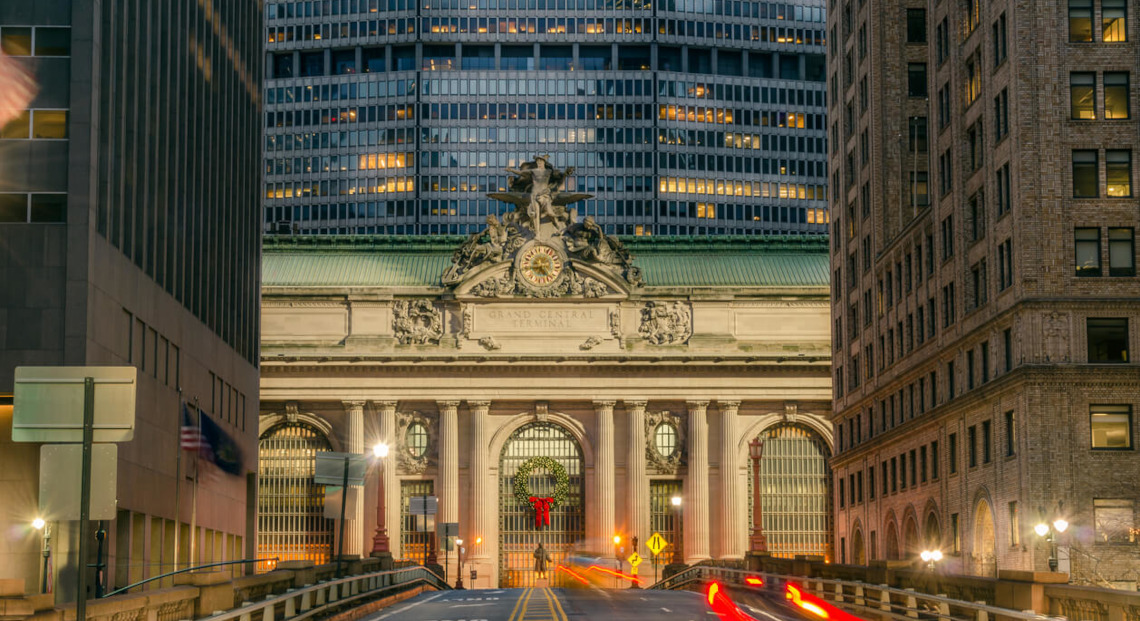
I get calls about Grand Central office space constantly. Hedge fund managers from Greenwich. Private equity executives tired of Penn Station. Law firm partners who want a polished address without the chaos of a massive tower.
Their priorities rarely surprise me. A short walk from the train. Quiet elevators. A lobby that doesn’t feel like an airport terminal. Boutique Class A buildings where the owner invests consistently, and the staff knows your name.
Since the LIRR opened at Grand Central, these calls have picked up. Companies that spent years near Penn are now looking east. The challenge, though? True boutique Class A inventory near the terminal is limited. Only a handful of buildings check every box: intimate scale, quality ownership, solid amenities, and real proximity to the trains.
The five properties below represent the best options available right now. They serve different tenant sizes and budgets, but each delivers the controlled, commuter-friendly experience that keeps tenants renewing year after year.
Why Boutique Class A?
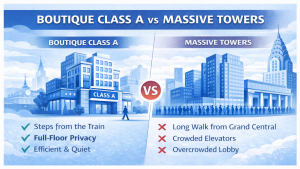
Before I walk you through the specific buildings, you need some context. Boutique Class A buildings operate differently from the massive towers that dominate the Midtown skyline. Learning those differences will save you time, prevent mismatched expectations, and help you zero in on the right fit faster. Here’s what I tell every client before we start touring.
Commuter Logic Beats Trophy Logic Every Time
Most tenants searching near Grand Central share a common thread: they value efficiency over bragging rights. Their executives live in Westchester, Connecticut, or Long Island. They want to step off the train and reach their desk in under five minutes.
Crossing six avenues to sit in a flashy lobby with a 45-minute elevator wait? That pitch falls flat.
Boutique Class A buildings win here because they sit in that sweet spot between trophy megadevelopments and tired mid-block inventory. You get quality ownership, real amenities, and efficient floorplates without the friction of sharing an elevator bank with 3,000 other people. For commuters, that tradeoff makes all the difference.
These Buildings Favor Full-Floor Tenants
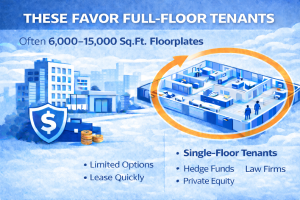
Here’s where expectations need adjusting. Many boutique Class A buildings near Grand Central were designed around full-floor occupancy. Typical floorplates run between 6,000 and 15,000 square feet, give or take. Hedge funds love that setup. So do private equity shops, asset managers, and law firms that want privacy and control over their environment.
Smaller companies looking for a 1,500-square-foot plug-and-play suite? The options get tighter. A few buildings on my list offer partial-floor availability or prebuilt suites, but those spaces lease quickly. Knowing which buildings accommodate smaller tenants will keep you from wasting time on properties that were never going to work.
Some Boutique Buildings Offer Better Value Than Others

Cost matters. And while all five buildings on my list deliver Class A quality and commuter convenience, a couple consistently offer better value for smaller or budget-conscious tenants.
These tend to be the properties with efficient layouts, hands-on management, and asking rents that stay grounded compared to newer construction. Smaller firms can establish a legitimate Grand Central presence without overcommitting on space or paying trophy-level rent. I’ll flag which buildings fall into this category when we get to the profiles.
Stability Explains Why Tenants Stay
The secret weapon of boutique Class A buildings? Long-term ownership.
Many of these properties have been held by the same families or firms for decades. Those owners reinvest consistently in lobbies, mechanical systems, and common areas. They care about tenant retention because they plan to hold the asset for another 30 years.
That stability shows up in the tenant roster. You see established firms with five and ten-year lease histories. Renewal rates run higher than the market average. The vibe skews professional and predictable, which attracts tenants who want the same qualities in their neighbors.
You Can Match the Building to How Your Team Works
Choosing the right boutique Class A building comes down to honest self-assessment. Full-floor users who want privacy and brand identity have different needs than smaller firms prioritizing flexibility and value. Growing companies balancing expansion potential with amenity access fall somewhere in between.
The best building for your company has nothing to do with which one photographs well on Instagram. Pick the one that supports how your people actually show up and work every day.
The Five Buildings
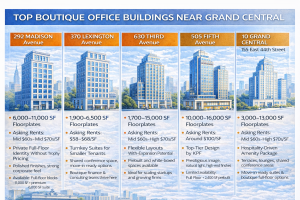
Now let’s get specific. The five buildings below represent the best boutique Class A options within walking distance of Grand Central Terminal. I’ve toured each of these properties dozens of times and placed tenants in most of them. They serve different company sizes, budgets, and priorities. Still, they all deliver on the fundamentals: quality ownership, efficient layouts, and commuter-friendly locations.
292 Madison Avenue: The Quiet Corporate Performer
292 Madison Avenue flies under the radar, and its tenants like it that way. The building has the feel of a private corporate headquarters without the drawbacks of a megatower. Floorplates run between 6,000 and 11,000 square feet, and most tenants occupy entire floors. You can combine floors for larger blocks if needed.
Investment firms and professional services groups gravitate here because the building projects credibility without screaming for attention. Ceiling heights, finishes, and overall presentation punch above what you’d expect at this price point. Asking rents typically land in the mid-$60s to mid-$70s per square foot, depending on floor and term.
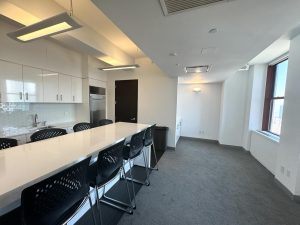
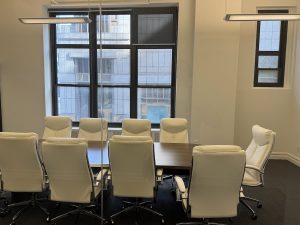
Current availability includes several full-floor opportunities around 11,000 square feet, plus a smaller upgraded suite near 6,000 square feet. These spaces emphasize conference rooms, private offices, and polished pantry installations.
If you want full-floor identity near Grand Central without paying trophy rent, put 292 Madison on your tour list.
370 Lexington Avenue: The Best Option for Smaller Tenants
370 Lexington Avenue solves a problem that frustrates a lot of smaller companies: finding genuine Class A space near Grand Central without committing to a whole floor. While the building does accommodate full-floor users, it consistently offers partial-floor suites that are rare in this submarket.
Suite sizes typically range from 1,900 to 6,500 square feet. Shared conference facilities let smaller tenants punch above their weight without wasting square footage on rooms they’d use twice a month. Asking rents fall between $58 and $68 per square foot, making 370 Lexington one of the most affordable high-quality options near the terminal.
Current availability includes multiple turnkey suites under 2,500 square feet and a full-floor option around 6,500 square feet. Several spaces are move-in ready with efficient layouts already built out. Boutique finance teams, consulting groups, and satellite offices do well here.
630 Third Avenue: The Flexible Middle Ground
630 Third Avenue bridges the gap between smaller boutique buildings and larger Midtown towers. The building’s strength is flexibility. Tenant sizes range from sub-2,000 square foot suites up to full floors approaching 15,000 square feet. Larger contiguous blocks are available for companies that need real scale.
Startup companies love 630 Third because they can start in a smaller suite and expand within the building as headcount increases. Terraces, upgraded mechanical systems, and a strong management team help differentiate the property from older Third Avenue inventory that hasn’t kept pace with tenant expectations.
Rents generally fall in the mid-$60s to high-$70s per square foot range. Current availability includes smaller suites between 1,700 and 5,500 square feet, plus larger floor opportunities around 15,000 square feet. Some spaces are white-boxed for customization. Others come prebuilt for faster occupancy.
505 Fifth Avenue: The Premium Play
505 Fifth Avenue sits at the top of the boutique Class A spectrum near Grand Central. Kohn Pedersen Fox designed the building, and it shows. The corner location at Fifth Avenue and 42nd Street delivers architectural quality and presence that few smaller buildings can match. Bryant Park sits steps away. Grand Central is around the corner.
Floorplates run from roughly 10,000 to 16,000 square feet, and availability tends to be limited. Tenants here care deeply about image and presentation. They’re willing to pay for quality light, modern design, and a prestigious address. Asking rents hover around $100 per square foot, reflecting the building’s positioning and scarcity.
Current options include a full-floor opportunity around 16,000 square feet and a smaller prebuilt sublet of approximately 2,400 square feet. Both offer strong natural light, clean finishes, and direct elevator presence. If brand matters to your business and budget allows, 505 Fifth belongs on your shortlist.
10 Grand Central (155 East 44th Street): The Amenity Leader
Finally, 10 Grand Central has become one of the most amenity-rich boutique Class A buildings in the submarket. Recent capital investment created a hospitality-driven workplace with lounges, terraces, conference facilities, and shared spaces that rival much larger developments. The building punches well above its size class when it comes to tenant experience.
Floorplates range from approximately 3,000 to 13,000 square feet, accommodating both smaller teams and full-floor corporate users. Firms that prioritize employee experience and collaboration find the amenity package particularly compelling. Rents trade in the mid-$60s to high-$70s per square foot range.
Current availability includes plug-and-play suites between 3,000 and 5,000 square feet, plus boutique full-floor options exceeding 10,000 square feet. Several spaces feature terraces, upgraded pantries, and modern conference layouts.
If your recruiting pitch includes “great office,” 10 Grand Central makes that promise easy to keep.
Boutique Class A Is a Strategy, Not a Compromise
Most of my clients who commute through Grand Central don’t want the biggest building or the flashiest lobby. They want to get off the train, walk two blocks, and start their day without a production.
Boutique Class A buildings deliver exactly that.
Yes, the five properties I covered here each have different personalities and price points. However, the key takeaway is that they share the same fundamentals: responsive ownership, efficient floorplates, and locations that make the daily commute painless.
There’s a reason why tenants stay in these buildings over the long term.
Grand Central’s pull keeps growing. And especially since the LIRR opened, quality space near the terminal rarely lasts long. If one of these buildings sounds like a fit, don’t wait around.
Feel free to reach out. I’d be happy to discuss your search and suggest specific buildings and spaces.