
In May, a company came to me looking for twenty-five hundred square feet of Flatiron District office space. They build training environments for artificial intelligence, which are essentially playgrounds where automated systems learn to do things.
They arrived extremely well capitalized and the particular certainty of people who have never leased an office in Manhattan. Flatiron or Union Square, nothing above Twenty-Fourth Street, and don’t bother showing them Chelsea.
We researched the market and came back with all of four spaces available, and I don’t mean four good ones. I mean, four in the entire neighborhood at the size they wanted.
I told them what I’m about to tell you, and I understood why they said no. When you’ve already fallen for a neighborhood, the last thing you want to hear is that you should want something else. Today they’re sharing space with their investor.
None of that surprised me, because I’ve watched this neighborhood do this to people twice already, and both times it ended the same way.
The Flatiron District Was the Birthplace of Silicon Alley

Before you tour a single Flatiron District office space, you should understand what you’re standing in, because Silicon Alley was born in Flatiron. I’m not saying that as a figure of speech, either. It’s a fact of geography.
In 2000, it was the dot-coms. By 2011, new media had the market running again at 30.1 million feet leased citywide, the first year since 2000 to come anywhere close. Two years later, New York had roughly 7,000 tech companies with job growth four times the rest of the economy.
Then it folded, the way these things fold. By 2023, more than a third of Manhattan’s 22 million feet of sublease space was tech, advertising, and media quietly handing back floors they’d fought each other over in the good years.
The brick hasn’t changed, and neither has the script.
Flatiron District Office Space Didn’t Dodge the Crash. It Had the Worst One.
You’ll hear that these neighborhoods sailed through the pandemic. Which sounds right if you weren’t here for it.
Availability in Flatiron and Union Square peaked at 28.7% and Chelsea at 28.0%, against 19.5% for Manhattan as a whole. Which is to say these blocks got hit harder than the city did rather than softer, and anybody telling you otherwise is selling something (Newmark, 1Q26).
What happened next is the part that actually explains your search. Flatiron clawed its way back to 13.9%, a 1,480 basis point swing, and the fastest recovery anywhere in Midtown South except Meatpacking. Chelsea, in comparison, is still sitting at 19.2% and lost tenants last quarter.
So the market never gradually tightened on you. It got vacuumed out in twenty-four months, and you happened to walk in at the end of it.
Why 13.9% Availability Still Leaves You Nothing
Somebody is going to look at that number and tell me thirteen-nine isn’t a tight market, and on paper they have a point, because roughly one floor in seven is sitting empty.
Availability gets counted in square feet, though, not in doors. Sixty empty two-thousand-foot suites and one building with six empty twenty-thousand-foot floors are the same hundred and twenty thousand feet, and they look identical to that percentage and nothing alike to you.
Ramp expanded into 285,300 feet at 28-40 West 23rd Street, the biggest Midtown South lease of the first quarter. That’s one signature moving more space than a hundred and forty small tenants combined, and it’s the kind of deal that percentage is actually built out of.
Startups start small, and small is precisely the band where the shelves are bare.
Twenty-Third Street Is the Line

The other thing that percentage buries is that it averages ground that doesn’t behave like one market.
Run the same search north of Twenty-Third and it opens up. The older NoMad buildings and the blocks running toward Madison Square have space, they have landlords who keep prebuilt suites ready to go, and they have people who will pick up the phone on a small deal.
South of Twenty-Third is where it’s genuinely tight, and south of Twenty-Third is also where everybody wants to be, which is not a coincidence. That’s the stretch with the loft stock and the restaurants and the address that goes in the deck.
So when the company in May said nothing above Twenty-Fourth Street, they kept exactly one block of the market that had any give in it and locked themselves out of the rest.
Everybody Wants the Same Brick

AI firms took roughly a million feet of New York office space in the first quarter alone, more than in all of 2025, and about 70% of this year’s AI deals landed in Midtown South (Cushman & Wakefield via Gothamist; JLL via Commercial Observer).
Most of them are hunting ten to twenty thousand feet, which shouldn’t be your problem. Except that they’re hunting in your buildings.
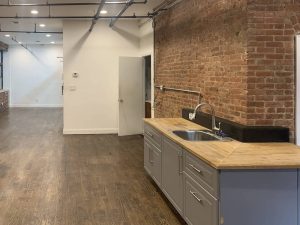
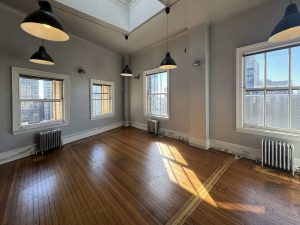
My read, and this one is mine, off the deals on my desk rather than out of a report, is that they want the brick: exposed ceilings, oversized windows, a floor that doesn’t feel like a floor, and there was never much of that product to go around.
The research backs into the same answer sideways, because Class B took 42% of Midtown South leasing last quarter, beating Class A, and Cushman credits AI money for part of that flip.
And Spare Me the Conversion Story
Somebody is going to tell you that office-to-residential conversions are eating your supply, and citywide, that’s fair enough. Especially with 19.2 million feet in the pipeline and real cranes over real buildings.
But it just isn’t happening in Flatiron. Of the twenty-one buildings where conversion has actually broken ground, ten sit in Midtown and seven Downtown, which leaves four for all of Midtown South, whose entire pipeline runs about 1.6 million feet against a 76-million-foot inventory.
That works out to two percent, which is a rounding error in a trench coat.
The Average Flatiron District Office Rent Is Lying to You

Flatiron District office rents averaged $87.18 a foot across Flatiron and Union Square in the first quarter, up 8.9% on the year, the sharpest climb anywhere in Midtown South.
I quote seventy to eighty on the phone, the report says eighty-seven, and we’re both right. That’s the entire point of this article in the first place.
What drags that average up is Park Avenue South, where AI tenants sign at $90 to $120 per square foot, with most of the good buildings fully leased. Walk three blocks west, off Sixth, into the prewar side streets, and many Flatiron listings can ask $42 to $58.
What I Told the Company in May
Go to three to five thousand feet, I said, and your list goes from four spaces to roughly twenty. Same blocks, same trains, same brick, five times the options, and for the first time in this process, you’d be the one holding something worth trading.
Landlords sitting on bigger blocks want term, and they will pay you for term. That’s leverage you cannot manufacture at twenty-five hundred feet in a neighborhood where twenty-five hundred feet doesn’t exist.
They didn’t love the four; they wouldn’t stretch, and they moved in with their investor instead. It won’t hold, because it never does, and I’d put money on them being back in the market inside a year, running the same search in a tighter market with less time on the clock.
They Didn’t Lose to Flatiron. They Lost to Waiting.
What killed that deal wasn’t the neighborhood. It was a company waiting for the market to produce its exact requirement, and I’ve never once seen the market do that for anybody.
So stretch the footprint before you stretch the timeline. Run your real headcount through the space calculator instead of guessing, because two thousand feet is almost never the honest answer. It’s the number you picked when you were nervous about the rent, and the gap between it and the real one is the gap between four options and twenty.
There’s also a version of this where you don’t stretch at all, and it’s the one nobody in Flatiron wants to hear.
Same Bones, 20 Blocks North
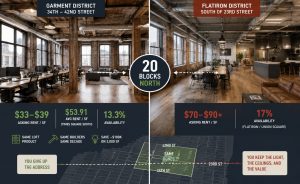
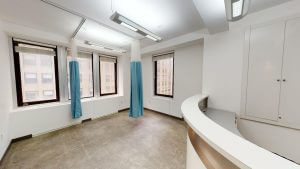
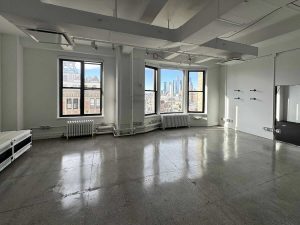
Fifth to Ninth Avenue, 34th to 42nd Street. Brick, oversized windows, skylights, wood and concrete floors, which is the identical loft product they’re bidding up in Flatiron, thrown together by the same builders in the same decade for the same reason.
Garment District inventory is asking thirty-three to thirty-nine a foot, and the wider submarket, the brokerages still file under its old name, Times Square South, averages $53.91 at 13.3% availability. Either number is a fraction of the Flatiron District office ask.
You give up the address, and you keep the light, the ceilings, and about a hundred grand a year on two thousand feet, which is worth an honest twenty minutes before you wave it off over a zip code.
The Only Market in Manhattan Going the Other Way

There are nineteen submarkets in Newmark’s Manhattan table. Eighteen of them are flat or up year over year, and one is down 7.5%.
Tribeca and City Hall, averaging $65.20, got cheaper while Flatiron ran up nearly nine points. That rarely ever happens and never lasts long when it does.
City Hall inventory is asking thirty-seven to fifty, in buildings like 15 Maiden Lane, 111 John, and 291 Broadway, with real loft floors and real light at roughly half the Flatiron average.
The commute changes, and lunch gets worse, and I’m not going to pretend otherwise. But for most of the startups calling me, that math isn’t close, and the window is closing while they think about it.
Or You Could Just Write the Check
Widening your size and widening your geography are both things you do when the budget is fixed. Raising the budget is the direct route, and this market will hand you almost anything if you’re willing to pay for it.
You want Park Avenue South with no compromises? 2 Park Avenue is quoting ninety-five to a hundred fifteen and sits around 90% leased after Via and an AI shop called Cadent took floors this spring (Norman Bobrow, June 2026).
The tier underneath is cheaper than the noise suggests. 215 Park Avenue South, the SL Green–managed loft on the corner of Eighteenth, runs seventy to seventy-three on our listings, and 915 Broadway starts around fifty to sixty.
So the premium for a great address is real, and it’s also a lot narrower than anyone selling you one would like you to know.
Free Rent Is Leaving, and So Is Your Margin for Error
If you’re signing, sign like somebody who has read a lease before.
Free rent on new Manhattan deals averaged 12.4 months in the first half, the thinnest since 2019, and improvement money has flatlined near a hundred forty a foot (Colliers, July 2026). Midtown South landlords repriced more than twice as much space up as down last quarter, and the borough’s average ask hit $78.03, the highest since July 2020.
Term still buys concessions, just less than it bought last year, and it’ll buy less again next year.
Before you commit a decade to an AI thesis, though, go read the Comptroller’s May report, because Levine’s people put the combined odds of a bad AI outcome for this city at 50%. I’ve watched two of these cycles end. Sign a lease you can carry when the music stops.
Call Me Before You Tour, Not After
Every one of these calls arrives the same way: a month into the search, twenty listings deep, already sick of the whole business. By then, you’ve priced your own requirement, and you know precisely what four options look like.
What you don’t know is what twenty looks like, because nobody ever showed you the version of your search that had twenty in it.
That conversation takes fifteen minutes. The company from May didn’t have it until month two, and they’ll be having it again in the spring, and it will cost them more the second time around.
Have it first.
Call me at (212) 444-2241 if you have any questions or go see what’s out there in the market.