There’s a firehouse at 124 Liberty Street called Ten House. It was the only one inside the perimeter on the morning of 9-11, and it lost men of its own. The city rebuilt it on the same spot. Along the side, there’s a bronze wall with the names of all 343 firefighters who died.
I walk clients past it on the way to tour floors at 4 World Trade, and I’ve learned not to point it out. The ones who notice go quiet for a second, and then we keep walking. That’s about right. That’s the neighborhood now.
Twenty-five years ago on 9-11, 2,977 people didn’t come home. Most of them were doing roughly what you and I do all day. Got in early, took the elevator, sat down at a desk. It was an ordinary Tuesday until 8:46. That’s the part I still can’t shake, 22 years into leasing offices in this city.
The Wall Street Journal ran a piece this week under the headline “Lower Manhattan Has Roared Back,” and it’s mostly right. I’ve got nothing profound to add about the grief; better people than me already have. What I can do is walk you through what actually came back and what didn’t. Then I’ll tell you how I’d play Lower Manhattan office space if I were signing a lease down here this fall.
What Came Back
The Journal’s numbers are real. What follows is the version from someone who leases the floors, which means I care less about the ribbon cuttings and more about who’s paying rent.
The Workers
More than 230,000 people are working Downtown again, close to the pre-attack headcount. You can see the change in the leases getting signed.
Cleary Gottlieb took 476,000 square feet at 1 Liberty Plaza, and Aon renewed another 201,000 in the same building. A city pension fund added 78,000 square feet at 55 Water Street. Norm AI moved from 7 World Trade into 64,000 square feet at One World Trade.
It’s a funny mix when you put it all together: law firms, insurers, pension funds, AI companies. Twenty years ago, getting companies comfortable with Downtown was part of the job. Mary Ann Tighe, who leases the site for Silverstein, told the Journal that “people were literally afraid.”
Now you read a quarter’s worth of leasing news and barely think twice about the address. That may be the clearest sign of how far Downtown has come.
The Residents
As the offices filled back up, Lower Manhattan started changing after hours too. About 25,000 people lived below Chambers Street before 9/11; today, it’s roughly 70,000, with more than 37,000 apartments.
That residential base didn’t appear overnight. The Alliance helped push 421-g through Albany in 1995, and the city comptroller credits it with creating about 12,900 apartments. After 9/11, federal incentives helped keep residents Downtown, and 467-m gave office conversions another boost in 2024.
Now the idea has gone supersized. 25 Water Street became 1,320 apartments, while 55 Broad and 222 Broadway added hundreds more.
The Trade Center
Then came the part everyone could see: the World Trade Center itself.
Roughly 10 million square feet of new offices and $20 billion in public and private investment later, the rebuilt World Trade Center and Brookfield Place are basically full. Availability ended 2025 below 7%, and Savills put Trade Center asking rents at $110.35 a foot, versus $67.35 for Class A space elsewhere Downtown, according to Commercial Observer.
I’ve had tenants walk into One World Trade Center expecting the old Downtown discount and come back out staring at Midtown numbers. The surprise makes sense. That building has very little vacancy left to bargain over.
The Corner at Church and Vesey
If the Trade Center’s rents show how far Downtown has come, the corner of Church and Vesey tells the longer story.
Larry Silverstein signed the Twin Towers lease 7 weeks before 9/11 and then spent 25 years rebuilding the site. When I started representing tenants in 2004, 7 World Trade was still a steel frame, and Downtown tours usually came with a long explanation about incentives.
Church and Vesey remained the unfinished piece until July 9, when American Express broke ground on 2 World Trade, a 55-story, nearly 1,250-foot tower it plans to own outright with no public money. After 175 years Downtown, AmEx is staying put in a very big way.
That says plenty.
The Neighborhood After Six
A new headquarters at 2 World Trade makes more sense when you look at what Lower Manhattan has become outside office hours.
The old Financial District used to clear out with the closing bell. Now Stone Street is packed on Friday nights, Pier 17 draws 3,400 people to rooftop concerts, and the Alliance counted 10.3 million visitors last year while hotels ran 88% full. There’s even a Balloon Museum in the Tin Building, which would’ve sounded fairly ridiculous in 2001.
The Journal found a 24-year-old SHoP Architects designer who lives in FiDi and walks to the Woolworth Building. His mother was pregnant with him on 9/11. Twenty-five years later, Downtown is simply his neighborhood.
What Didn’t
Now the part the anniversary pieces skip. Some of this never came back, some of it shouldn’t, and one or two items are your negotiating leverage. Read it that way.
Twenty-Four Million Square Feet of Offices
For all the life that returned Downtown, one thing never did: all of the office space.
Lower Manhattan had about 139 million square feet of offices on September 10, 2001. Today, CoStar puts the total closer to 115 million, according to Commercial Observer. That’s 24 million square feet gone from the inventory.
Much of it was exactly the kind of aging commodity space tenants had already stopped loving. Conversions gave those buildings another use and steadily tightened the office market at the same time. You can see the effect in Q2: Downtown absorbed 2.16 million square feet even though leasing totaled just 1.14 million.
Wall Street’s Monopoly
Something else disappeared along with those 24 million square feet: Wall Street’s grip on the neighborhood.
Finance and real estate once accounted for roughly two-thirds of Downtown jobs. Today, they’re closer to a third. Brookfield Place used to be almost half Merrill Lynch, and when the banks pulled back, Brookfield spent years filling some enormous holes. Those floors now hold media companies, tech firms, asset managers, and quant shops like Jane Street.
Durst’s Eric Engelhardt told Commercial Observer that maybe it’s time to rename the Financial District. He was only half kidding. Downtown spent decades depending heavily on Wall Street, and what grew back around it turned out to be much broader.
Full Floors on Water Street
The old tenant mix changed faster than some of the old buildings did.
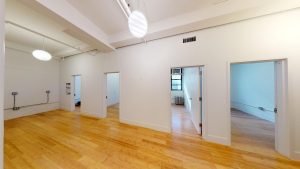
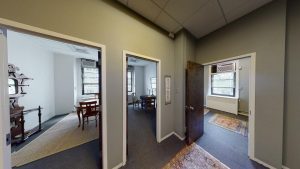
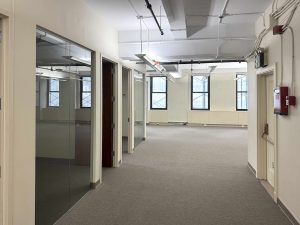
Downtown vacancy still sits at 22.3%, versus 19.3% across Manhattan, according to Cushman & Wakefield. Figures that make it the softest office market in Manhattan. A lot of that space is concentrated in 1960s and ’70s towers along Water and Broad Streets, where huge floor plates and dated interiors have become harder to lease and expensive to convert.
That’s also where tenants still have room to negotiate. Colliers puts average free rent at 12.4 months. Downtown landlords are still dealing, even if they’re getting less generous about it.
Westfield’s Faith in Fulton Center
Retail has had the most uneven comeback of anything Downtown.
Westfield parent URW tried to walk away from its master lease at Fulton Center, citing crime, and it’s still in court with the MTA. The Alliance counted 26 openings and 14 closures in the first quarter, which tells you stores are still coming in, even as plenty keep cycling out.
You notice it when you walk the neighborhood. The Oculus is busy and polished, then 2 blocks later you can hit a storefront that’s been dark for months. I tell tenants to look at those things closely. The ground floor and the surrounding block shape how an office feels every day, long after the tour is over.
A Finished World Trade Center Complex
Twenty-five years later, the World Trade Center complex is still being built.
2 World Trade won’t open until 2031, so the cranes at Church and Vesey have another 5 years to go. Across the site, 5 World Trade, the planned 1,200-unit housing tower on Liberty Street, is stalled over construction costs, according to Lisa Silverstein.
Conversions are getting harder too. After 2 steel columns buckled at the Pfizer conversion on East 42nd Street in July and 9 buildings were evacuated, projects across the city started drawing more scrutiny. That means more time and more money for the very conversions Downtown still needs to keep clearing out obsolete office space.
How I’d Play Lower Manhattan Office Space Right Now
Downtown is a much better office market than it was 20 years ago. It’s also easier to overpay in the wrong building than a lot of tenants realize.
If I were signing a lease here this fall, I’d start with 5 things before I got too attached to any floor.
- Move Fast on Trophy: The Trade Center and Brookfield are under 7% available, and AmEx’s two million feet will tighten it further. Bring whoever signs the lease to the first tour, not the third. A floor you like at 4 World Trade won’t wait a quarter for your board meeting.
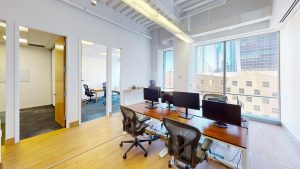
- Buy the Discount Where It’s Real: Downtown Class A asks $63.60 against $88.50 in Midtown, per Cushman & Wakefield, which is about $250,000 a year on 10,000 feet. Well-run Class A off the campus goes for $65 to $70, and solid Class B like 11 Broadway runs $55 to $60, with plenty of 3,000-to-15,000-foot floors around the Insurance District.
- Take the Free Rent While They’re Still Offering: A year of free rent and real TI money is still achievable Downtown in a way it mostly isn’t in Midtown anymore. But that window closes a little every quarter. My guide to lease clauses covers the rest of what to ask for.
- Ask If the Building Is a Conversion Candidate: Get it in writing, because if the answer is yes, your ten-year lease is a buyout negotiation waiting to happen. Some of these owners are interviewing architects while they’re showing you the space.
- Know Your Size Before You Tour: Down here the small stuff goes first, and sublease space is worth a look while it lasts. Figure out how much space you need before you start, not after you’ve fallen for a floor that’s twice it.
The Names on Friday, the Lobbies on Monday
Each year, the names are read at the memorial plaza: all 2,983 of them, including the 6 people killed in 1993. The neighborhood stops around the place where the towers stood, and for a few hours Lower Manhattan remembers exactly what was taken from it.
Then the trains fill up again. Coffee shops get their morning rush. More than 230,000 people swipe into office lobbies, while roughly 70,000 people call Downtown home.
That everyday life grew back around the memorial. I started representing tenants here in 2004, when 7 World Trade was still a steel frame, and companies needed convincing to come Downtown. Since then, offices have become apartments, new offices have filled, Wall Street has made room for tech and media, and the streets stay busy long after the workday ends.
The cranes haven’t disappeared, and neither have the empty floors. Lower Manhattan is still changing.
Maybe that’s why the memorial and the neighborhood around it belong in the same story. One preserves what Downtown lost. The other shows what came back.