

Wall Street just told you commercial real estate brokers are obsolete. I find that narrative perplexing.
Two weeks ago, AI panic wiped $12 billion from CBRE’s market cap in 48 hours. Then, last week, the sell-off came back for round two: CBRE dropped 1.4%, JLL fell 1.1%, and Newmark took a 5.2% hit. Investors watched a ChatGPT demo, glanced at commercial real estate brokers, and wrote us off.
Classic Wall Street move. They confused automating tasks with replacing deals.
Can AI pull comps and draft an LOI? Sure. But that’s never been why deals close. NYC office leasing runs on knowing a certain landlord at a certain building will flex on TI if you structure the term right. It runs on hearing the tenant down the hall is about to give back half a floor before anyone else does.
You don’t scrape that from a database. You pick it up in lobby conversations, over lunch, and through years of trust.
The market backs that up, too. Manhattan leasing volume hit 32.29 million square feet in 2025, a 37% jump year-over-year, with availability dropping to 15.5%. NYC office leasing is accelerating, competitive, and broker-driven.
So before some stock ticker convinces you we’re finished, here are five reasons AI won’t be taking our jobs anytime soon and why Wall Street’s CRE brokerage selloff is wrong and misguided.
Reason 1: The Stock Chart Is Pricing a Story, Not the Process and Service Brokers Provide

Stock prices move on vibes. NYC office leasing moves on handshakes, term sheets, and months of negotiation.
On February 27th alone, CBRE fell 3.35%, JLL dropped 3.73%, and Newmark slid 3.83%. Two weeks earlier, CBRE cratered nearly 20% in just two sessions, falling from $170.33 to $136.28. Every major brokerage peer got hit in the same window.
Wall Street heard “AI can do research and search” and leapt straight to “AI replaces brokers.”
But finding available office space was never the hard part. The hard part is aligning incentives between landlords and tenants, extracting real concessions, managing risk through a complex approval process, and getting everyone to sign.
No algorithm closes that loop.
If you’re a tenant watching these charts, don’t confuse a stock sell-off with a signal about your lease strategy. Markets can gap down 10% on a headline. Your lease locks in cash flow for the next 5 to 15 years.
Those two things have nothing to do with each other.
Reason 2: The Latest Fundamentals and Earnings Reports Were Strong
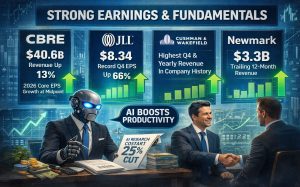
Wall Street priced these stocks as if the business were falling apart. The earnings tell a completely different story.
CBRE posted $40.6 billion in 2025 revenue, up 13%, and guided 2026 core EPS growth at 17% at the midpoint. JLL printed a record Q4 diluted EPS of $8.34, a 66% jump. Cushman & Wakefield reported its highest Q4 and full-year revenue in company history. Newmark disclosed nearly $3.3 billion in trailing twelve-month revenue across 9,300+ professionals.
It’s also not like these firms are ignoring AI. CBRE’s own management said AI should reduce internal research costs by roughly 25%. That’s operating leverage, not obsolescence. Every major brokerage is already using AI to move faster, cut overhead, and sharpen execution.
If you’re a tenant in the NYC office leasing market, a broker’s stock dip doesn’t mean the service got worse. Ask the smarter question: which parts of the process get cheaper, and do you benefit from those savings?
Reason 3: NYC Leasing Isn’t a Search Problem—It’s a Negotiation Problem

Finding available office space in Manhattan has never been the bottleneck. You could do that on CoStar ten years ago. The part that determines whether you overpay or land a great deal happens entirely after the shortlist is built.
Manhattan leasing volume hit 32.29 million square feet in 2025, availability fell to 15.5%, and net absorption turned positive at 13.6 million square feet. Landlords feel that tightening, and they price accordingly. TI allowances, free rent periods, escalation structures, early termination rights: a tenant looking at two similar floors in the same submarket can see wildly different economics depending on who owns the building and what else they’re negotiating that quarter.
The only way to know what a landlord will privately accept is to have spent years across the table from them. That’s how a broker knows when to push, when to wait, and how to keep multiple buildings competing against each other so no single landlord gets comfortable enough to stall.
Reason 4: AI Can’t Sit in Your Leadership Meeting

Every lease negotiation starts with understanding what a tenant truly needs, and that goes far beyond square footage. A broker has to learn how your leadership team makes decisions, where the internal politics sit, which department heads have competing priorities, and what the company looks like in three years versus today.
That context shapes every single term in the deal, from sublease flexibility to expansion rights to how aggressively you push on operating expense protections.
AI, on the other hand, has no way to read a room, pick up on an executive’s hesitation during a planning meeting, or understand why your CFO and your head of HR are pulling in opposite directions on the hybrid policy. Those dynamics drive the deal structure, and getting them wrong means locking into terms that don’t best serve the business.
JLL found that 92% of CRE teams planned AI pilots in 2025, but 54% still cite legacy-system compatibility as a top barrier. Even the firms pushing hardest on adoption are leaning on people for the judgment calls. In NYC office leasing, the judgment calls are the whole deal.
Here’s a firsthand anecdote. I recently worked with a client where the real obstacle had nothing to do with the space or the economics. Two department heads had fundamentally different visions for how the team would work in their new office. Until that got resolved internally, no term sheet was going to get signed. That’s not something you model.
Reason 5: AI Won’t Replace Brokers, But It Will Replace the Ones Who Can’t Use It

The threat to NYC office leasing brokers was never AI itself. It was always the broker down the street who figured out how to use it before you did.
CBRE has already framed AI as a productivity lever and expects meaningful cuts to internal research costs. JLL, Cushman, and others are building tools to speed up everything from market mapping to lease abstraction. The firms that adopt early will move faster, model deals more sharply, and show up to negotiations better prepared. The ones who don’t will lose clients to the ones who do. Simple as that.
Picture the difference.
One broker walks into a pitch with AI-generated headcount scenarios, hybrid policy stress tests, and all-in effective rent models across five buildings. Another broker walks in with a PDF and a gut feeling. Both call themselves tenant rep specialists. Only one of them is equipped for where the market is heading.
That said, knowing how to use the tools only matters if you still know how to close. AI can model every concession in a deal. It can’t read a landlord’s body language, engineer a real-time tradeoff, or protect your position without showing your hand.
Ask your broker one blunt question: “Show me how you use AI to get me more leverage, faster—without increasing risk.” If they can’t answer, that’s your signal.
The Selloff Is Little More Than Hype and a Headline
Stock traders panicked about AI and dumped brokerage shares. I get it. But those traders don’t negotiate leases, they don’t sit across from landlords, and they’ve never had to explain to a CFO why the operating expense clause they overlooked just blew up next year’s budget.
Everything I’ve broken down in this article comes back to one simple gap. Wall Street is pricing a story about the future of brokers while the people who hire brokers are living in a market that’s getting tighter, moving faster, and punishing sloppy execution harder than it did a year ago.
AI will reduce research and administrative costs for CRE firms, and that’s going to improve their earnings. That’s a good thing. But cheaper back-end operations don’t lower the stakes of a lease that locks your company in for five, ten, or fifteen years. The search gets faster. The consequences of getting it wrong stay exactly the same.
So let the stock charts bounce around. When it’s time to sign, you’re still going to want a broker across that table who knows your business, knows the landlord, and has done this enough times to know what to fight for and what to leave on the table.