Advertising Agency Office Space in New York City
Find the right property, avoid hidden costs, and negotiate favorable terms.

Find the right property, avoid hidden costs, and negotiate favorable terms.

Say your lease runs out next spring. You’ve got 12,000 feet you signed in 2019 when your ad agency was 60 people. You’re 38 now, and on a good Tuesday 25 of them come in.
So what happens? Most agencies call the landlord, cut down to 9,000 feet in the same building, sign five more years and get back to work. It’s the safe call. It’s also, this year, probably the wrong one.
Because of the Omnicom-IPG merger, of all things. When holding companies combine they dump real estate, and IPG alone walked away from 730,000 square feet last year. That’s finished space. Somebody already spent $250 a foot on the pitch room and the edit bays and the millwork, and now they need out from under it.
Trouble is, you’re not the only one who noticed the market turned. Availability in Manhattan is down to 13%, tightest since 2020. Rents are up 5.7% on the year. Free rent that ran eighteen months in 2022 is down to 12.4 (Colliers). Good space is out there, and it doesn’t sit.
We’ve been leasing ad agency space since 2004, and the part that’s different from every other kind of office: yours has to sell. A prospect sees your reception, sits in your pitch room, reads what’s on the walls, and forms a view about your shop before the deck ever opens.
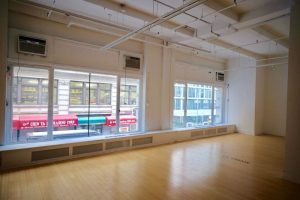
So we spend a lot of time talking people out of buildings they’ve fallen for. The loft is always beautiful. It’s the freight elevator that gets you. Four feet wide, shared with the restaurant downstairs, and every set build you do for the next ten years goes up the stairs.
What follows: what space costs in 2026, which neighborhoods earn their pricing, what a build with edit bays and a studio runs, and the handful of building questions that decide whether a floor can carry your work.
Two notes first. Our fee comes from the landlord, so we cost you nothing. And the good creative floors get taken over the phone before they’re ever listed.
Want the whole city instead of agency space? Start with our rundown of office space for rent in New York City.
Those empty desks aren’t a you problem. Every shop in town has them, and the reason is two numbers pulling opposite directions.
Ad spending crossed a trillion dollars globally this year, up 5.1% (dentsu). Headcount went the other way, down 15% in 2026 on top of 8% the year before (Forrester), with creative roles off 14.3% on their own (IPA).
More money, fewer people. Fine if you’re running the P&L. Awkward if you signed a lease back when the org chart looked different. We’ve got clients billing more today than they did in 2023 out of two-thirds the desks, and others still writing checks against rows that have sat empty since 2022. Same business, same three years. What separated them was a sizing decision made when none of this was visible yet.
Four things sitting underneath that, worth knowing before you tour.
Sources: Colliers’ Q2 2026 Manhattan Office Market Report (July 1, 2026) for availability, rents, leasing, concessions and submarket detail; Newmark 2Q26 for the Midtown South record and large-block supply; Cushman & Wakefield’s Q2 2026 MarketBeat (July 13, 2026) for TAMI share and sublease supply; CBRE Q1 2026 for Midtown South TAMI activity; Savills for the legal services share; dentsu (December 2025), Forrester and the IPA Agency Census (February 2026) for industry figures. Refresh quarterly.
Pick the neighborhood before the building. It sets your rent, who you can hire, whether clients bother making the trip, and it gets a tour list from thirty buildings down to five in an afternoon. Agencies ended up where the ceilings were high and the block had some character, so this map looks nothing like where the banks sit. If you’re earlier than that in your thinking, our roundup of the best NYC neighborhoods for small businesses covers the wider trade-offs.
| Cluster | Why Agencies Are There | Anchors | Asking Rent | Best For |
| Hudson Square & Tribeca | Where big creative lives now. Publicis, Wieden+Kennedy, RadicalMedia and Red Antler within a few blocks. Big plates, industrial bones, and more availability than any other prime creative district. | 375 Hudson, 75 Varick, 250 Hudson, 155 Sixth Ave | $75 to $105/SF | Mid-size and large shops that want plates and room to negotiate |
| Flatiron & Park Ave South (Midtown South) | Silicon Alley grew up and priced accordingly. Best transit in the city, the densest cluster of client-side marketing teams anywhere, and AI money chasing the same floors. | 11 Madison, One Madison, 200 Fifth, 250 Park Ave S | $80 to $120/SF | Shops that recruit hard and pitch tech, fintech and DTC |
| Chelsea | Galleries, the High Line, photo studios and post houses on the same blocks, so it’s the most production-ready loft stock in Manhattan. Still cheaper than Flatiron. | West 20s loft blocks, Sixth Avenue corridor | $65 to $95/SF | Production-heavy shops, content studios, brand and design |
| SoHo & NoHo | The address does the talking. Cast iron and window lines nothing else matches. Smaller plates, older systems, and vacancy that’s stayed loose. | 568-578 Broadway, 599 Broadway, the Greene and Wooster lofts | $60 to $100/SF | Boutique creative, fashion and beauty, brand-led shops under 15,000 SF |
| Midtown & Rockefeller Center | Close to the client, which still counts for media agencies living around upfronts. Xfinity Creative moved here from SoHo in early 2026. | 75 Rockefeller Plaza, 1271 Sixth Ave, 1515 Broadway, 636 11th Ave | $85 to $120/SF | Media agencies, healthcare marketing, client-service-led shops |
| Downtown & the World Trade Center | WPP put 4,000 people into 700,000 feet at 3 World Trade Center and stayed. Newest space in Manhattan at the lowest Class A pricing you’ll find. | 3 WTC, 4 WTC, 195 Broadway, 1 Liberty Plaza | $56 to $75/SF | Cost-conscious shops, big media teams, New Jersey workforces |
| Brooklyn: Dumbo, Williamsburg, Gowanus | The independent belt. Cheaper, roomier, and your people probably live there already. The trade is that some clients won’t cross the river. | Dumbo Heights, Empire Stores, 25 Kent | $45 to $75/SF | Independents, production companies, Brooklyn-resident teams |
Two things the tour won’t tell you.
SoHo sells itself in about four minutes. The cast iron, the light, the address on your letterhead. Then you’re five years in and the freight was converted from something else, the HVAC dates to a renovation with no paperwork left, and you’re paying a 30% loss factor on a floor with a column every twelve feet. None of which stops us putting clients there. Just go in knowing the floor that photographs best and the floor that survives a February shoot aren’t always the same floor.
And two neighborhoods get written off too early. The Financial District gets you Class A systems at Class B money, and the PATH puts your New Jersey people at their desks without a Midtown transfer. If you do healthcare or pharma work, your list starts looking more like a regulated tenant than a creative one once privacy and storage come up. Our page on medical and healthcare office space covers that side.
Work out which of these you’re shopping for before you look at a price, because a flex desk and a studio floor have nothing in common. The harder question is which shop you’re running, the one on the org chart or the one in the credentials deck. Signing ten years and a full loft build off one new account is how agencies end up subletting their own floor eighteen months later. We’ve worked enough of those to see it coming on a first call.
| Space Type | What It Is | Typical Commitment | Best For |
| Flex desks or private flex suite | Furnished desks or a private room inside an operator’s floor. Nothing to build or furnish. | Month to month up to 2 years | Project teams, new-market tests, shops under 10 people |
| Prebuilt / plug-and-play suite | A finished small floor built on spec, with offices, conference room, pantry and cabling already in. | 3 to 7 years | 5 to 25 people who need a real address and no construction |
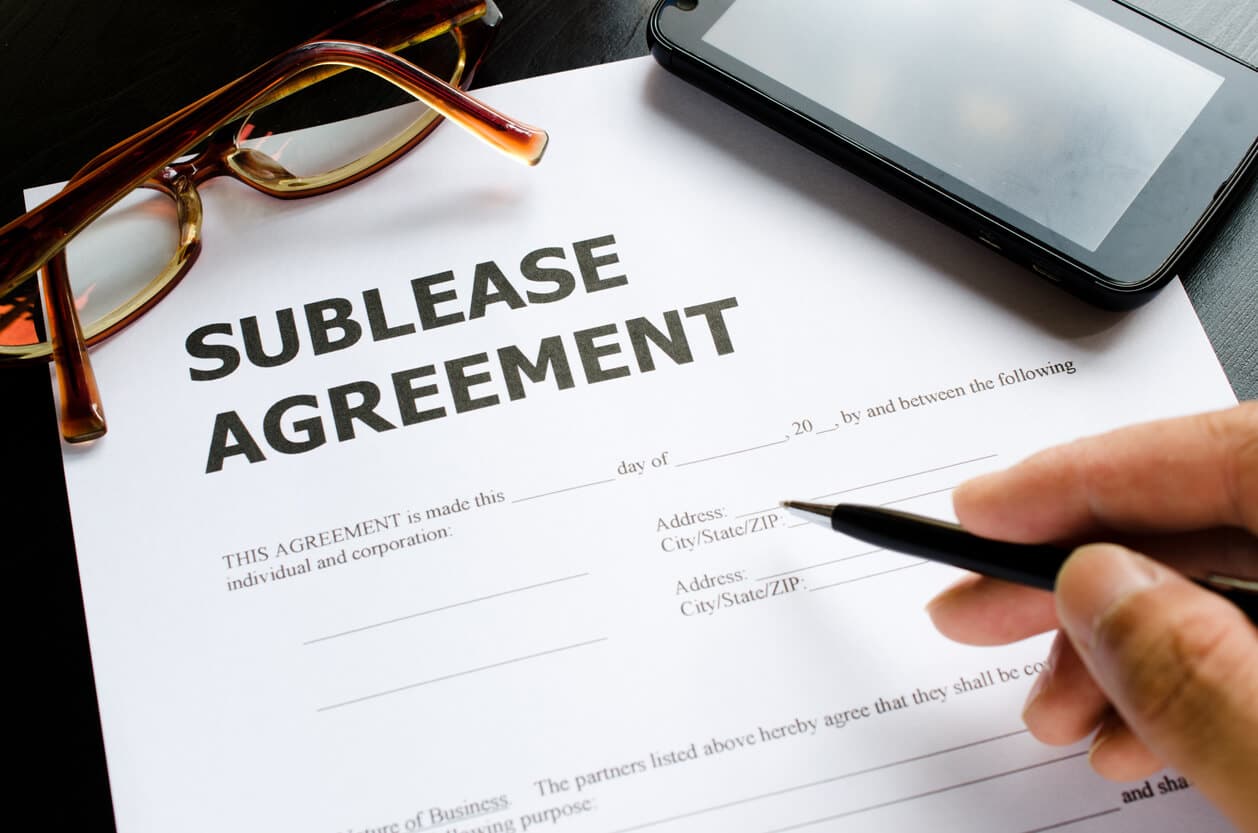
| Agency sublease | A built creative floor from a shop that merged, shrank or pivoted. Usually furnished and wired. | 1 to 5 years, whatever’s left | Anyone who wants finished creative space fast and under market |
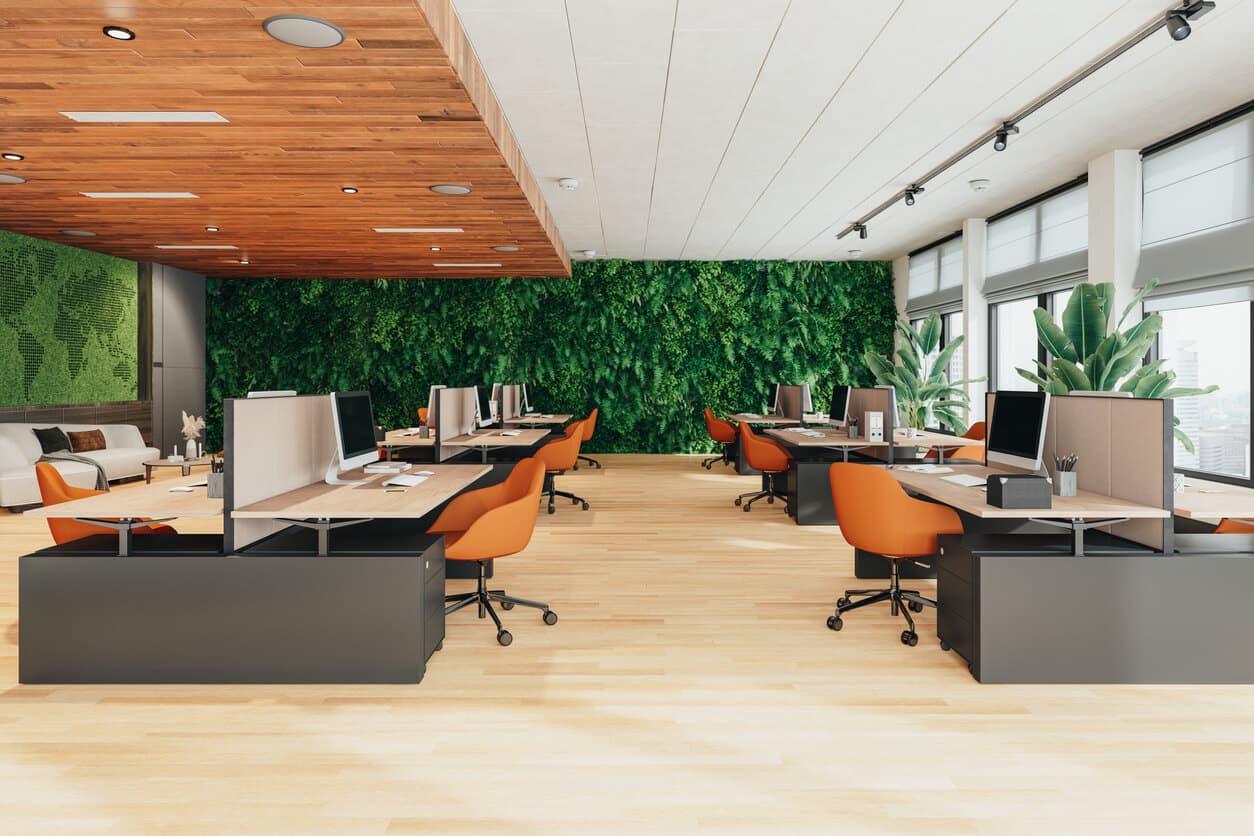
| Loft floor, Class B or C | The New York classic. Open floor, high ceilings, big windows, and a build that’s yours to pay for. | 5 to 10 years | Shops that want their own room and will spend to get it |
| Full-floor Class A | Tower space with modern systems, fast elevators and a lobby you needn’t apologize for. | 7 to 15 years | Media agencies, holdco units, healthcare marketing |
| Studio-capable space | Low or ground floor with the height, power, freight and loading for a cyc wall, grid and edit suites. | 5 to 10 years | Content studios, production companies, in-house brand teams |
| Hybrid HQ plus studio | An office floor with a production block attached, so the shoot and the edit happen in one building. | 7 to 12 years | Agencies that pulled production in-house |
Built creative loft in Midtown South, $75 to $105 a foot. Raw, $60 to $95. Prebuilt suite, $70 to $110. Manhattan averaged $78.03 last quarter and Downtown’s the cheap seat at $56.66 (Colliers and Cushman & Wakefield, Q2 2026).
| Space Type | Typical NYC Cost (2026) | How It’s Priced | What You Get |
| Flex desk or private suite | $650 to $1,300 per desk, per month | Membership | Furnished desk or room, internet, meeting-room credits, cleaning |
| Prebuilt / plug-and-play suite | $70 to $110/SF/year | Usually gross | Offices, conference room, pantry, cabling, ready to occupy |
| Agency sublease | 10% to 25% under direct asking | Gross, mirrors the prime lease | A built creative floor, often furnished and wired |
| Loft floor, Class B or C | $60 to $95/SF/year | Usually gross | Raw or lightly built open floor with height and light. Your build |
| Full-floor Class A | $85 to $130/SF/year | Usually gross | Modern systems, elevator service, lobby, amenities |
| Studio-capable space | $55 to $95/SF/year, plus the build | Gross or modified gross | Height, power, freight, loading. The studio is yours to build |
| Trophy tower floor | $120 to $200+/SF/year | Usually gross | The address, the views, the amenity floor, the recruiting story |
Two things will cost you more than the rent does, and neither one’s on the flyer.
First is loss factor. Loft buildings quote you rentable feet, which can run 25% to 35% over what you can put a desk in. Two floors both advertised at 10,000 feet can differ by 2,500 usable. At $85 a foot that’s over $200,000 a year for nothing. Ask for the usable number and a test fit everywhere you go, compare on that, and if somebody won’t hand it over, take the hint.
Second, the concessions are going. Free rent averaged 12.4 months in the first half, worst since 2019, and allowances have flattened around $140 a foot while construction keeps getting more expensive (Colliers). Ask for everything anyway. Just know a floor that’s been dark three years and a floor with two tenants circling are different conversations, and the same ask in both tells the landlord you haven’t done your homework.
You’ll build more than most office tenants, because the space is half sales tool and half factory. Open plan is ordinary construction. Add edit suites, an audio booth and a studio and you’re somewhere else entirely.
| What You’re Building | Typical NYC Cost (2026) | What Drives It |
| Refresh of a built floor | $40 to $90/SF | Paint, flooring, lighting, light demo. Cosmetic only |
| Standard open-plan creative office | $150 to $250/SF | Demo, floors, lighting, pantry, a few conference rooms, cabling |
| High-spec creative with millwork | $250 to $375/SF | Feature stair, custom joinery, specialty glass, brand build, exposed ceilings |
| Edit, audio and color suites | Add $200 to $400/SF on that portion | Acoustic isolation, dedicated cooling, clean power, structured cabling |
| Photo or video studio | Add $150 to $300/SF on that portion | Cyc wall, lighting grid, blackout, three-phase power, freight access |
| AV, conferencing and IT | 8% to 12% of total project | Pitch rooms, displays, network. Fastest-rising line in the budget |
So the allowance matters more than the rent. Take a 12,000-foot loft at $200 a foot. The gap between a $70 allowance and a $110 allowance is $480,000 out of your business, and nothing you win on the rent line gets it back. Our guides to who pays for the build-out and how build-out agreements get structured are worth an hour before you sit down, because the difference between a decent allowance and a good one usually comes down to who scopes the work and who eats the overruns.
Run the numbers on a prebuilt before you write it off, too. A finished suite at $95 often beats a raw loft at $75 once you count six months of rent on a construction site plus $200 a foot of your own cash. The loft wins the argument anyway, because it looks better. That’s fine. Just say so out loud while the decision’s still open.
Two buildings quote the same rent and only one can do your work. Bring your architect. And when a landlord tells you a floor can handle a studio, ask to see the drawing.
| What to Check | Why It Matters | What to Ask For |
| Ceiling height and column grid | Open plan dies in a forest of columns, and every creative floor you’ve admired was shot at twelve feet or better. | Slab-to-slab height and a column grid drawing, before anyone commits to a plan |
| Power capacity | Edit bays, render nodes and a lighting grid pull multiples of what an accounting floor pulls. | Amperage at the panel in writing, plus a real price to upgrade. Our guide to office electricity costs covers the billing |
| Supplemental cooling | Server rooms and edit suites throw off heat the base system was never sized for, and they run after hours when HVAC is off. | Condenser water or roof rights for supplemental units, plus after-hours HVAC rates in writing |
| Freight and loading | Set builds, seamless paper, backdrops and client samples don’t go up in a passenger elevator. | Freight dimensions, capacity, hours, and whether there’s a dock or just a curb. Measure it yourself |
| Acoustics and neighbors | Sound leaks both ways, and a recording booth under a gym is a bad week every week. | Slab construction, who’s above and below you, and whether isolation work is allowed |
| Front of house | Reception, the pitch room and the first sixty seconds are the part of the floor that makes money. | Contiguous space near the elevator for a real client path, plus whatever lobby signage you can get |
| Loss factor | Loft buildings quote rentable feet 25% to 35% over usable, so two “10,000 SF” floors can differ by 2,500. | Usable square footage and a test fit, and compare on usable, never rentable |
| Bandwidth and carriers | One provider in the building is a single point of failure on launch day. | Which carriers are in the building, whether you can bring your own, where the risers run |
| Building class | The A/B/C system falls apart in loft markets, where a 1910 Class B in SoHo out-rents a Class A tower. | Read the building, not the letter. Our explainer on what makes a building Class A, B or C covers where grades mislead |
| Insurance and certificates | Shoots, events, vendors and client visits mean you’ll be pulling certificates constantly. | The landlord’s requirements in writing, and a price on your commercial liability coverage while you negotiate |
| Expansion and contraction rights | Client contracts run one to three years against a lease that runs seven to ten. That mismatch is the defining risk here. | A right of first offer on adjacent space, plus a contraction or sublease right you could use |
| Amenities | A roof deck sells the tour. Enough phone rooms and a working freight elevator sell the next four years. | Call booths and conference rooms counted against peak-day attendance, not total headcount |
Most agencies never frame this as a choice. They renew or they move, and the other two options never come up in the meeting. Side by side it sorts itself out fast.
| Factor | Direct Lease | Sublease | Coworking / Flex |
| Commitment | 5 to 10+ years | 1 to 5 years, whatever’s left | A month to 2 years |
| Speed to occupancy | 3 to 9 months with a build | Days to weeks if it’s built | Days |
| Cost | Full asking, offset by TI and free rent | 10% to 25% under direct asking | Highest per head, all in |
| Build-out | Yours to fund and manage, with a landlord contribution | Somebody else already did it | None |
| Branding and control | Your name, your floor plan, your rules | Someone else’s build, limited changes | Limited signage, shared identity |
| Risk you carry | Yours alone, for the whole term | The sublandlord’s credit and lease terms come with it | Almost none, past a notice period |
| Best fit | Stable shops over 20 people with a defined book | Anyone who wants finished creative space fast and cheap | Project teams, satellite offices, shops under 10 |
That middle column is the whole reason this page exists right now. Those holdco floors are coming back on somebody else’s clock. Less space than you’re carrying, better than what you’ve got, priced under market because their timeline is running and yours isn’t. Sublease supply across Manhattan is down to 12.1 million feet, lowest since Q2 2020, so this isn’t a window that stays open.
The catch is you’re taking over a deal you didn’t write. Read the sublease and assignment clauses closely, find out what happens if the sublandlord goes under, and ask whether there’s a path to a direct lease when the prime term ends. Our sublet space page walks the process.
Other end of the range, small shops sit in coworking longer than they should. It stops working sooner for an agency than the general advice suggests, because you can’t pitch new business out of a shared lounge or build a brand into a room you don’t control. Our guide to transitioning from coworking to your own office covers the move.
Agency deals go wrong in more places than a normal office deal, because the build’s bigger and your client book is less predictable than your lease. This is the order we work in.
Who you sign with changes your build schedule and how much of it lands on you. A landlord who’s delivered twenty agency floors opens you months earlier than one learning on your job, and those months are rent on space you can’t use yet.
| Owner | What They Run | Notable Buildings | Best For |
| Hudson Square Properties (Hines, Trinity Church Wall Street, Norges Bank) | The twelve-building Hudson Square portfolio, the deepest run of large creative plates in Manhattan, plus the SQ Collection flex product. | 75 Varick, 155 Sixth Ave, 205 Hudson, 435 Hudson, 345 Hudson | Mid-size and large shops that want plates and a landlord who knows the tenant type |
| Jack Resnick & Sons | Family-held New York portfolio with a strong Hudson Square position. 250 Hudson hit roughly 99% occupancy in 2026 on creative and production tenants. | 250 Hudson, 110 E 59th St | Full-floor tenants between 20,000 and 30,000 SF |
| RXR | Large owner-operator with a heavily amenitized Midtown and Rockefeller Center presence. Signed Xfinity Creative at 75 Rockefeller Plaza in early 2026. | 75 Rockefeller Plaza, 1285 Sixth Ave, 5 Times Square | Client-facing shops that want a Midtown address with modern systems |
| Silverstein Properties | The World Trade Center campus, including the tower where WPP anchors 700,000 SF across thirteen floors. | 3 WTC, 4 WTC, 7 WTC | Big agencies and media teams wanting new construction at Downtown pricing |
| SL Green Realty | Manhattan’s largest office landlord, with interests in 56 buildings totaling 31.4M SF as of year-end 2025. | One Vanderbilt, 245 Park Ave, 919 Third Ave | Agencies taking Class A or trophy space in Midtown |
For the trophy end, where a few agencies and a lot of their clients sit, our piece on how trophy buildings set themselves apart and our list of the top Class A buildings in Midtown go deeper.
Most of our agency clients sign between $60 and $105 a foot. A built loft in Midtown South runs $75 to $105, a raw one $60 to $95, and Downtown’s the cheapest real option at around $56.66 (Cushman & Wakefield, Q2 2026). Manhattan averaged $78.03 last quarter, up 5.7% on the year (Colliers). And a rent quote without a loss factor attached doesn’t tell you much.
Depends who you’re selling to, and anyone who answers without asking that is guessing. Hudson Square and Tribeca have the biggest creative plates and the most availability. Flatiron and Park Avenue South have the deepest talent pool at the highest prices. Chelsea has the most production-ready stock, and SoHo buys the address in a smaller footprint. If your clients are media networks, or your staff commutes from New Jersey, Midtown and Downtown beat any loft.
Less than the old rule says, and the number keeps dropping. Size to your busiest day instead of total headcount, because hybrid means you’re never full and headcount is falling while revenue grows. Most shops we work with plan 125 to 175 feet per person on a peak day, then add studio, edit and storage separately.
A standard open-plan floor runs $150 to $250 a foot, and high-spec work with custom millwork pushes $250 to $375. JLL’s 2026 guide puts a medium-quality fit-out at $295 a foot across the U.S. and Canada in a range of $230 to $375, with New York at the top. Edit suites, audio booths and studio space carry their own premiums, and none of it includes furniture, production gear or design fees.
Best they’ve been in years, for one reason. The Omnicom-Interpublic integration is putting built creative space back on the market on the seller’s timetable, and IPG alone exited about 730,000 feet during 2025. Subleases usually price 10% to 25% under direct asking and often come furnished. The catch is that Manhattan sublease supply is down to 12.1 million feet, lowest since Q2 2020, so the good ones don’t sit.
Power, cooling, freight and acoustics, in that order. Edit bays and render hardware pull far more electricity and throw off more heat than a standard floor, and building HVAC is usually off when your editors are still working. Set materials won’t fit in a passenger elevator, sound isolation is brutal to retrofit, and ceiling height and the column grid will matter more to you than the building’s letter grade ever does.
Five to ten years on a direct deal, longer if the landlord funds a big build. The structural problem is that client contracts run one to three years against a lease that runs seven, and optimism about the pipeline doesn’t fix it. Buy protection with rights instead of a short term: a contraction option, a clean sublease and assignment right, a right of first offer next door. A one-to-five-year sublease is the other way to bridge an uncertain stretch.
In some buildings, and the limits are physical rather than legal. You need ceiling height, three-phase power, a freight elevator and loading path that fits set materials, and a landlord who’ll permit a lighting grid and blackout. Chelsea, Hudson Square and parts of Brooklyn have the most workable stock. Budget another $150 to $300 a foot across the studio portion.
For a few people or a project team, sure. For a shop pitching new business it runs out of room fast, because you can’t present a brand in a space you don’t control and shared floors are a bad setting for client-confidential work. Most agencies outgrow flex around ten people or a two-year horizon, whichever comes first, and the next step is usually a prebuilt or a sublease.
Costs you nothing, because the landlord pays the commission the same as on any office deal. It matters more here than in most product types, since the better creative floors get taken before they’re marketed, and the gap between a building that can carry your power, freight and acoustic loads and one that claims it can is worth real money. Metro Manhattan has represented New York tenants since 2004.










Accessibility Tools