





I Pulled 10 Random Manhattan Office Leases. Here’s What I Found
Most tenants walk into a Manhattan lease negotiation with the same shrug.



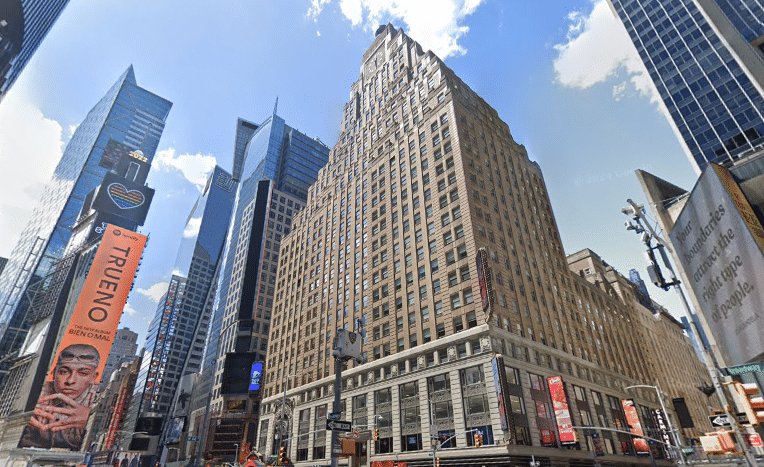
Everybody knows Times Square. Almost nobody thinks of it as an office market, which is exactly the mistake worth exploiting. Under the billboards and the 300,000-plus people who cross it on a normal day sits roughly 30 million square feet of office space across more than 40 buildings, and right now it is going through the biggest change of its life.
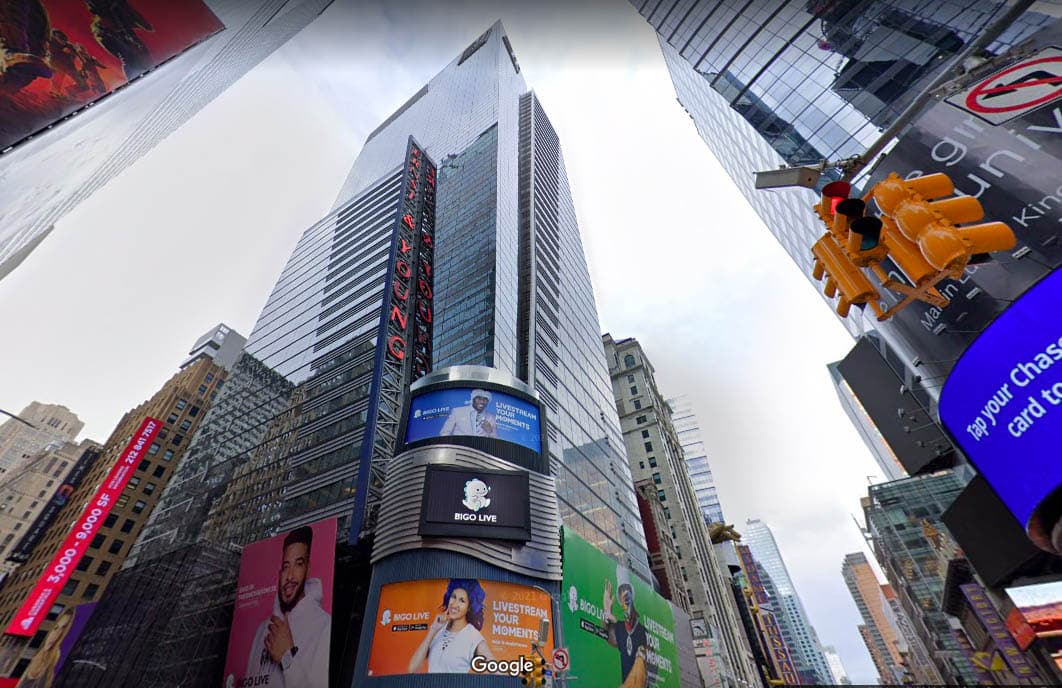
Two of its largest Class A towers are walking off the field. 5 Times Square, where Ernst & Young sat for two decades, is being gutted into about 1,250 apartments. And 1515 Broadway, after SL Green’s $5.4 billion casino pitch got shot down, is now slated to become a 992-room hotel wrapped in an entertainment complex. Pull two blocks that size out of the office supply and the math flips: what is left gets scarcer, not cheaper.
That is why the number that matters here is not the rent, it is the availability. Class A space in Times Square asks about $75 a foot direct (Metro Manhattan, August 2025), a genuine discount to Grand Central at $93 and Columbus Circle at $86. But availability sits at 14% (Transwestern, Q4 2025), tighter than you would ever guess from a neighborhood people still write off. The bargain is real, the window is not permanent, and the building you pick matters more here than almost anywhere in Midtown. If you would rather see the open listings before you read another word, start there.
Times Square has always run on a different clock than the rest of Midtown, and in 2026 that is truer than ever. While Park Avenue and Hudson Yards fight over trophy tenants at $150 a foot, Times Square is quietly rebuilding itself, tower by tower, into something that is part office district, part hotel corridor, part neighborhood. The office space that survives that transition is getting a serious upgrade, and for the moment it is still a bargain.
The wider market gives you a tailwind. Manhattan just posted its strongest first quarter of leasing since 2014, with availability tightening for the eighth straight quarter to 13.7% (Colliers, Q1 2026), and Midtown Class A now asks about $85 a foot (Cushman & Wakefield, April 2026). Rents are firming across the city. Times Square is the rare place where you can still catch the recovery before it prices you out, as long as you move on the right building. Start with a clear read on office space sizes and budgets, then narrow by block.
The rent is the hook, so start there. Class A space in Times Square asks about $75 a foot direct (Metro Manhattan, August 2025), a real discount to Grand Central five minutes east at $93 and Columbus Circle up the road at $86. For a globally famous address on the best transit in the country, that is a bargain, not a compromise.
The catch hiding in that average is spread, because one number is covering very different space. The signage towers and the rebuilt Class A buildings, 1633 Broadway and 3 Times Square and 1540 Broadway, push into the mid-$80s on the good floors, which is why the aggregate figure that includes them climbs to about $90 (Metro Manhattan, August 2025). Down on the Theater District side streets and the older Seventh Avenue stock, Class B and value space runs from the high $40s into the $60s. Figure out how much space you actually need before a billboard view you cannot afford does it for you, and the Office Space Calculator gets you there in about a minute.
| Area | Class A Profile | Class B / C Coverage | Availability | Typical SF for New Leases | Tier |
|---|---|---|---|---|---|
| Times Square Bowtie | Signage-wrapped Class A (3 Times Square, 4 Times Square, 1500 Broadway), $70s to high $80s | Limited | ~12 to 16% | 2,500 to 50,000+ SF | A / Mixed |
| Broadway North (47th to 53rd) | Full-block Class A (1585, 1633, 1675), $70s to $86 | Some Class B | ~10 to 15% | 5,000 to 100,000+ SF | Class A / B |
| Eighth Avenue and the far west | Large Class A (Worldwide Plaza, 11 Times Square) | Class B toward the Hudson | ~14 to 20% | 5,000 to 80,000 SF | A / Value |
| Theater District side streets | Limited Class A | Class B and loft dominate | ~13 to 18% | 1,000 to 15,000 SF | Value / B |
| Seventh Ave South / Diamond District | Little to no Class A | Class B, C, and showroom | ~14 to 18% | 500 to 10,000 SF | Value |
| Submarket average (context) | $74.86 direct / $89.90 aggregate | n/a | 14.0% | Varies | Mixed |
Times Square Class A direct ($74.86/SF) and aggregate ($89.90/SF) are from Metro Manhattan, Class A Office Rents in New York City by Neighborhood (as of August 1, 2025). Submarket availability (14.0%) is Transwestern, Q4 2025. Area-level profiles, coverage descriptors, and availability ranges are Metro Manhattan internal research (June 2026); the brokerages publish Midtown submarket figures but do not break out these per-area Times Square numbers. Rents are asking rents, before concessions.
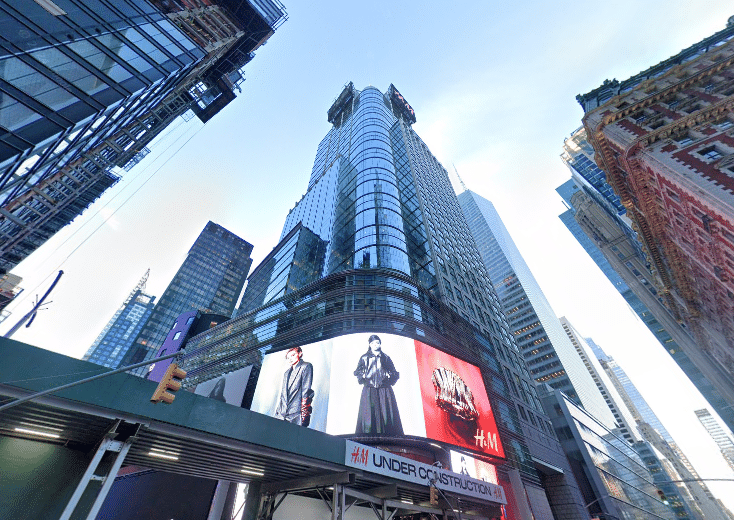
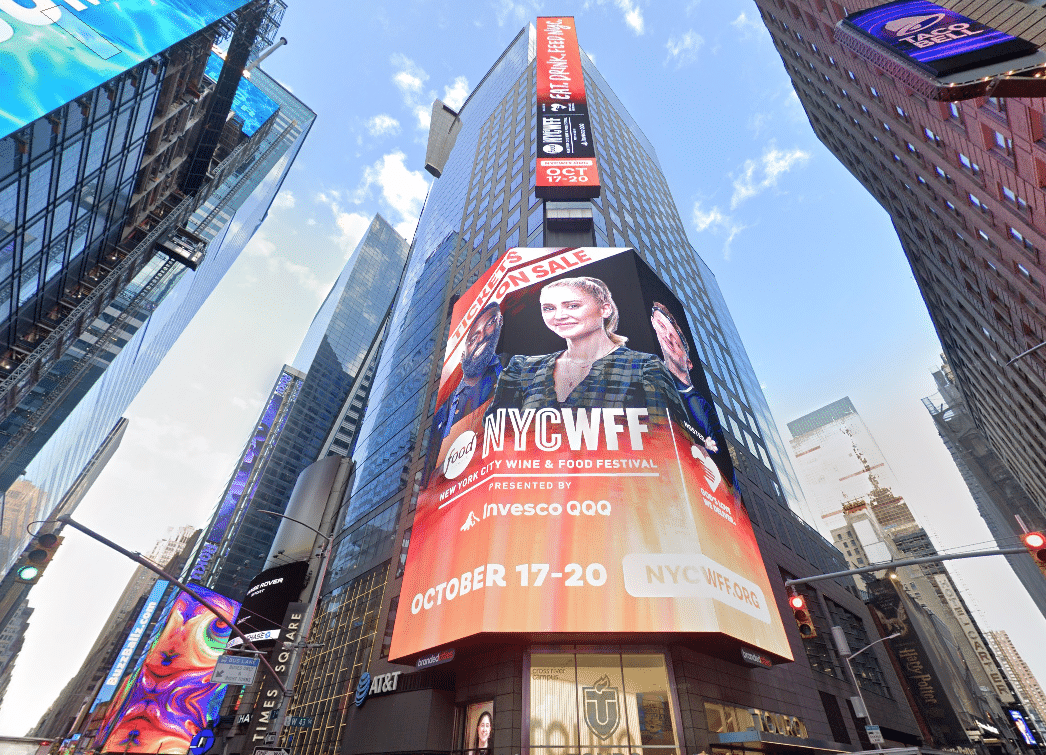
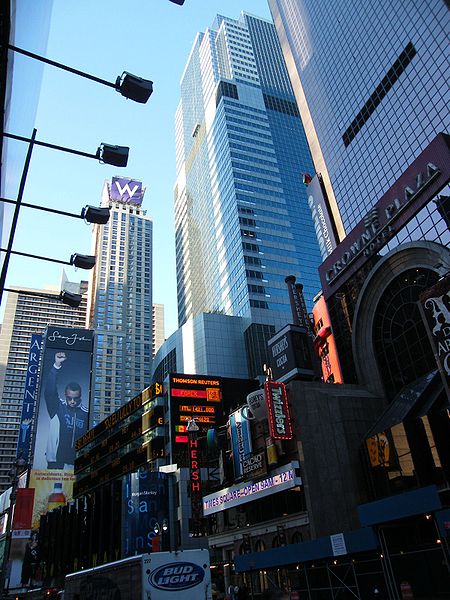
Class A in Times Square splits into two groups: the buildings that got rebuilt and the buildings that are getting torn up on the inside. On the rebuilt side, 3 Times Square is the model. Rudin poured a nine-figure renovation into the 30-story former Reuters tower, gave it a glass triple-height lobby and a 16th-floor amenity center, and then did the unthinkable for Times Square by leasing 310,000 square feet to Touro University. It now fills with law firms and accountants alongside the students. A few blocks over, 1540 Broadway is mid-transformation under GFP Real Estate and BDT & MSD, a $150 million job with roughly half the building available and tenants like Adobe and Pandora already in place.
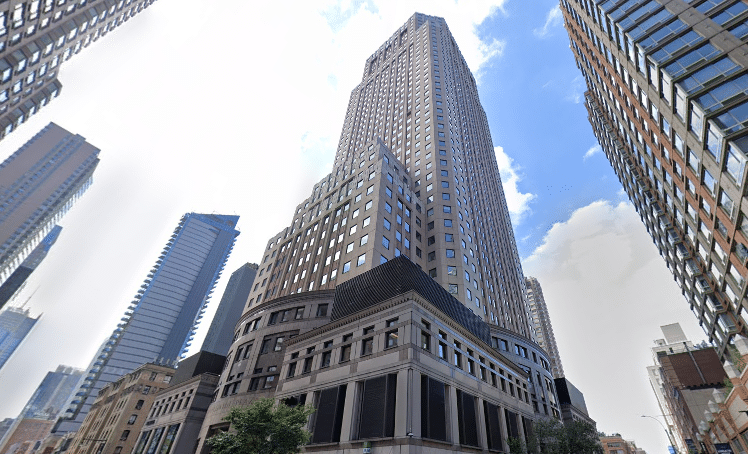
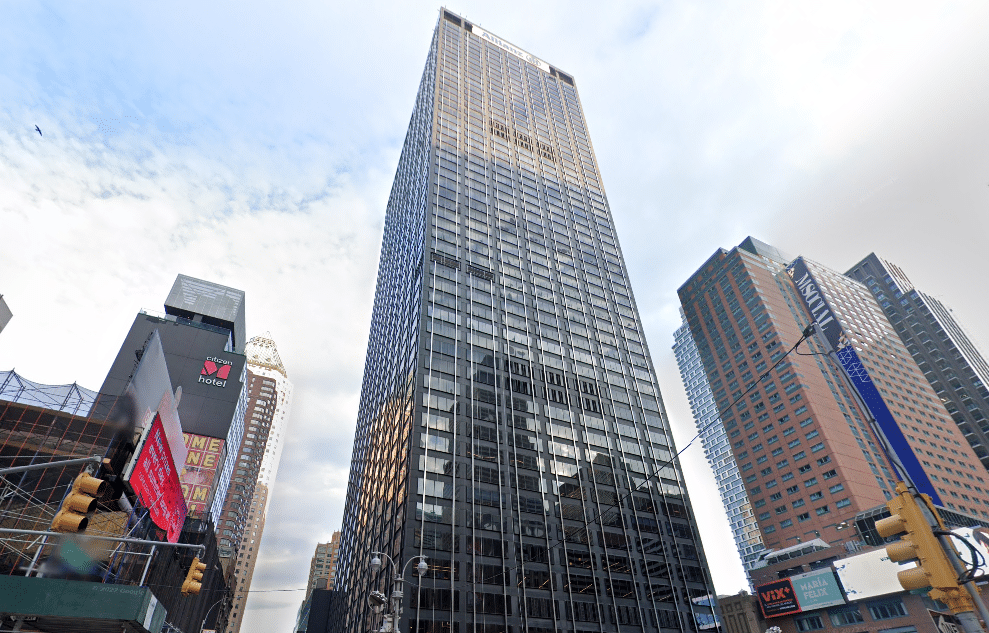
The blue-chip full-block towers are the other face of Class A. 1633 Broadway, now owned by Rithm Capital, is essentially full at blue-chip rents, home to Allianz, Morgan Stanley, and Warner Music Group. 1585 Broadway is Morgan Stanley’s global headquarters. These are corporate, quiet, and expensive, and they rarely have much to give.
What you will not find much of here is brand-new trophy construction, because there is nowhere left to build it. That is a Hudson Yards or Park Avenue conversation, the kind of market where a tenant just paid a record north of $300 a foot at One Vanderbilt. In Times Square, Class A means a well-run tower with a spectacular address, not a glass box that opened last year. If the true trophy tier is what you are after, the guide to how trophy buildings set themselves apart and the rundown of the top Class A buildings in Midtown will point you the right way.
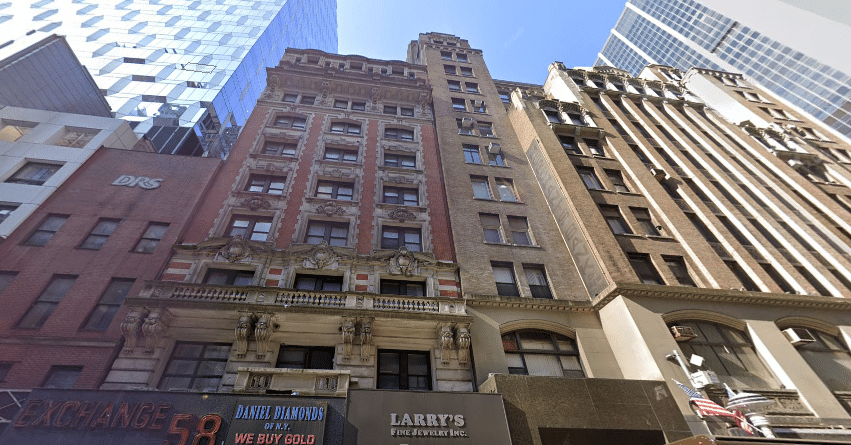
Most deals in Times Square close in Class B, and that is where the neighborhood gets interesting for normal-size tenants. The Theater District side streets through the West 40s and 50s are lined with prewar and boutique buildings full of showrooms, entertainment-industry offices, and nonprofits. 1560 Broadway, the Actors’ Equity Building, is the archetype. These floors are smaller, cheaper, and full of character, and a lot of them come prebuilt. This is the same loft stock that pulls tenants toward Chelsea and SoHo, often for less.
What you pay in Class B depends almost entirely on the building and the block (Metro Manhattan internal research, June 2026). Two buildings on the same side street can quote you very different numbers on the same afternoon, so walk the floors and treat the average with suspicion. This is solid ground for media shops, creative firms, nonprofits, and any small business that wants a Times Square address without a Times Square invoice. Not sure what the letter grade actually buys you? The guide to what makes a building Class A, B, or C is worth five minutes.
The genuine bargains sit on Seventh Avenue south of 42nd, in the Diamond District buildings on 47th, and in the older far-west stock toward the Hudson. This is the tier for showrooms, jewelers, early-stage startups, back-office teams, and anyone optimizing for cost per seat. You give up the marble lobby and gain a rent that leaves money for payroll.
Two things to know before you sign down here. First, your best deal probably will not be a sublease, because the submarket had no recorded Class A sublease inventory as of August 2025 (Metro Manhattan); the big blocks that would have hit the sublet market are being converted to housing instead. Your value play is a direct lease in an older building with a landlord who has space to fill. Second, nobody publishes a clean Class C number for these blocks, so a single flat figure quoted at you deserves a hard look (that read is Metro Manhattan internal research, June 2026). If cost is the whole point, it is worth comparing against Downtown and the Financial District, which run well below Times Square.
The most expensive mistake tenants make here is fighting the wrong battle. They spend three weeks grinding a landlord down two dollars a foot on the asking rent, feel good about the win, and then wave through the two terms that actually move the numbers: free rent and the build-out allowance. That is where the real money lives, and in Times Square, with availability at 14% and several landlords racing to fill repositioned towers, you have real room to push on both.
The ranges below reflect recent deals on a 5 or 10-year term (Metro Manhattan internal research, June 2026). Shorter terms get less, longer terms get more.
| Building class | Free rent (typical) | TI allowance (typical) | Notes |
|---|---|---|---|
| Repositioned / signage Class A (3 Times Square, 1540 Broadway, 4 Times Square) | 10 to 14 months free | $90 to $130/SF | The rebuilt buildings are hungry to lease up, so this is where the give is. |
| Blue-chip full-block Class A (1633 Broadway, 1585 area) | 8 to 12 months free | $80 to $110/SF | These towers are close to full, so concessions are tighter. |
| Class B and loft (side streets, Seventh Avenue) | 12 to 18 months free | $50 to $85/SF | Prebuilt suites common. A 10-year commitment is your leverage. |
| Class C and value (Diamond District, older far-west and Seventh Avenue stock) | 12 to 16 months free | $35 to $65/SF | Often as turnkey suites you can occupy within a month. |
Two points before you sign. Once you stack the free rent and the build-out money, your effective rent, the figure that actually matters, drops well below the number on the door (the concessions breakdown runs that math). And a build-out allowance is only as good as what it actually builds, so understand who pays for the build-out before you sit down to negotiate. If the length of the term is your sticking point, the rundown on 3-year, 5-year, or 10-year lease terms lays out the tradeoffs.
Times Square is the natural home of the businesses that need to be seen: media, entertainment, broadcast, advertising, and the consumer brands that want their name in lights. But the modern roster is broader than that. Education, law, finance, and technology have all planted flags here, mostly chasing the transit and the discount to the trophy districts. In practice, the building tells you the tenant, so finding your row below narrows the search fast.
| Industry | Best-Fit Areas | Class Fit | Example Buildings |
|---|---|---|---|
| Media / Entertainment / Broadcast | Times Square Bowtie, Broadway North | Class A / B | 1633 Broadway (Warner Music, Showtime), 1500 Broadway (ABC's GMA), 4 Times Square |
| Advertising / PR / Marketing | Bowtie, Theater District side streets | Class A / B | Signage towers, prewar side-street stock |
| Technology / SaaS | 1540 Broadway, Eighth Avenue | Class A / B | 1540 Broadway (Adobe, Schrodinger), Eighth Ave towers |
| Financial Services | Broadway North | Class A | 1585 Broadway (Morgan Stanley), 1633 Broadway (Allianz, New Mountain Capital) |
| Law Firms | Broadway North, Bowtie | Class A / B | 1633 Broadway (Kasowitz), 3 Times Square (Kilpatrick), 787 Seventh (Sidley, Willkie) |
| Education / Institutional | Times Square Bowtie | Class A | 3 Times Square (Touro University) |
| Consumer Brands / Flagship HQ | Bowtie, 1540 Broadway | Class A | 1540 Broadway (Pandora), signage towers |
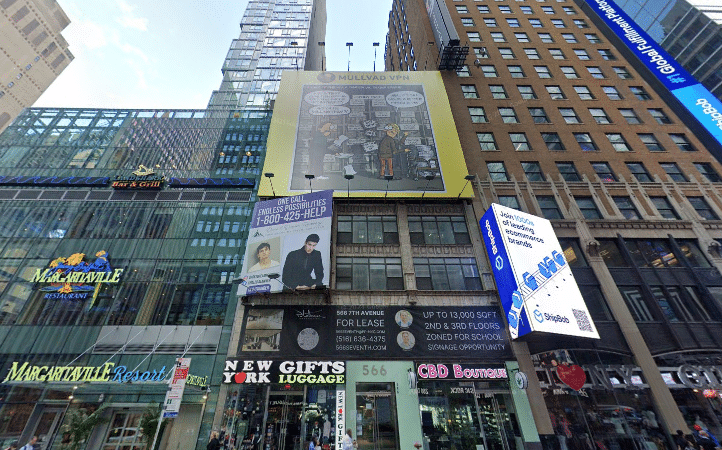
| Fashion / Showrooms | Seventh Avenue South, Diamond District | Value / B | 566 Seventh Avenue, Seventh Ave showroom stock |
| Nonprofits / Entertainment Orgs | Theater District side streets | Class B / Value | 1560 Broadway (Actors' Equity), side-street stock |
| Startups / Small Business (under 20) | Side streets, Seventh Ave, Diamond District | Class B / C | Value side streets, Diamond District buildings |
Industry and class fits are Metro Manhattan internal research (June 2026). Vertical landing pages: Financial Services, Law Firm Offices, Startup & Tech Space, Medical Offices, Retail/Stores, Coworking Space.
Running a small team or a nonprofit? Times Square is more attainable than its reputation suggests, because the value lives on the side streets and the Seventh Avenue frontage rather than in the billboard towers. To see how it stacks up against other neighborhoods, the guide to the best NYC areas for small businesses runs the comparison, and if you are trading a coworking membership for space of your own, we mapped how to make that leap without regretting it.
Two things Times Square offers that no other Midtown submarket can match: your name in lights on the most-photographed block on earth, and the deepest bench of restaurants, theaters, and hotels within a two-minute walk. The new money went into rebuilt lobbies, amenity floors, and the LED frontage that turns an address into advertising. It breaks down into three tiers.
Repositioned and signage Class A (3 Times Square, 1540 Broadway, 4 Times Square). Rebuilt lobbies, new amenity floors with fitness and food and lounges, modern systems, and the Times Square signage that markets your brand for free. These buildings spent the money, and they are leasing.
Full-block Class A (1633 Broadway, 1585 Broadway, 1675 Broadway). Blue-chip towers with big efficient floors, attended lobbies, ground-floor retail, and, at 1633, two working Broadway theaters downstairs. Corporate, quiet, and mostly full.
Class B, loft, and value (Theater District side streets, Seventh Avenue, the Diamond District). Prewar bones, good light, showroom and boutique floors, and rents that leave room in the budget. This is where small and mid-size tenants actually sign.
Browse every Midtown building or filter active listings by size and price.
Ownership in Times Square right now is a story of two strategies. One camp is repositioning: Rudin rebuilt 3 Times Square, GFP and BDT & MSD are rebuilding 1540 Broadway, Durst re-leased and refinanced 4 Times Square. The other camp is reinventing the asset entirely: SL Green wants to turn 1515 Broadway into a hotel, and its partnership with RXR and Apollo is converting 5 Times Square into apartments. Then there are the buildings caught in the middle, like Worldwide Plaza, working through a lender auction. Knowing which landlord is leasing, which is converting, and which is just trying to survive is the difference between a smart deal and a wasted month, and it is exactly what a tenant broker tracks. The rundown on the biggest commercial real estate landlords in NYC fills in the wider field.
| Landlord | Notable Times Square / West Side Properties | Approx. Portfolio | Typical Lease Profile |
|---|---|---|---|
| SL Green Realty | 1515 Broadway (One Astor Plaza); stakes in 5 Times Square and Worldwide Plaza | ~30M+ SF across Manhattan (city's largest office landlord) | Class A / trophy; Times Square strategy now leans conversion and entertainment |
| Rudin | 3 Times Square (Thomson Reuters Building), 1675 Broadway | ~10M SF private NYC portfolio | Class A / B, 5,000+ SF, long term |
| Paramount Group (Rithm Capital) | 1633 Broadway (Paramount Plaza) | 2.5M SF here; larger nationally | Class A, 10,000+ SF, blue-chip |
| Durst Organization | 4 Times Square (151 West 42nd / One Five One) | Large private Midtown portfolio | Class A, 10,000+ SF |
| RXR | 5 Times Square (residential conversion, with Apollo and SL Green); Worldwide Plaza stake | Large Manhattan portfolio | Class A; repositioning legacy towers |
| GFP Real Estate + BDT & MSD Partners | 1540 Broadway | 17.5M+ SF (GFP) across the region | Class A, 5,000+ SF, spec suites |
Vornado Realty Trust owns much of the retail and signage at the base of the Times Square towers (including 1535 and 1540 Broadway), and Boston Properties owns Times Square Tower at 7 Times Square. Portfolio figures are approximate; several landlords listed hold much larger books across Manhattan, Midtown South, and Downtown. Ownership changes and several of these buildings are mid-transaction, so confirm current ownership before an offer. Rithm Capital's acquisition of Paramount Group and the Worldwide Plaza foreclosure status source to Bisnow, Commercial Observer, and CoStar (2025 to 2026); all other entries are Metro Manhattan internal research (June 2026).
Here is the one thing nobody disputes about Times Square: the transit is the best in the country, full stop. The 42nd Street subway complex is the busiest in the system, and it is not close. You have the 1, 2, and 3 under Seventh Avenue, the N, Q, R, and W under Broadway, the 7 running west to Hudson Yards and east under 42nd, and the S shuttle to Grand Central. One block west, the A, C, and E run under Eighth Avenue at the Port Authority. One block east, the B, D, F, and M run under Sixth at Bryant Park. For a team commuting from anywhere, this is as good as it gets, and the Commute Calculator will prove it with everyone’s actual home address.
| From | To Times Square / West Side | Mode |
|---|---|---|
| Penn Station | 5 to 10 min | Walk, or 1/2/3 |
| Grand Central | 5 to 10 min | S shuttle or 7 |
| Herald Square / Midtown South | 5 to 10 min | N/Q/R/W or walk |
| Hudson Yards | 5 to 10 min | 7, or walk |
| Long Island City, Queens | 15 to 20 min | 7 |
| Downtown Brooklyn | 25 to 35 min | 2/3 or N/R |
| Hoboken / Jersey City | 25 to 35 min | PATH to 33rd + subway, or bus to Port Authority |
| Newark, NJ | 30 to 45 min | NJ Transit to Penn + walk |
| Hicksville, NY (Long Island) | 50 to 65 min | LIRR to Penn or Grand Central Madison + subway |
| White Plains, NY (Westchester) | 45 to 60 min | Metro-North to Grand Central + S shuttle |
| Stamford, CT | 60 to 75 min | Metro-North to Grand Central + S shuttle |
Figure on about $75 a foot for Class A direct as of August 2025 (Metro Manhattan), a real discount to the trophy districts. That average hides a wide spread, from the high $40s and $50s for older side-street and Seventh Avenue space up to the mid-$80s in the rebuilt signage towers, which pushes the aggregate figure to about $90 (Metro Manhattan, August 2025). For context, Midtown Class A averaged $85.28/SF in Q1 2026 (Cushman & Wakefield, April 2026), and Grand Central next door asked $93.37/SF (Metro Manhattan, August 2025).
Because it has traded on tourism and entertainment rather than trophy prestige, and its stock is older than the Grand Central and Park Avenue towers. Class A here asks about $75/SF direct versus $93 at Grand Central (Metro Manhattan, August 2025). The gap is not a knock on the buildings; it is a discount you can capture, especially now that two of the softest towers are being pulled for conversion and the remaining office space is tightening.
Very little on record. The submarket showed no recorded Class A sublease inventory as of August 2025 (Metro Manhattan), which surprises people given Times Square’s reputation. The reason is that the big blocks that would normally hit the sublet market, like 5 Times Square and 1515 Broadway, are being converted to housing and hotel instead of subleased. Your best value here is a direct lease in a building with real vacancy to fill.
Around 14% availability (Transwestern, Q4 2025), close to Manhattan’s overall 13.7% (Colliers, Q1 2026) and tighter than most people expect. Part of that tightness comes from the two large towers leaving the office market. For a tenant, moderate availability plus several landlords racing to lease up repositioned buildings still means real negotiating room on free rent and build-out.
Both are leaving the office market. 5 Times Square, once Ernst & Young’s home, is being converted by RXR, Apollo, and SL Green into roughly 1,250 apartments, with construction underway and a first phase due in 2027. 1515 Broadway, after SL Green’s $5.4 billion casino proposal was rejected in 2025, is now slated to become a 992-room hotel and entertainment complex with an observation deck. Both should be treated as space in transition, not available office towers.
The Broadway towers, starting with 1633 Broadway (Warner Music Group, Showtime) and the signage buildings around the Bowtie like 1500 Broadway (home to ABC’s Good Morning America) and 4 Times Square. These buildings offer the big floor plates, the broadcast infrastructure, and the LED frontage that media and entertainment tenants want (Metro Manhattan internal research, June 2026).
Look to the Theater District side streets, the older Seventh Avenue stock below 42nd, and the Diamond District buildings on 47th, where a small tenant can land a Times Square address without the Class A invoice (Metro Manhattan internal research, June 2026). Many of those floors come prebuilt and move-in ready. If you want to go cheaper still, Downtown and the Financial District run below this submarket.
Class A here means the signage and full-block towers with modern systems and amenities, asking $70s to high $80s. Class B is the renovated loft and side-street stock, priced in the $50s to $60s and where most deals close. Class C and value space, in the Diamond District and older far-west buildings, runs lower and trades on price rather than polish. The full breakdown is in our guide to what makes a building Class A, B, or C.
It is the best-connected spot in the city. The 42nd Street-Times Square complex carries the 1, 2, 3, 7, N, Q, R, W, and S shuttle; the A, C, and E stop one block west at the Port Authority; and the B, D, F, and M stop one block east at Bryant Park. Grand Central (Metro-North and the LIRR via Grand Central Madison) and Penn Station (NJ Transit, LIRR, Amtrak) are both a short hop away. No Midtown address makes commuting easier.
It helps a lot here, because the market is mid-transformation and moving fast. A broker tells you which towers are leasing, which are converting, and which landlords are actually dealing, and gets you into space that never reaches the public listing sites. The landlord pays the commission, so it costs a tenant effectively nothing. Before you tour, read the essentials to ask before leasing NYC office space and the key terms to get into your lease offer.
Accessibility Tools