Commercial Loft Space in New York City
Find the right property, avoid hidden costs, and negotiate favorable terms.
Find the right property, avoid hidden costs, and negotiate favorable terms.

The loft is New York’s original office. Long before the glass towers, the city’s businesses worked in cast-iron warehouses and printing houses with tall windows, high ceilings, and open floors you could arrange any way you wanted. A century later those same buildings are the most sought-after workspaces in the city, and the companies chasing them are not artists on a shoestring. They are the fastest-growing tech, AI, media, and fashion firms in New York, and they are paying record rents to sit in a converted factory instead of a Class A tower.
What a loft costs you is not really a single citywide number. It comes down to three decisions: which neighborhood you choose, how good the building actually is behind its class letter, and how hard you negotiate the lease and the build-out.
This page is your guide to all three, plus the buildings where the best loft space sits and exactly how a loft lease works once you start. Two things are worth knowing up front. Broker representation costs a tenant nothing in New York, because the landlord pays the commission, so getting an expert in your corner is free. And almost none of the best loft space sits on public search platforms, which is why this page pairs a map of the market with the building knowledge a data feed cannot give you. For the broader citywide picture across every kind of space, see our overview of office space for rent in New York City.
A tenant representation broker works only for you, with no building of their own to fill. Out of the thousands of spaces on the market at any moment, that means the ones you tour are the ones worth seeing.
Loft space is the tightest, most competitive corner of the New York office market right now, and it is not close. Converted lofts and warehouses drove the city’s entire office recovery, and demand has only picked up speed in 2026.
Almost all of Manhattan’s true loft stock sits in Midtown South, the band of former factory and warehouse districts running from the Garment District down to Canal Street. Pick the neighborhood first, because it sets your rent, your neighbors, and your commute before you ever look at a floor plan. Beyond Midtown South, you will find scattered loft and loft-style floors in Downtown Manhattan, especially the older buildings around Maiden Lane in the Financial District, where the AI cluster has started to spill south.
| Neighborhood | Loft Character & Who Leases | Typical Asking Rent | Example Loft Buildings |
| SoHo & NoHo | Classic cast-iron lofts and cobblestone streets. Fashion, design, media, and boutique tech. | $70 to $95/SF | Prince Building (568-578 Broadway), 599 Broadway |
| Hudson Square & Tribeca | Big-plate converted warehouses west of SoHo. Tech, AI, and media anchors. | $75 to $120/SF | 1 Hudson Square (75 Varick), 345 & 330 Hudson |
| Flatiron & Park Ave South | Prewar loft and the epicenter of the AI and fintech boom. A huge split by block. | $65 to $120/SF | 11 Madison, One Madison, American Woolen Bldg (225 PAS) |
| Chelsea | Factory lofts by the High Line and Chelsea Market. Media, tech, and fashion. | $60 to $110/SF | Starrett-Lehigh (601 W 26th), Chelsea Market |
| Meatpacking & Greenwich Village | Boutique, flagship-quality loft in the city’s most stylish blocks. Fashion and tech. | $75 to $125/SF | Converted low-rise loft and flagship floors |
| Union Square & Gramercy | Mixed prewar loft at a central transit crossroads. Tech, media, and boutique firms. | $65 to $100/SF | 915 Broadway, 860 Broadway |
| Garment District & NoMad | The value end and the showroom heartland, with NoMad pricier at the top. | $40 to $85/SF | Nomad Tower (1250 Broadway) at the top; Garment side-street loft at the value end |
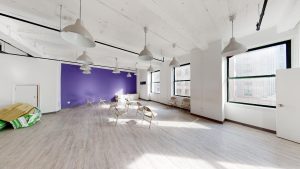
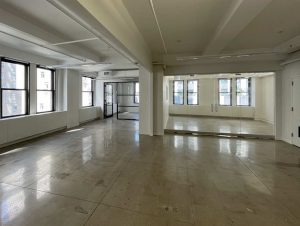
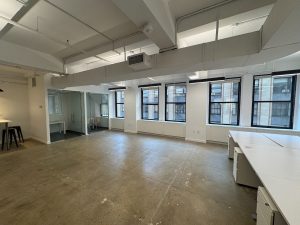
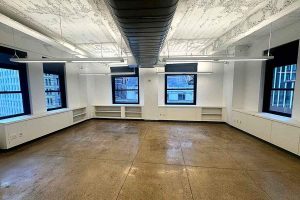
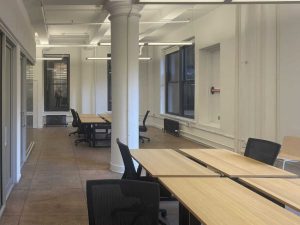
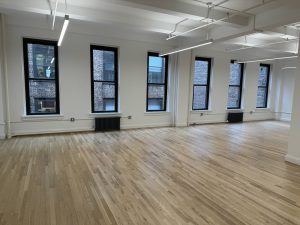
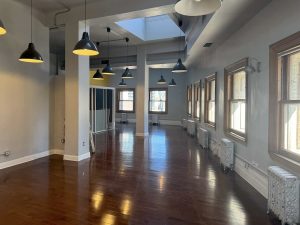
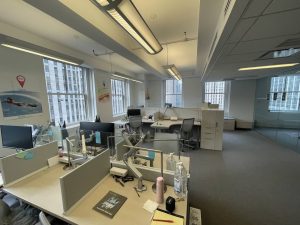
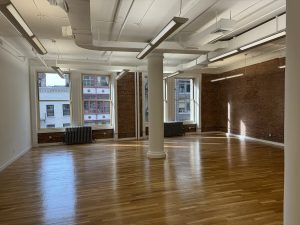
A loft is a former industrial building, a factory, warehouse, or printing house, converted to office use. Four features define it: ceilings usually between 11 and 16 feet, oversized windows that flood the floor with daylight, open floor plates with wide column spacing, and original materials like exposed brick, heavy timber, or poured concrete. Those features are what tenants actually pay for, and they are why a loft rents on height and light rather than on the polished amenities a glass tower sells.
A loft is not a studio. A studio is typically one or two rooms; a loft is a larger open space, often an entire floor, that you can leave wide open or partition into private offices, conference rooms, and shooting or sample space as you need. That flexibility is the whole point, and it is why one loft floor can serve a coding team, an ad agency, and a showroom equally well.
Loft space is where the A, B, and C system stops making sense, so it is worth getting straight before you compare two spaces. In most of Manhattan, class tracks price. In the loft market, it often does not.
| Loft Tier | What It Means | Rough Rent Position | Typical Loft Examples |
| Converted trophy loft | The best repositioned lofts: new systems, hotel-grade amenities, and marquee Hudson Square and Park Avenue South addresses. | Top of the loft market, rivaling Midtown trophy | One Madison Avenue, 345 Hudson Street |
| Class A loft | Modern or heavily renovated conversions with staffed lobbies, real amenities, and strong building systems. | Premium | 1 Hudson Square (75 Varick), renovated SoHo and Chelsea loft |
| Class B loft | Solid prewar loft, many with prebuilt or move-in-ready floors. The deep pool that defines Midtown South. | Mid-market, but no longer cheap | Starrett-Lehigh, Chelsea Market, the American Woolen Building |
| Class C loft | Older, no-frills converted manufacturing stock. The deepest value in the city. | Value tier | Garment District and older side-street loft |
A warning on those letters. The A, B, and C system is only a rough grade of a building’s age, systems, and prestige, and it falls apart completely in loft markets. A 1910 cast-iron loft in SoHo routinely out-rents a Class A tower, because tenants are paying for ceiling height, light, the floor plate, and the block, not the letter. Class describes the building; the rent tier describes what tenants actually pay. Treat class as a starting filter, not a verdict. Our explainer on what makes a building Class A, B, or C breaks down the distinctions, and for the premium end, how trophy buildings set themselves apart explains what that top-tier rent buys, while our roundup of the top Class A buildings in Midtown shows the glass-tower alternative for anyone weighing loft against a conventional tower.
What you pay for a loft depends on the building’s condition and neighborhood more than on the class letter, so the ranges below are organized by loft tier rather than by A, B, and C. Midtown South’s district average was $88.32/SF in Q1 2026 (Newmark), well above the Manhattan average of $78.03/SF (Colliers, Q2 2026), which tells you how far this market has moved. The ranges are meant to put you in the right ballpark before you tour, not to price a specific space.
| Loft Tier | Typical Asking Rent ($/SF/yr) | Typical Available Space | Best Suited For |
| Converted trophy loft | $90 to $150+ | Full floors and large blocks, 15,000 SF and up | AI, fintech, media and fashion flagships |
| Prime loft (Class A / high B) | $70 to $95 | Full and partial floors, 5,000 to 40,000 SF | Established creative and tech firms |
| Mid-market prewar loft (Class B) | $55 to $75 | Partial floors and prebuilt suites, 2,000 to 20,000 SF | Growing companies and boutiques |
| Value loft (Class C) | $40 to $60 | Small suites and value floors, 500 to 10,000 SF | Startups, showrooms, and SMBs |
| Sublease loft | $35 to $75 | Prebuilt and furnished, 1,000 to 30,000 SF | Cost-sensitive and shorter horizons |
Loft rents are overwhelmingly a Midtown South story, and the submarket pages linked in the neighborhoods table above carry the live numbers block by block. For the other Manhattan markets, see Midtown Manhattan and Uptown Manhattan.
Most expensive: premium converted loft in Hudson Square and on Park Avenue South, where marquee buildings ask $90 to $120/SF and up. Best value: the Garment District and older side-street stock, where honest Class C loft still rents in the $40s. The spread inside a single neighborhood can be $50/SF or more, which is exactly why touring more than one building pays off.
Ranges are directional and span the borough; actual rents vary by neighborhood, floor, condition, and lease term. Compiled from Newmark Q1 2026, Colliers Q2 2026, and Lee & Associates Q4 2025 reports plus Metro Manhattan internal research (June 2026).
A loft is the one kind of office where the building matters as much as the space. These are century-old structures, often owned by smaller landlords, and the charm can hide real problems. Walk in knowing what to look for, because the difference between a great loft and a headache usually comes down to the things you cannot see in a photo.
| Element | Why It Matters in a Loft | What to Look For |
| Ceiling height & columns | Height and column-free spans are what you are paying for and what makes the floor usable. | Ask for the column grid and clear spans before you fall for a listing photo. Confirm the actual ceiling height, since it can vary floor to floor. |
| Windows & light | Oversized factory windows are the whole appeal, but exposure and operability vary widely. | Check which windows open, the direction they face, and whether neighboring buildings block light on the lower floors. |
| Elevators & freight | Old buildings often have one or two small cabs, a real problem at 9 a.m. and for moving goods or equipment. | Ride them at rush hour, find the freight elevator and the loading situation, and read the modernization history. |
| HVAC & systems | Many lofts were never built for dense office cooling, and systems are often the tenant’s responsibility. | Ask whether HVAC is landlord-provided or on you, and budget for supplemental cooling if you pack in people or servers. |
| Electrical capacity | A century-old building can be short on power for a modern team and its equipment. | Confirm available amperage and whether the landlord will upgrade the service. Full-floor loft is often on a direct Con Edison meter. |
| Floor load | Heavy uses like libraries, equipment, fitness, or assembly need rated floors. | Get the floor-load rating in writing for showrooms, studios, gyms, or event use. |
| Soundproofing | Open plates and hard surfaces echo, and demising walls in old buildings are often thin. | Plan acoustic treatment and slab-to-slab demising walls if you host clients, take calls, or run a studio. |
| Bathrooms & ADA | Older loft floors may have minimal or non-compliant restrooms and access. | Confirm the number and code compliance of bathrooms and a step-free path from the street to your suite. |
| Landlord & responsiveness | Many loft buildings have smaller, individual owners, for better and for worse. | Ask who owns and manages the building, how fast they fix things, and what they have recently reinvested (lobby, roof, elevators). |
| Redevelopment risk | A minority of loft buildings get sold for residential or hotel conversion mid-lease. | Ask about the owner’s plans and negotiate notice and early-termination protections up front, before a sale forces you to move mid-lease. |
Lofts attract a specific kind of tenant: businesses that value open space, natural light, and a creative address, and that want their office to say something about who they are. Match your business to the right cluster and the right vertical page below.
| Industry | Why Lofts Fit | Best-Fit Neighborhoods | Vertical / Guide |
| Technology, AI & SaaS | Open plates for fast-growing engineering teams and a recruiting edge. | Flatiron / Park Ave South, Hudson Square, Chelsea | Startup & Tech |
| Media, advertising & PR | Open floors for collaboration and a creative address clients notice. | Hudson Square, Chelsea, SoHo | Ad Agency Space |
| Fashion, apparel & showrooms | Light and space to display and present collections to buyers. | SoHo, Meatpacking, Garment District | Showroom Space |
| Architecture & design firms | The workspace doubles as a portfolio and a stage for client meetings. | SoHo, Tribeca, Flatiron | SoHo loft for design firms |
| Art galleries, photo & film | Column-free volume, height, and light for installations and shoots. | Chelsea, Tribeca, Hudson Square | Gallery Space |
| Boutique law, finance & fintech | Character space for firms that want a less corporate feel. | SoHo, Flatiron, Tribeca | Law Firm / Financial Services |
| Life sciences & med-tech | Loft plates and high ceilings convert well to lab and R&D space. | Hudson Square, Chelsea | Medical & Healthcare |
| Fitness, wellness & events | Big open volumes for studios, classes, and gatherings. | Flatiron, Chelsea, Garment District | creative-firm neighborhoods |
| Ground-floor retail & flagships | Loft ground floors bring height and character to a store. | SoHo, Meatpacking, Flatiron | Retail / Stores |
Running a lean team? Loft is not the cheapest corner of Manhattan, but the Garment District and older side streets keep it in reach, and the talent you can recruit by being in a creative neighborhood is worth real money. Our roundup of the top New York neighborhoods for small businesses lays out the trade-offs.
Before you tour anything, decide what kind of loft you are actually shopping for. A raw white-box floor, a move-in-ready prebuilt, a coworking desk, and a sublease are different products with different commitments and price points. Most tenants do not realize they have this many options.
| Type | Best For | Typical Commitment | Trade-Offs | Explore |
| Direct lease | Established creative and tech teams that want control and a custom build-out. | 5 to 10 years | Best concessions and leverage, longest commitment. | |
| Prebuilt / spec loft | Teams that want a move-in-ready loft without managing construction. | 3 to 7 years | Move-in ready, less customization. | |
| Coworking loft | Solos, satellite teams, and anyone under about 20 people or unsure of headcount. | Month to 2 years | Fast and flexible, higher per-desk cost, less control. | Coworking |
| Sublease loft | Cost-sensitive tenants and shorter time horizons. | 1 to 5 years | Often below market and prebuilt, terms set by the existing tenant. | Sublets |
| Raw / white-box loft | Tenants who want a fully custom build in a blank space. | 7 to 15 years | The most control and the biggest build-out, longest lead time. |
Two notes on flexibility. If you are scaling out of a shared desk into your own loft, our guide to transitioning from coworking to an office is the playbook. And if a sublease looks appealing, understand sublease and assignment clauses before you sign someone else’s lease, because you inherit the terms they negotiated.
Commitment ranges are typical-market and vary by deal (Metro Manhattan internal research, June 2026).
Leasing a loft is not like renting an apartment, and the best space in these neighborhoods leases fast. A tenant rep broker who works only for you, and is paid by the landlord, levels the field. Below is the path from “we need space” to “we moved in.”
The face rent your broker first quotes is almost never what you actually pay. Net effective rent, after free months and build-out money, can land well below the asking number. The savviest tenants negotiate the whole package, not just the headline rate.
Midtown South concessions are still among the most tenant-favorable in Manhattan, though they are tightening as availability drops. The gap between asking and taking rents narrowed to about 6% in early 2026 (Colliers, Q2 2026), so the era of landlords bending on everything is fading. The value still lives in two negotiable levers: free rent and the tenant improvement allowance. Typical packages right now:
| Loft Tier | Free Rent | TI Allowance | Notes |
| Converted trophy loft | 8 to 12 months | $80 to $130/SF | Tightest terms; another tenant is often lined up behind you. |
| Prime loft (Class A / high B) | 10 to 14 months | $70 to $110/SF | The sweet spot for established creative and tech firms. |
| Mid-market prewar loft (Class B) | 12 to 16 months | $50 to $90/SF | Real leverage on a longer term, and prebuilt floors are common. |
| Value loft (Class C) / sublease | 12 to 18 months | $30 to $70/SF | Turnkey and furnished options are widely available. |
Two ideas do most of the work. First, the value lives in the free rent and the TI allowance, not the asking rate, as our look at rising landlord concessions explains. Second, those allowances are negotiable, and our primer on tenant improvement allowances walks through the structures and how to bargain. For a raw loft that needs a full build, the TI number can decide whether a deal pencils.
Typical-market figures based on recent Metro Manhattan deals (internal research, June 2026). Final terms depend on credit, lease length, building, and negotiation.
Established firms often sign 7 to 10 years to justify a real build-out and lock in a rate, while smaller and newer teams lean to 3 to 5 years for flexibility. Longer terms pull richer concessions and lock in your rent; shorter terms keep you nimble. Our breakdown of 3-year, 5-year, or 10-year lease terms lays out which fits which kind of business.
The face rent is rarely what you actually pay. Budget for the rest before you sign:
The clearest signal of where the loft market is heading is where companies are actually signing. AI, fintech, and media firms drove Midtown South to its strongest first quarter of leasing since 2019, and several of the neighborhood’s best buildings filled to 100% in the process.
| Company | Building | Neighborhood | Size | Deal |
| Ramp | 28-40 West 23rd Street | Flatiron | 285,300 SF | Expansion (Q1 2026) |
| Harvey AI | One Madison Avenue | Park Ave South | ~185,000 SF | Expansion (Q1 2026) |
| Clay | 11 Madison Avenue | Park Ave South | 163,000 SF | New lease at $90/SF (Mar 2026) |
| Tennr | 345 Hudson Street | Hudson Square | 124,733 SF | Sublease (Apr 2026) |
| Sierra | 11 East 26th Street | NoMad | 94,145 SF | New lease (Apr 2026) |
| Hex | 250 Park Avenue South | Park Ave South | Full floor | New lease at $80/SF (Jan 2026) |
| Brooklinen | 225 Varick Street | Hudson Square | 32,000 SF | 10-year relocation (2024) |
The throughline is a rush of high-growth tenants into converted loft. AI and fintech firms are the loudest names, media and fashion are close behind, and the pattern keeps pulling the best loft buildings off the market first.
A handful of owners control much of Manhattan’s best loft space, and each negotiates differently, which matters as much as which building you pick. Hudson Square Properties, a joint venture of Trinity Church, Hines, and Norges Bank, has repositioned a 13-building loft portfolio that now anchors the neighborhood’s AI and media boom. SL Green, the city’s largest office landlord, redeveloped One Madison Avenue into converted-loft trophy. Williams Equities and Rockrose own deep benches of prewar loft in Flatiron and NoMad. Who you sit across from shapes the deal. Background reading: our overview of the biggest commercial real estate landlords in NYC.
| Landlord | Notable Loft Properties | Concentrated In | Lease Profile |
| Hudson Square Properties (Trinity, Hines, Norges) | 75 Varick, 225 Varick, 435 Hudson, and the 13-building Hudson Square portfolio | Hudson Square | Repositioned prewar loft, large plates, 10,000+ SF |
| SL Green Realty | One Madison Avenue, plus redeveloped Midtown South floors | Midtown South, Midtown | Converted-loft trophy, 10,000+ SF |
| Williams Equities | 28-40 West 23rd Street and a Flatiron / Chelsea loft portfolio | Flatiron, Chelsea | Renovated prewar loft, 5,000+ SF |
| Vornado Realty Trust | 770 Broadway (Meta) and Midtown South holdings | NoHo, Midtown South | Large converted-loft floors |
| Rockrose Development | 11 East 26th Street and NoMad loft | NoMad, Flatiron | Prewar loft for AI and creative tenants |
| Related Companies | West Chelsea and the Hudson Yards edge | Chelsea, Hudson Yards | The newest large-format space at the loft market’s western edge |
Loft office space is converted industrial space, a former factory, warehouse, or printing house, tailored for office use. It is defined by high ceilings (usually 11 to 16 feet), oversized windows, open column-spaced floor plates, and original materials like brick, timber, or concrete. New York’s best loft stock sits in Midtown South, in buildings like the Starrett-Lehigh Building, the Puck Building, and Chelsea Market.
Loft rents run from roughly $40/SF for value Garment District space to $150/SF and up for premium converted loft in Hudson Square and on Park Avenue South. Midtown South’s district average was $88.32/SF in Q1 2026 (Newmark), above the Manhattan average of $78.03/SF (Colliers, Q2 2026). Your number depends on the neighborhood, the building’s condition, and how much build-out your space needs.
A studio is typically one or two rooms, while a loft is a larger open space, often an entire floor. A loft can stay wide open or be partitioned into offices, conference rooms, and studios, which gives it far more flexibility for a growing business.
SoHo, Hudson Square, Tribeca, Chelsea, Flatiron and Park Avenue South, the Meatpacking District, and the Garment District. SoHo has the classic cast-iron, Hudson Square and Chelsea have the big converted-warehouse floor plates, and the Garment District has the value. Almost all of it sits within Midtown South.
Often yes for a lease of five years or more, and many landlords will do lighter work like paint and updates for shorter terms. Build-out money comes through a tenant improvement allowance, which is one of the most important things to negotiate. A raw or white-box loft needs the most work and the longest lead time.
It can be, but plan for it. Open floor plates and hard surfaces echo, and demising walls in older buildings are often thin, so budget for acoustic treatment and slab-to-slab walls if you host clients or need quiet. Firms that want mostly private offices sometimes do better in a traditional building.
The systems, not the look. Ride the elevators at rush hour, confirm HVAC and electrical capacity for your team, check the floor-load rating for heavy uses, and ask what the landlord has recently reinvested. Many loft buildings have smaller, individual owners, so responsiveness varies building to building.
Less than it used to be. Class B asking rents hit record highs across Midtown South in late 2025 as demand broadened beyond trophy buildings (Lee & Associates, Q4 2025). A cast-iron loft can technically be Class B and still out-rent a Class A tower, so judge the space, not the letter.
Most fast-growing tech and AI teams in New York choose loft, and the data backs the instinct: Midtown South is the city’s AI hub, and AI firms signed roughly 1.5 million SF across Manhattan in the first half of 2026 (Colliers, Q2 2026). Loft plates suit engineering teams and help with recruiting. A traditional tower can still win on amenities and a central-Midtown commute.
Most of the best loft space never appears on public listing sites, and the good buildings lease fast, so a tenant rep broker is how you see the full market. Brokerage commissions are paid by the landlord, so representation costs your business effectively nothing. A broker also helps vet the building’s systems and structure the build-out and lease terms that drive the real cost of the deal.













Accessibility Tools