




Commercial Lease Clauses: The Scariest Between Ghosts and Gravy
You know that post-Halloween feeling when you’re sorting through candy and find something unappetizing you missed?



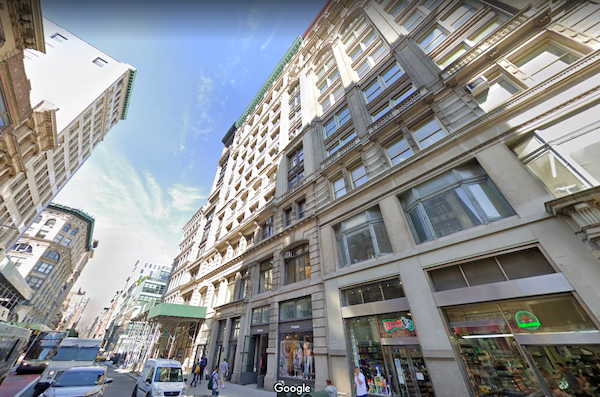
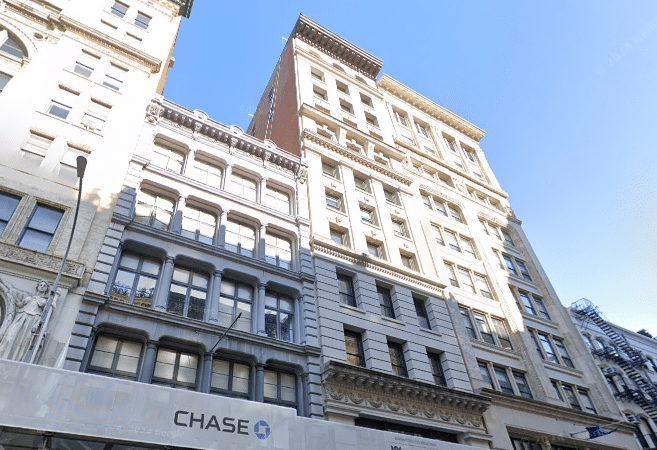
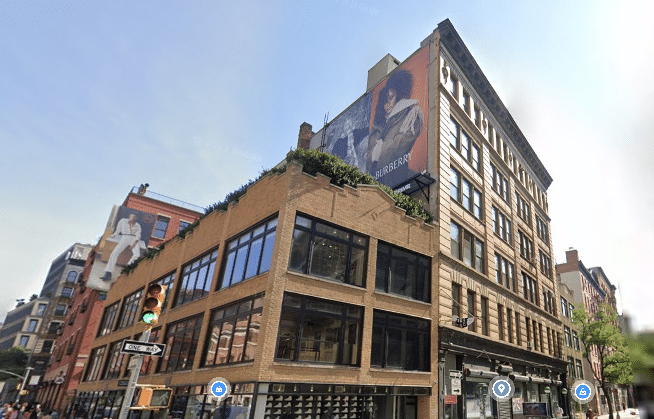
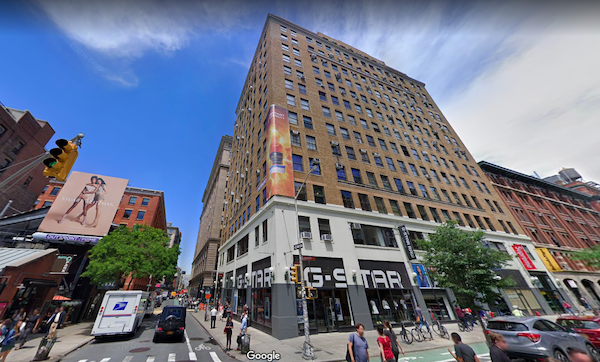
Walk down Greene Street on a Saturday and you’d swear nobody could afford an office here. Every ground floor is a flagship. There’s a line outside a store that sells one kind of sneaker. The cobblestones are wrecking somebody’s suitcase.
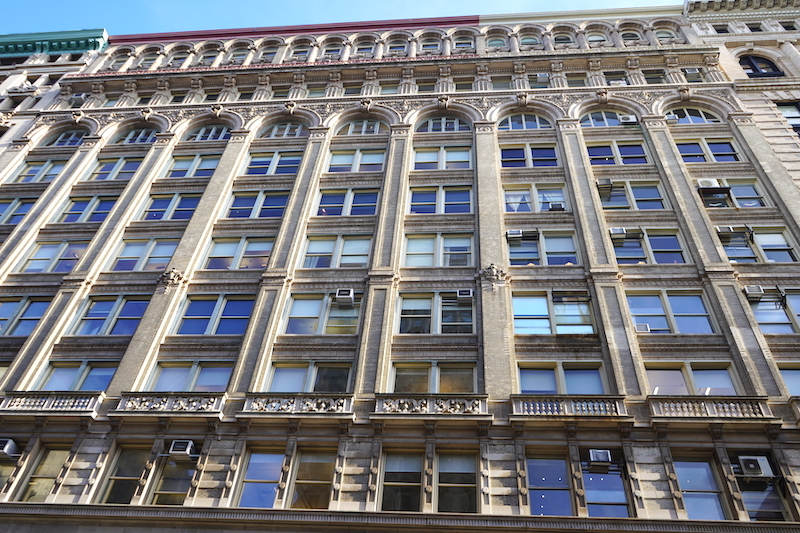
Then look up.
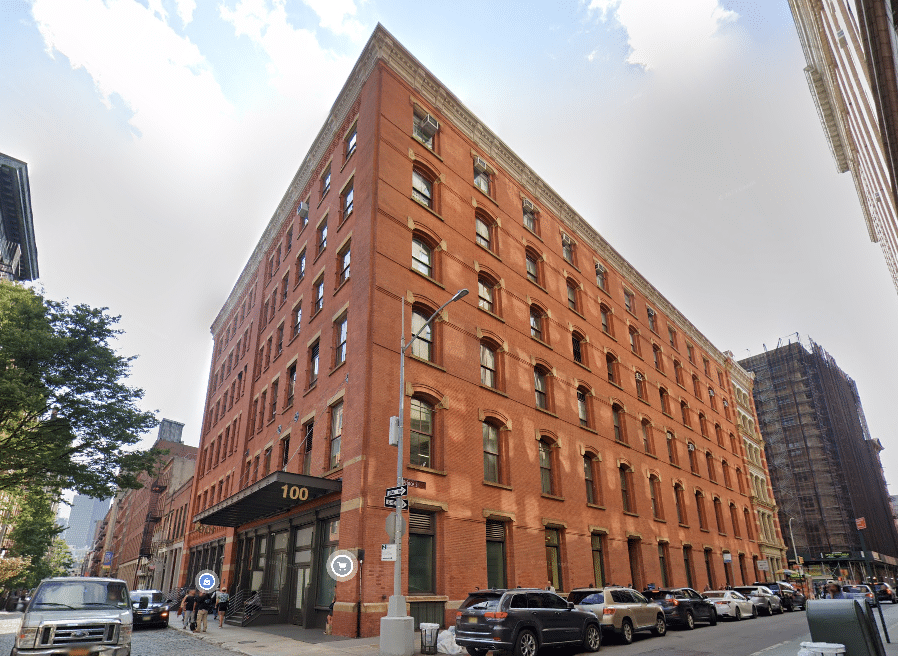
Above all that retail sit five million square feet of nineteenth-century loft, and a quarter of it is empty. SoHo office space asks less per foot than Chelsea, less than Greenwich Village, less than Hudson Square right next door. The most photographed neighborhood in New York is quietly one of the better deals in it.
The part that still gets me is the grading. Space in SoHo that appraisers call Class A asks less than the neighborhood average. Not more. Less. It’s the only submarket in Manhattan that prices upside down, and it happens because the letter is measuring the wrong things.
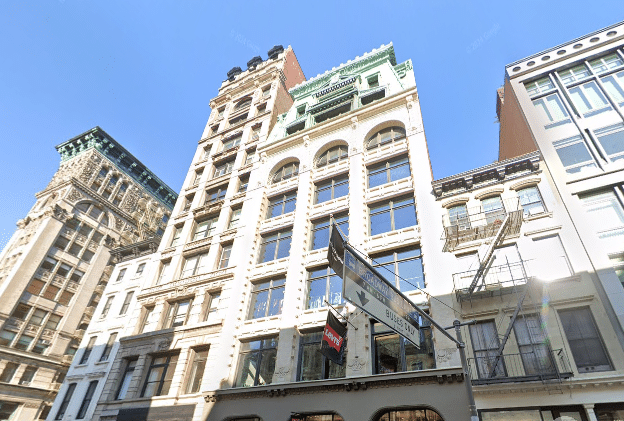
An appraiser rewards elevator banks, central air, and a glass curtain wall. A SoHo tenant is buying timber columns, fourteen-foot ceilings, and a corner of Wooster Street. Those two lists have nothing to do with each other, which is why the grade is useless here and the building is everything.
One more thing before you tour, because the page title buries it. This is two neighborhoods. Cross Houston into NoHo and the rent jumps about fifteen dollars a foot while the vacancy falls by half. Same trains, same cast iron, completely different conversation.
Knowing which side of that street you belong on is most of the job, and it’s what we do all day. If you’d rather just see what’s open, start with the current listings.
Nothing gets built here. Not one square foot of office was under construction in SoHo this spring, and there won’t be, because the entire district is landmarked and the Landmarks Preservation Commission has never been in a giving mood. What exists is what you get.
So when demand comes back, it has nowhere to go except into buildings that went up before the Brooklyn Bridge.
Demand came back. SoHo leased more space in 2025 than in any year on record, cleared a million feet for the first time since 2018, and finally took in more than it gave back for the first time since 2022. Vacancy then dropped better than two points in a single quarter.
None of that is a fluke. Manhattan just posted its strongest first half of leasing since 2002, free rent is the thinnest it’s been since 2019, and landlords across Midtown South are marking space up rather than down.
SoHo is late to that. Which is the whole opportunity, and also the reason not to take your time.
Anyone who quotes you one number for SoHo is guessing, and probably selling.
This spring a full floor at 555-557 Broadway went out at $99 a foot. Six blocks south, floors at 455-457 Broadway have asked $58. Over near Prince we’ve seen built-out lofts list in the high $40s. All of it cast iron. All of it landmarked. All of it SoHo.
So the honest answer is a range. SoHo averages $79 a foot and NoHo runs to about $95, but those averages are stretched across a spread that starts in the high $40s and doesn’t stop until $135. Broadway and the rebuilt cast iron carry the premium. NoHo carries more. Canal is where the math gets friendly.
Worth naming the alternative, too. If the lowest number is the only thing driving you, Downtown Manhattan averages about $57 a foot and the Financial District closer to $54. You give up the cobblestones and keep most of the same trains.
So the question was never what SoHo costs. It’s what you’re buying. If you need this address to hire designers, or to make a client feel something when the elevator opens, you’ll pay for it, and it might be the best money you spend all year.
If what you want is great bones and good light, walk south and pocket the difference.
Before you tour anything, run your headcount through our office space calculator. In a neighborhood where floor plates swing from 5,500 to 30,000 feet, guessing wrong costs you more than it does uptown.
| Area | Class A Profile | Class B / Loft Coverage | Availability | Typical SF for New Leases | Tier |
|---|---|---|---|---|---|
| Broadway spine | Renovated loft priced like Class A, $75 to $99 | Deep; most of the stock | ~22 to 26% | 2,000 to 40,000+ SF | Class A / B |
| Cast-iron core (Greene / Mercer / Wooster) | Repositioned loft, $70 to $95 | Deep prewar loft | ~20 to 25% | 2,000 to 20,000 SF | Class A / B |
| West SoHo (West Broadway / Thompson) | Boutique jewel box, $65 to $90 | Limited; leases whole | ~15 to 20% | 3,000 to 15,000 SF | Boutique / A |
| The Lafayette seam | Factory loft, $70 to $135 | Deep, heavy floor loads | ~18 to 24% | 1,000 to 30,000+ SF | Class A / B |
| NoHo proper | Landmark and new boutique, $95 to $135+ | Thin; little comes open | ~11 to 15% | 4,000 to 30,000 SF | Trophy / A |
| The Canal edge | Minimal | Class B and C loft, $49 to $65 | ~24 to 28% | 500 to 8,000 SF | Value |
| SoHo average (context) | $70.32 Class A | $79.23 overall | 25.2% | Varies | Mixed |
| NoHo / Greenwich (context) | $126.68 Class A | $94.96 overall | 13.0% | Varies | Mixed |
SoHo Class A ($70.32/SF), SoHo overall ($79.23/SF), SoHo vacancy (25.2%), and the Greenwich Village/NoHo figures ($126.68 Class A, $94.96 overall, 13.0% vacancy) from Cushman & Wakefield, Q2 2026. Area-level profiles, coverage descriptors, availability ranges, and the $49 to $135 rent bands are Metro Manhattan internal research (July 2026); the approved firms publish a SoHo submarket number but not per-block breakouts. Deal-level anchors: $99/SF asking at 555-557 Broadway (Commercial Observer, May 2026), $135/SF asking at the Puck Building (Traded, 2023), $58 to $60/SF on the lower floors at 455-457 Broadway (Metro Manhattan, January 2026). Rents are asking rents, before concessions.
Set $70.32 next to $79.23 and you’ve found the strangest pair of numbers in Manhattan office. Nowhere else does the top grade sell at a discount to the field. It isn’t a data error. It’s a category error.
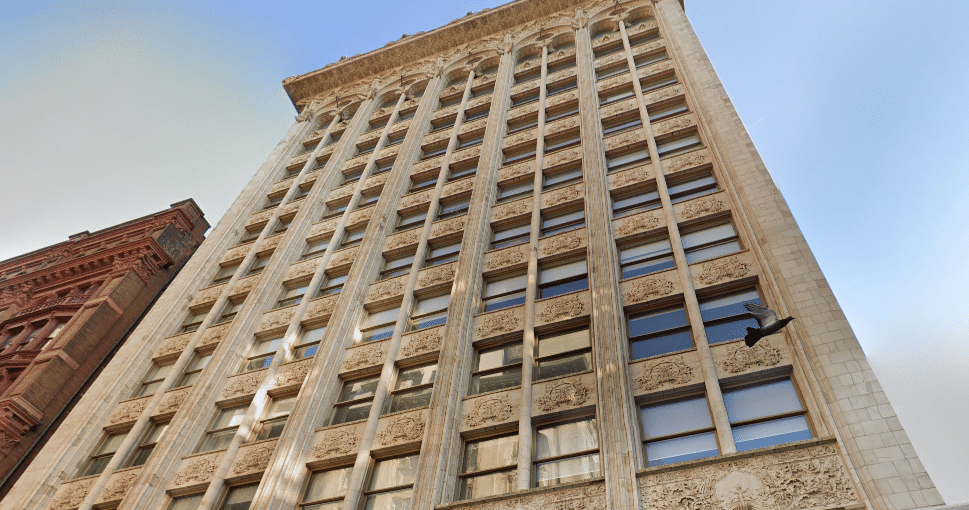
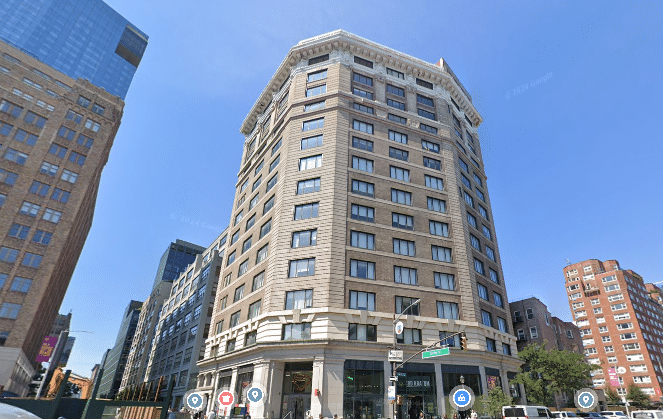
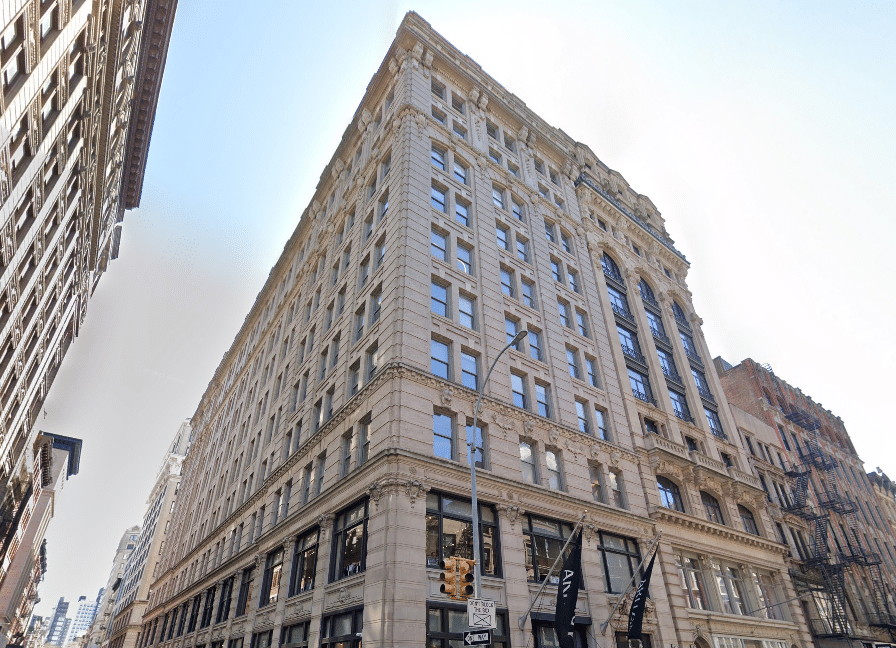
The Prince Building at 568-578 Broadway is the one everybody wants. It went up in 1879 as a sewing factory, it wraps three sides of the block at Prince, and the floors run close to 30,000 feet with windows on three exposures.
Allied Partners rebuilt the lobbies and the elevators and put a roof deck on top. Equinox is in the base. ZocDoc, Milk Makeup, and The Farmer’s Dog are upstairs. In twenty years nobody has ever asked us what letter it is.
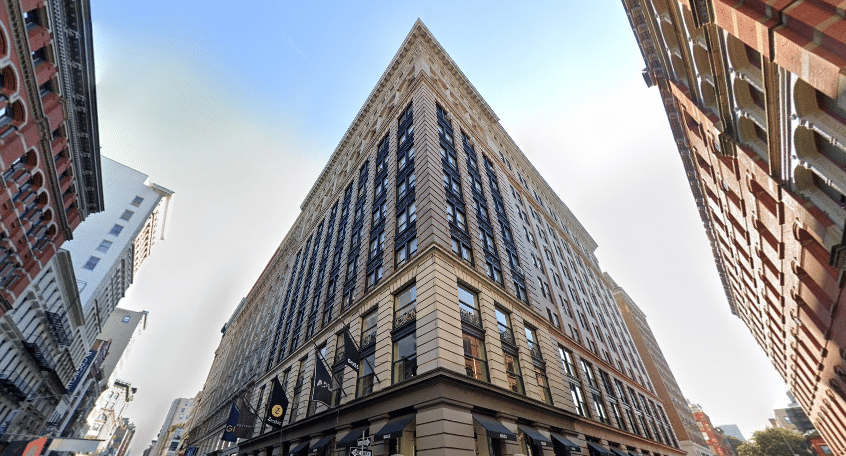
110 Greene Street is the other one we show. SL Green owns it, thirteen stories and 295,000 feet at Greene and Prince, and they spent real money on it: polished concrete, exposed brick, light on four sides, a roof deck, a cafe downstairs, LEED Gold. Birkenstock runs its headquarters out of it.
It feels like Hudson Yards money spent on a building that already had bones. If you want the vocabulary for that distinction, our piece on how trophy buildings set themselves apart lays it out, and the top Class A towers in Midtown rundown makes a useful contrast.
The biggest thing to happen in SoHo in years happened last December, and plenty of tenants still haven’t caught up to it. Empire State Realty Trust, the Empire State Building people, paid $386 million for the Scholastic Building. First office they’ve ever bought in SoHo. That was a statement.
The part that matters to you is what came with it. Scholastic stayed but shrank from ten floors to six, which left a three-floor block of more than 110,000 square feet in a neighborhood where 15,000 contiguous is considered a heavy lift. There is nothing else like it down here.
Rain, the stablecoin company, took 38,000 feet of it this spring at $99. Convene has the second floor, Sephora and Capital One hold the retail, and ESRT built a 290-person town hall and a terrace. If you need real space in SoHo, that’s the conversation.
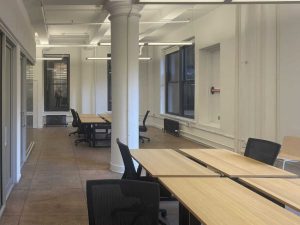
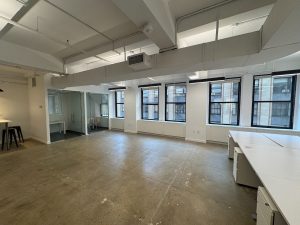
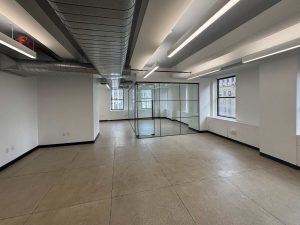
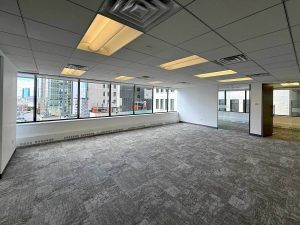
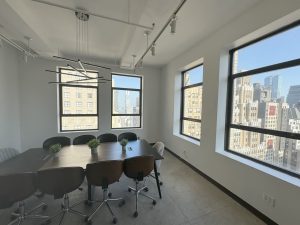
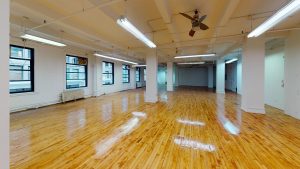
Strip away the two or three marquee names and almost every deal in SoHo happens in old loft stock. That’s good news, because the stock is spectacular. Twelve to fifteen feet of clearance, columns you can work around, windows that throw daylight all the way to the back wall.
Nobody builds this anymore. At today’s construction costs, nobody could.
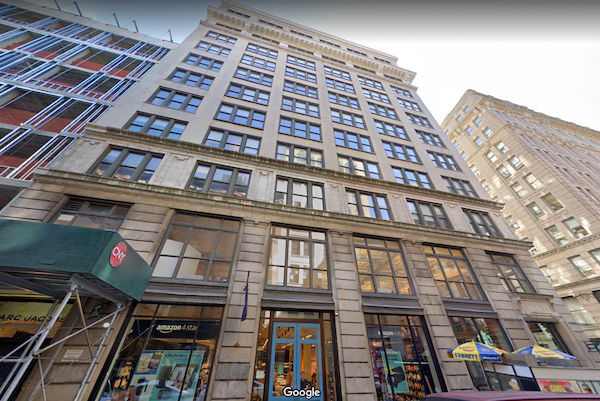
594 Broadway is the honest middle of the market and one of our favorite tours. It was a printing plant. The floors run 17,000 feet, the brick is exposed because it always was, and the rents come in under the trophy addresses up the street.
Ferguson & Shamamian works out of it. So does the Architectural League. You can take a few hundred feet or a whole floor, which is rare down here and more useful than it sounds.
270 Lafayette is for tenants who need the building to actually do something. It was a factory, so the ceilings are high and the floors were poured to hold machinery. You can put equipment in it, or build a shop, without a structural engineer telling you no.
They redid the lobby and the elevators and left everything else alone, which was the right call.
One piece of advice worth more than any grade: ignore the letter and tour the building. Two lofts on the same block will quote you wildly different numbers on the same afternoon, depending on how empty the landlord is and how he reads your credit.
The average won’t help you. Your feet will. This is the same stock that pulls tenants into Tribeca and up into Chelsea, often at higher rents than SoHo asks today.
The real bargains are south, toward Canal, on blocks that shade into Chinatown, in buildings nobody has bothered to reposition. At 455-457 Broadway, five stories and about 5,550 feet a floor, the second and third have asked $58 to $60. Near Broadway and Prince we’ve seen built-out lofts in the high $40s.
Same historic district as the $99 floors. Same trains. Different invoice.
Two warnings, though, and you should hear them from us rather than from a landlord. Nobody publishes a Class C average for SoHo. So when someone quotes you one precise number like it’s settled fact, that number came out of his own head.
The second one matters more. This is exactly the stock the rezoning made convertible, and in January the Court of Appeals cleared the last thing standing in its way. The cheapest office in SoHo is the office a developer most wants to gut. Whatever’s open today will be thinner next year.
This is where tenants leave the most money on the table, and it gets me every time. They grind on the asking rent, claw back a few dollars, feel like they’ve won, and then wave through the two things that actually move the math: the free rent and the build-out money.
SoHo’s vacancy is on your side here. A quarter of this market is sitting empty, three points looser than Midtown South and nearly six looser than Manhattan, which means the swagger you’ll hear on a tour is not always backed by the rent roll. NoHo is the reverse. Calibrate.
Below is what recent deals have looked like on a five- or ten-year term.
| Building class | Free rent (typical) | TI allowance (typical) | Notes |
|---|---|---|---|
| NoHo and boutique Class A | 8 to 12 months free | $80 to $120/SF | The thinnest package in the district, because there's barely anything open. |
| Broadway spine and renovated loft | 10 to 14 months free | $70 to $110/SF | The sweet spot, and the deepest pool of real options. |
| Cast-iron core and the Lafayette seam | 12 to 16 months free | $60 to $95/SF | Landlords here still move on a good credit and a long term. |
| Canal edge and value loft | 12 to 18 months free | $35 to $70/SF | Frequently already built out by the last creative tenant, which can save you months. |
Concession ranges are typical-market figures from Metro Manhattan broker data (July 2026) and swing materially by landlord, credit, term, and building. For reference, Manhattan's H1 2026 average free-rent period fell to 12.4 months, the lowest since 2019, with TI allowances averaging about $140/SF (Colliers, Q2 2026).
Three things to settle before you sit down. Your effective rent almost always lands well under the face rent once the free months are counted, and our breakdown of rising landlord concessions walks through that math.
A build-out check is only worth what it actually pays to build, so settle who pays for the build-out before you talk real numbers.
If term length is the sticking point, our guide to three, five, and ten-year leases lays out the tradeoffs. Budget early for the security deposit too, which on a loft floor can run several months of rent.
One more angle worth a look: the right sublease can beat all of it. Manhattan sublet supply fell 22% over the past year and now sits about 9% below pre-pandemic levels (Colliers, Q2 2026), so the pool is thinner than it was. When a furnished SoHo loft does surface, it moves fast.
SoHo has never been one industry, but it’s a creative town first and it has been since the artists got here in the seventies. Fashion, design, media. They set the tone, and everything that arrived afterward had to fit in around them.
What changed is who’s moving in next door. Sierra took its first New York office on West Broadway. TQ Ventures signed a ten-year headquarters on Spring Street. Rain is coming down from NoMad. Manhattan’s tech sector leased more space last year than it ever has, and a real slice of that appetite landed on these blocks.
NoHo runs bigger and more institutional. NYU took over 770 Broadway. Chobani took an entire building on the Bowery. Meta never left.
On these blocks the building picks the tenant about as much as the tenant picks the building. Find your row below and the search gets a lot smaller before you’ve toured anything.
| Industry | Best-Fit Areas | Class Fit | Example Buildings |
|---|---|---|---|
| Fashion, Beauty & Retail HQ | Broadway spine, cast-iron core | Class A / B loft | 110 Greene (Birkenstock, UNTUCKit), Prince Building (Milk Makeup), 555-557 Broadway |
| Design, Architecture & Creative | Cast-iron core, the Lafayette seam | Class B loft | 594 Broadway, 270 Lafayette, Wooster and Greene lofts |
| Technology, AI & SaaS | Broadway spine, West SoHo, NoHo | Class A / B loft | 375 West Broadway (Sierra), 555-557 Broadway (Rain), 770 Broadway |
| Venture Capital & Investment | West SoHo, the Lafayette seam | Boutique / A | 96 Spring Street (TQ Ventures, Lead Edge), Puck Building (Thrive Capital) |
| Media, Publishing & Advertising | Broadway spine | Class A / B | 555-557 Broadway (Scholastic), 599 Broadway, 584-590 Broadway |
| Consumer Brands & Food | NoHo, Broadway spine | Class A | 360 Bowery (Chobani), Prince Building (The Farmer's Dog) |
| Financial Services (boutique) | West SoHo, NoHo, the Lafayette seam | Boutique / A | Puck Building, 110 Greene, NoHo boutique floors |
| Law Firms (boutique and midsize) | Broadway spine, NoHo | Class A / B | 555-557 Broadway, 599 Broadway, NoHo landmark floors |
| Healthcare & Medical | Broadway spine | Class B | Prewar Broadway floors, prebuilt medical suites |
| Startups & Small Business (under 20) | Canal edge, cast-iron core | Class B / C loft | 455-457 Broadway, 100 Crosby, Canal-edge walk-ups |
| Coworking & Flex | Broadway spine, NoHo | Class A / B | 555-557 Broadway (Convene), Broadway-corridor operators |
| Retail & Showroom | Broadway, Prince, Spring, Greene | Ground floor | Broadway and Prince Street storefronts, Mercer and Greene flagships |
Industry and class fits are Metro Manhattan internal research (July 2026). Vertical landing pages: Startup & Tech Space, Financial Services, Law Firm Offices, Medical & Healthcare Offices.
Fashion and design deserve their own line, because SoHo and the Meatpacking District are still where those tenants land and it isn’t close. If you need a showroom and an office in the same building, our rundown of the best NYC buildings for fashion tenants covers the stock.
Our look at SoHo industrial loft space for design and architecture firms gets specific about what those teams actually need from a floor.
Running a small team? This isn’t the cheapest corner of Manhattan and we’re not going to insult you by pretending it is. But the Canal edge and the quiet side streets put it within reach far more often than the retail headlines suggest, which is why it keeps landing on our shortlist of the best NYC neighborhoods for small businesses.
If you’re finally trading a shared desk for your own front door, we walked through how to make that leap without regretting it.
Two things here that money cannot manufacture: the largest collection of cast-iron architecture on earth, and the street outside it.
That’s the amenity package. Nobody is going to pitch you a sky lobby, because the pitch is Greene Street at six in the evening, and it lands on recruits in a way a fitness center never has. We’ve watched candidates say yes to the walk from the subway.
What the buildings themselves give you breaks into three tiers.
Repositioned Class A (555-557 Broadway, 110 Greene, the Prince Building, 770 Broadway): rebuilt lobbies and systems, roof decks, ground-floor cafes, LEED certifications, and floor plates up to 30,000 feet. The top of the district, cast-iron shell and all.
Renovated loft (594 Broadway, 270 Lafayette, the Broadway corridor): exposed brick, timber and iron columns, oversized windows, attended lobbies, tenant-controlled HVAC, and a growing supply of prebuilt suites you can move into fast.
Value loft (the Canal edge, the side-street walk-ups): character over polish, buzzer or keyed-elevator entry, smaller floors, and the lowest rents you’ll find inside a landmark district.
For a closer read on the stock, our guide to the five best loft buildings in SoHo for creative companies walks the tour list building by building. Otherwise, see all Midtown South buildings or filter live listings by size and price.
Who holds the keys matters about as much as which building you pick, and SoHo’s ownership map has changed more in eighteen months than in the ten years before it.
Empire State Realty Trust, a company most people think of as one tower on 34th Street, now owns the biggest office asset in the neighborhood and has 110,000 empty feet sitting in it. That is a landlord with a reason to make a deal.
SL Green runs 110 Greene. Vornado keeps the retail at 770 Broadway while NYU takes the offices. Kushner has the Puck.
Below the big names sits a long bench of families who have owned these buildings since before SoHo was SoHo. They don’t run models. They price by instinct and by whether they like you, which sounds quaint until you’re on the wrong side of it.
Knowing which of them deals straight and which one grinds you to the last dollar is worth more than any listing site, and it isn’t something you can look up. Our rundown of the biggest landlords in NYC covers the wider field.
| Landlord | Notable Holdings Here | Approx. Portfolio | Typical Lease Profile |
|---|---|---|---|
| Empire State Realty Trust | 555-557 Broadway (the Scholastic Building); 298 Mulberry (residential) | ~356K SF here; ~7.8M SF office, now a 100% NYC portfolio | Class A, 5,000+ SF, 10 to 15 yr |
| SL Green Realty | 110 Greene Street (the SoHo Building) | ~295K SF here; ~31M SF citywide, NYC's largest office landlord | Class A loft, 3,000+ SF |
| Vornado Realty Trust | 770 Broadway (office master-leased to NYU; retail condo retained) | ~1.2M SF here | Retail only; office effectively off-market |
| Allied Partners | 568-578 Broadway (the Prince Building) | Full-block SoHo asset | Class B loft, large plates |
| Kushner Companies | 295 Lafayette Street (the Puck Building) | ~7 office floors plus retail and penthouses | Boutique Class A, 5,000+ SF |
| CBSK Ironstate | 360 Bowery | ~121K SF (single asset, fully leased) | Boutique Class A |
| Midwood Investment & Development | 96 Spring Street | SoHo and citywide value portfolio | Class B loft, 2,000+ SF |
| Manova Partners | 375 West Broadway | ~Single jewel-box asset, fully leased | Boutique full floors |
Portfolio figures are approximate and weighted to holdings in or near this submarket; several of these owners hold much larger books across Manhattan. Ownership and management change, so confirm at lease time. Metro Manhattan internal research (July 2026).
The transit here is almost unfair. Fourteen subway lines touch these blocks and you’re rarely more than three or four minutes from a train. For a neighborhood laid out for horse carts, it commutes better than most of Midtown.
There’s one honest catch, and it’s the same one Downtown lives with: no commuter rail. Metro-North and LIRR riders come into Grand Central and ride the 6 down, and that’s fifteen minutes a day they never get back.
So it comes down to where your people sleep. A Westchester or Long Island roster does better near Grand Central. Brooklyn, Queens, Jersey City, or anywhere down the west side, and nothing beats this.
Settle it with the commute calculator and everybody’s home address before it turns into an argument in a conference room.
| From | To SoHo (Prince St / Broadway-Lafayette) | Mode |
|---|---|---|
| Union Square | 3 to 6 min | 6, R, or W |
| Greenwich Village / West Village | 5 to 10 min | Walk, or A/C/E to Spring |
| Financial District | 8 to 12 min | 6, or R/W to Prince |
| Herald Square | 10 to 15 min | B, D, F, or M |
| Penn Station | 12 to 18 min | C or E to Spring |
| Grand Central | 12 to 18 min | 6 to Bleecker or Spring |
| Downtown Brooklyn | 15 to 25 min | R to Prince, or 4/5 plus transfer |
| Williamsburg, Brooklyn | 15 to 25 min | J or M to Bowery, or L plus transfer |
| Long Island City, Queens | 20 to 30 min | F to Broadway-Lafayette |
| Jersey City / Hoboken | 20 to 30 min | PATH to Christopher St or WTC |
| Newark, NJ | 30 to 40 min | PATH to WTC, then C/E or walk |
| Hicksville, NY (Long Island) | 60 to 75 min | LIRR to Grand Central Madison plus 6 |
| Stamford, CT | 70 to 85 min | Metro-North to Grand Central plus 6 |
Somewhere between $49 and $99, and anyone narrower than that is guessing. The submarket averaged $79.23 a foot this spring, a shade under Midtown South (Cushman & Wakefield, July 2026). The Canal edge is the floor, 555-557 Broadway is the ceiling, and NoHo sits above both at about $95. The building decides, not the neighborhood.
Because the grade is measuring the wrong things. Class A asked $70.32 against a $79.23 average, the only inversion in Manhattan (Cushman & Wakefield, July 2026). The letter rewards elevator banks and glass. SoHo tenants are buying fourteen-foot ceilings and cast iron. Filter by Class A here and you’ll screen out the best buildings on the block.
Yes, and it isn’t close. The brokerages fold NoHo in with Greenwich Village, and that combined submarket asked $94.96 a foot at 13.0% vacancy against SoHo at $79.23 and 25.2% (Cushman & Wakefield, July 2026). NoHo has less to lease and bigger tenants chasing it, which is how the Puck gets to quote $135.
25.2% this spring, down from 27.4% three months earlier (Cushman & Wakefield, July 2026). That’s looser than Midtown South at 21.8% and Manhattan at 19.3%, which is exactly why you still have leverage. It won’t last. SoHo absorbed 175,065 feet in the first half after its first positive year since 2022 (CoStar).
Creative money first, and it always has been: Birkenstock, UNTUCKit, Milk Makeup, Scholastic. Tech and venture moved in beside them without changing the furniture, including Sierra on West Broadway, TQ Ventures on Spring Street, and Rain at 555-557 Broadway. NoHo runs bigger and more institutional, with NYU at 770 Broadway and Chobani on the Bowery.
Almost anything, which surprises people. Suites under 1,000 feet turn up regularly in the Canal-edge walk-ups and on the side streets. At the top end the Prince Building runs 30,000-foot plates, and 555-557 Broadway is marketing a three-floor block over 110,000 feet. That block is the largest thing available down here by a wide margin.
Go south toward Canal and into the side-street walk-ups, where floors have asked $58 to $60 and built-out lofts sometimes list in the high $40s. Tour 594 Broadway early. It’s a real converted printing plant and it’ll rent you a few hundred feet. Plenty of these spaces come built out by the last tenant, which saves you months.
More than the neighborhood’s reputation suggests, because a quarter of it is empty. A renovated loft on Broadway typically runs 10 to 14 months free with $70 to $110 a foot of build-out money, and the value stock reaches 12 to 18 months. NoHo gives up less. Manhattan’s average is 12.4 months (Colliers, Q2 2026).
Not yet. But it’s closing, and we’d rather say so than sell you a story. SoHo leased more in 2025 than in any year on record, and vacancy dropped better than two points last quarter (CoStar; Cushman & Wakefield). Nothing new gets built in a landmark district, and the rezoning lets the cheap stuff become condos.
Empire State Realty Trust, after paying $386 million for 555-557 Broadway last December. SL Green holds 110 Greene, Allied Partners has the Prince Building, Vornado owns 770 Broadway, and Kushner has the Puck. Below them sits a bench of families who have owned these buildings since before SoHo was SoHo, and they price by instinct.
Easily, and from almost anywhere. Fourteen lines touch these blocks: Broadway-Lafayette and Bleecker carry the B, D, F, M, and 6; Prince has the R and W; Spring has the 6 on one side and the C and E on the other; Canal adds the N, Q, J, and Z plus a separate 1 at Varick. No commuter rail, though.
Most of the good space here never hits a listing site. These are family-held buildings where the owner calls two brokers and skips the marketing entirely, so a broker gets you floors you would never find on your own. The landlord pays the commission, so it costs you nothing. Read the essentials before leasing and the Good Guy Guarantee first.
Accessibility Tools